
Component mix-ups are the quietest defect on an assembly line: two resistor part numbers of the same size, two screws that differ only in length, two reels with the same label color. The error often only surfaces at final inspection or, worse, at the customer. The root cause is rarely a careless operator; it mostly lies in how components are stored and identified at the station. This guide summarizes ways to reduce mix-ups with trays, boxes, labels and layout.
- One compartment per part number: an ESD plastic tray with removable dividers, or an ESD corrugated plastic (danpla) box with compartments made to drawing.
- Labels readable from the seat: label holder at the front of the tray, large text, color coding by product line.
- Look-alike parts never side by side: placed far apart on the rack, in different tray colors.
- Machine-standard packaging: JEDEC trays, reels – made to order, high MOQ.
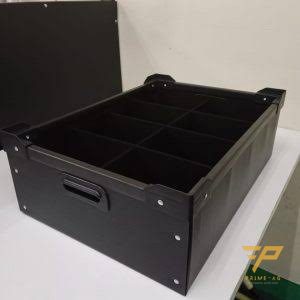
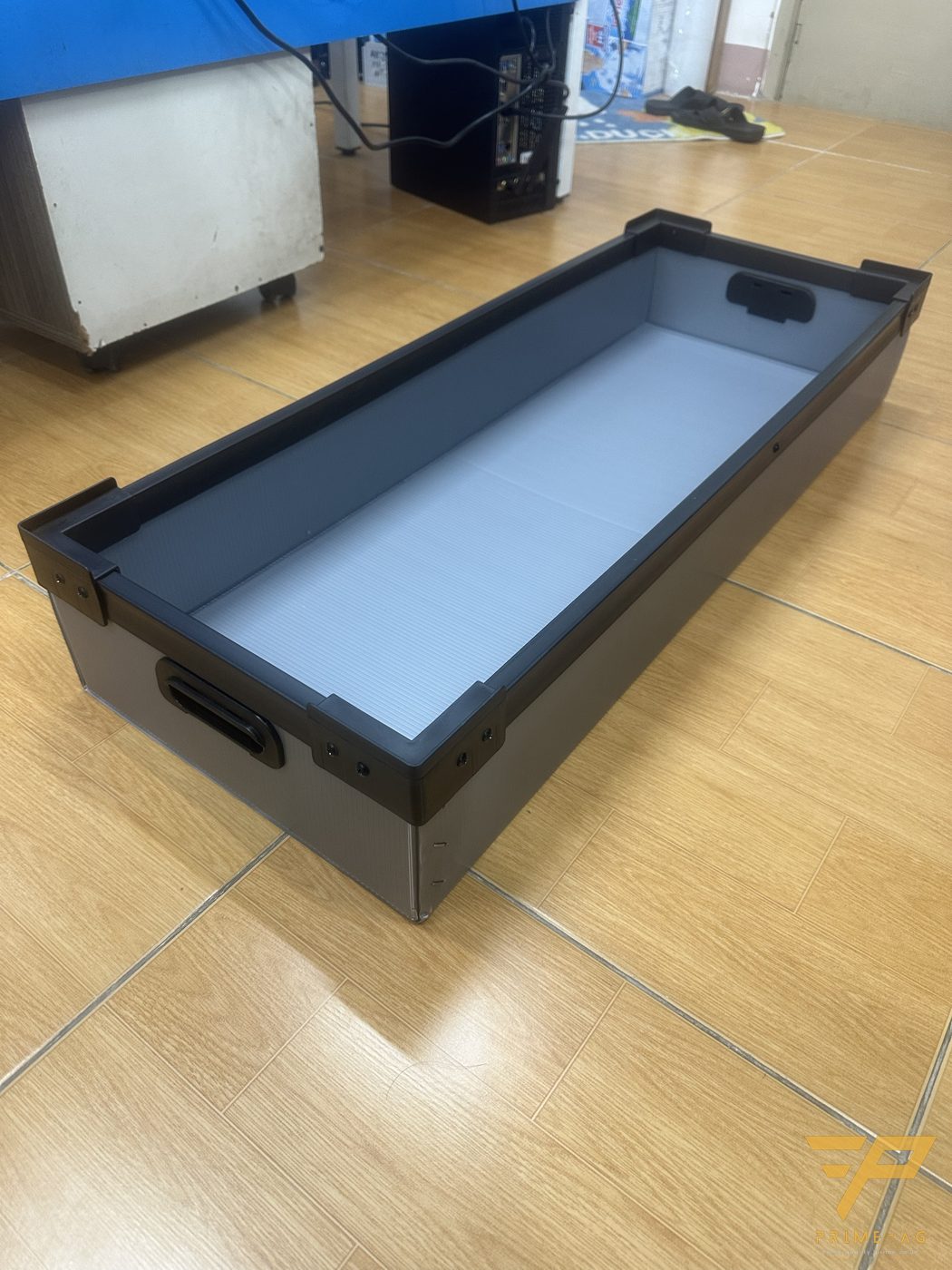

1. One dedicated compartment per part number
Two part numbers sharing one tray will get mixed sooner or later. For loose components, use an ESD plastic tray (450×300×60 mm, carbon-loaded PP, 10⁶–10⁹ Ω) fitted with removable dividers, or an ESD danpla box with fixed compartments sized for each part. Custom-size danpla starts from about 200 pieces, with 2 samples in 3 days; a custom injection-molded tray only makes sense at large volumes (about 2,000 trays or more).
2. Labels readable straight from the seat
Operators will not look at labels stuck on a lid or a hidden side. Put the label holder at the front of the tray facing the operator, with text large enough to read at arm’s length; for look-alike parts, add color coding (label color or tray color by product line). In cleanrooms use cleanroom paper and labels to avoid paper dust.
3. Separate look-alike parts
List the “look-alike” pairs (same size, same color, differing only in small printed values). Never place them next to each other on a rack or table; if they must share a station, put them on opposite sides and use different tray colors. For continuously replenished parts, a FIFO flow rack gives each part number its own lane, loaded from the back.
4. Machine-standard packaging: JEDEC trays
ICs and chips supplied in trays use JEDEC trays with standard outer dimensions and pockets specific to each package type. These usually have to be ordered to sample: the manufacturer needs a photo or drawing of the tray in use to check whether a mold already exists, and minimum order quantities are high. PRIMEAG sources JEDEC trays based on customer samples.
Tray or box?
| Need | Recommended |
|---|---|
| Loose components placed directly on the bench, many part numbers | ESD plastic tray + dividers |
| Kitting by set, stacked on racks | ESD danpla box with compartments made to drawing |
| Transport between workshops, heavy loads | ESD plastic bin 610×420×390 |
| Tray-packed ICs to machine standard | JEDEC trays (made to order) |
Need barcode identification at the station: barcode scanners and inspection equipment.
Frequently asked questions
Are divided trays ESD-safe? PRIMEAG’s carbon-loaded PP trays and ESD danpla have a surface resistance of 10⁶–10⁹ Ω, so components can be placed directly in them; the dividers are also ESD material.
How long does a custom divided box take? ESD danpla: send dimensions or a drawing; PRIMEAG redraws it and quotes in about 2 days, makes 2 samples in 3 days, and starts production after sample approval.
Can we buy JEDEC trays in small quantities? JEDEC trays usually have high minimum order quantities and the mold must be checked against a sample; send a photo of the tray you use so PRIMEAG can check first.
Email: info@primeag.vn · Phone/Zalo: +84 906 108 292
Written by the PRIMEAG engineering team