
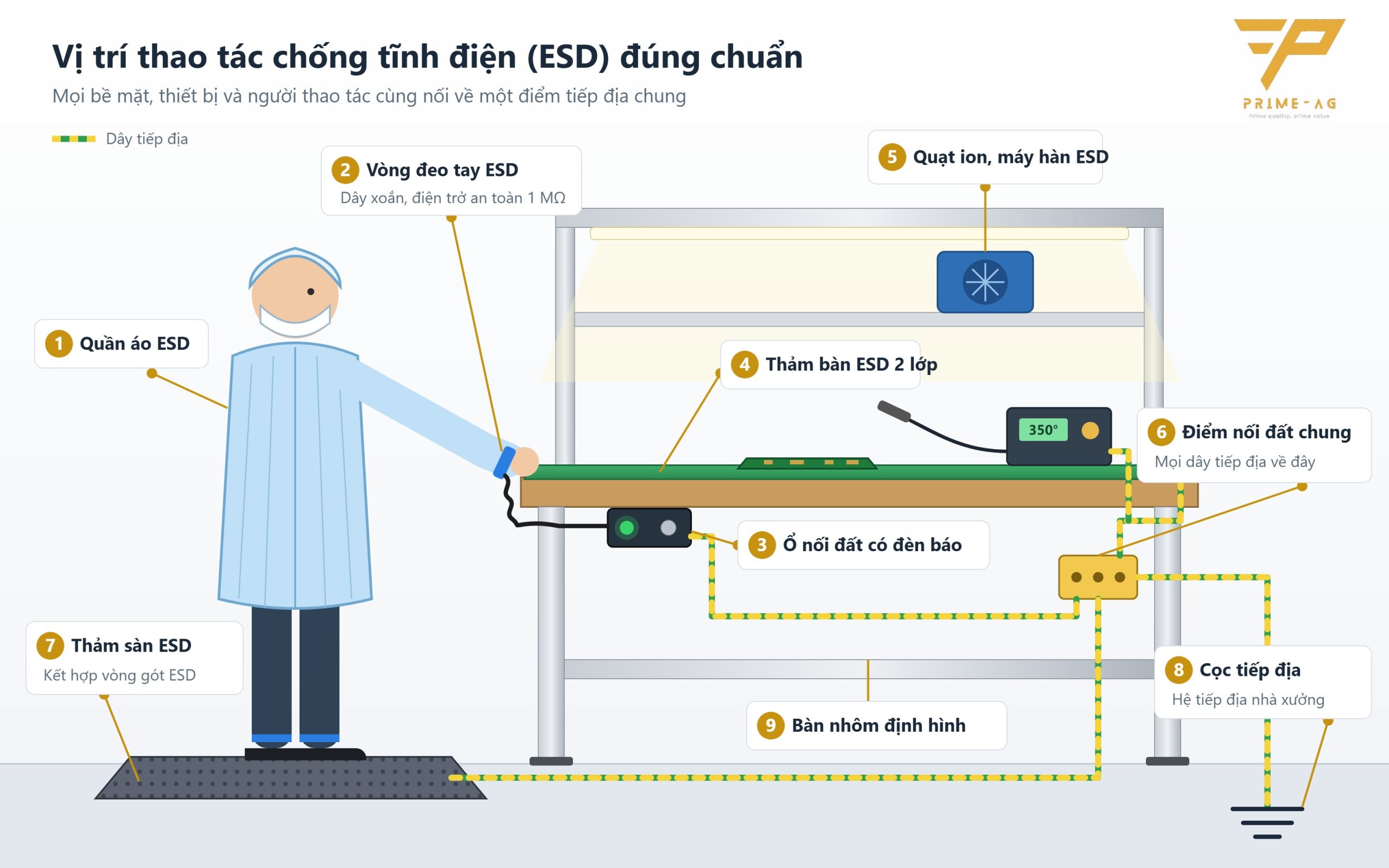
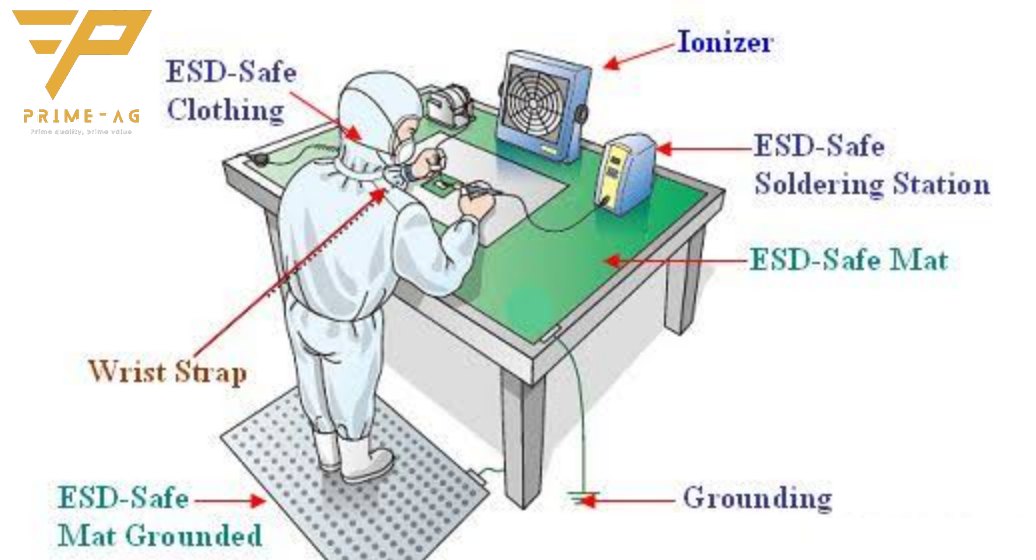
Wrist straps, ESD mats and ESD floors can only remove charge from conductors. Yet a production line is full of insulators that cannot be eliminated: plastic product housings, display glass, protective films, tape, ordinary plastic trays. For these items grounding has no effect – they must be neutralized with ions. The plastics, packaging and printing industries face the same problem when films running over rollers build up charge, attract dust and stick together.
- A single bench position: a 1-head benchtop ionizing blower (coverage about 60×90 cm).
- Long bench, several operators: a 2–3-head blower or an overhead ionizer.
- Dust blow-off plus static removal: a compressed-air ion gun.
- Films, conveyors, print rolls: an ionizing bar of 300–1,500 mm to match the web width.
When ionization is required
Since the 2014 revision, ANSI/ESD S20.20 requires that process-essential insulators within 2.5 cm of static-sensitive devices must not exceed 125 V/inch; if they do, ionization must be used to neutralize them. A quick check: use an electrostatic field meter to measure plastic housings and protective films right at the work position. Ionization does not replace grounding – it is a complementary measure for insulators.
Choosing a type by location
| Type | Coverage (reference) | Used for |
|---|---|---|
| 1-head benchtop blower | 60 × 90 cm | 1 work position |
| 2–3-head benchtop blower | 120–180 × 90 cm | Long bench, 2–3 operators |
| Overhead ionizer | 100 × 100 cm | Above machines, wide areas |
| Compressed-air ion gun | Spot | Dust blow-off + static removal on housings, narrow gaps |
| Ionizing bar | By length, 300–1,500 mm | Conveyors, films, printers, rolls |
| Mini flexible-neck ionizer | ≈ 30 cm | Under microscopes |
Figures from the supplier’s product tables; measurement distance and decay time per each model’s datasheet.
Maintenance to keep ionizers effective
Dirty emitter pins upset the balance (the unit emits more ions of one polarity) and slow the decay rate. Clean the pins weekly with IPA and a cotton swab; check balance and decay time periodically (6 months recommended) with a charged plate monitor (CPM). Ionization produces a small amount of ozone; the exact level is given in each model’s manufacturer data.
Plastics, packaging and printing
Film running over rollers and separating from the roll or from other layers builds up a strong charge, causing dust attraction, films sticking together and shocks to operators. The most effective position for an ionizing bar is across the web at the separation point or just before the winding/printing point; combine it with a lint roller or a web cleaning roller before laminating or printing.
Frequently asked questions
Can an ionizer replace a wrist strap? No. A wrist strap grounds the operator; an ionizer neutralizes insulators. The two measures complement each other.
How often should an ionizer be checked? Clean the emitter pins weekly, and check balance and decay time periodically, about every 6 months, with a charged plate monitor.
Where should an ionizing bar go on a printing or winding machine? Across the web, at the point where the film leaves the roller or just before the printing, laminating or winding point – where the most charge is generated.
Email: info@primeag.vn · Phone/Zalo: +84 906 108 292
Written by the PRIMEAG engineering team