
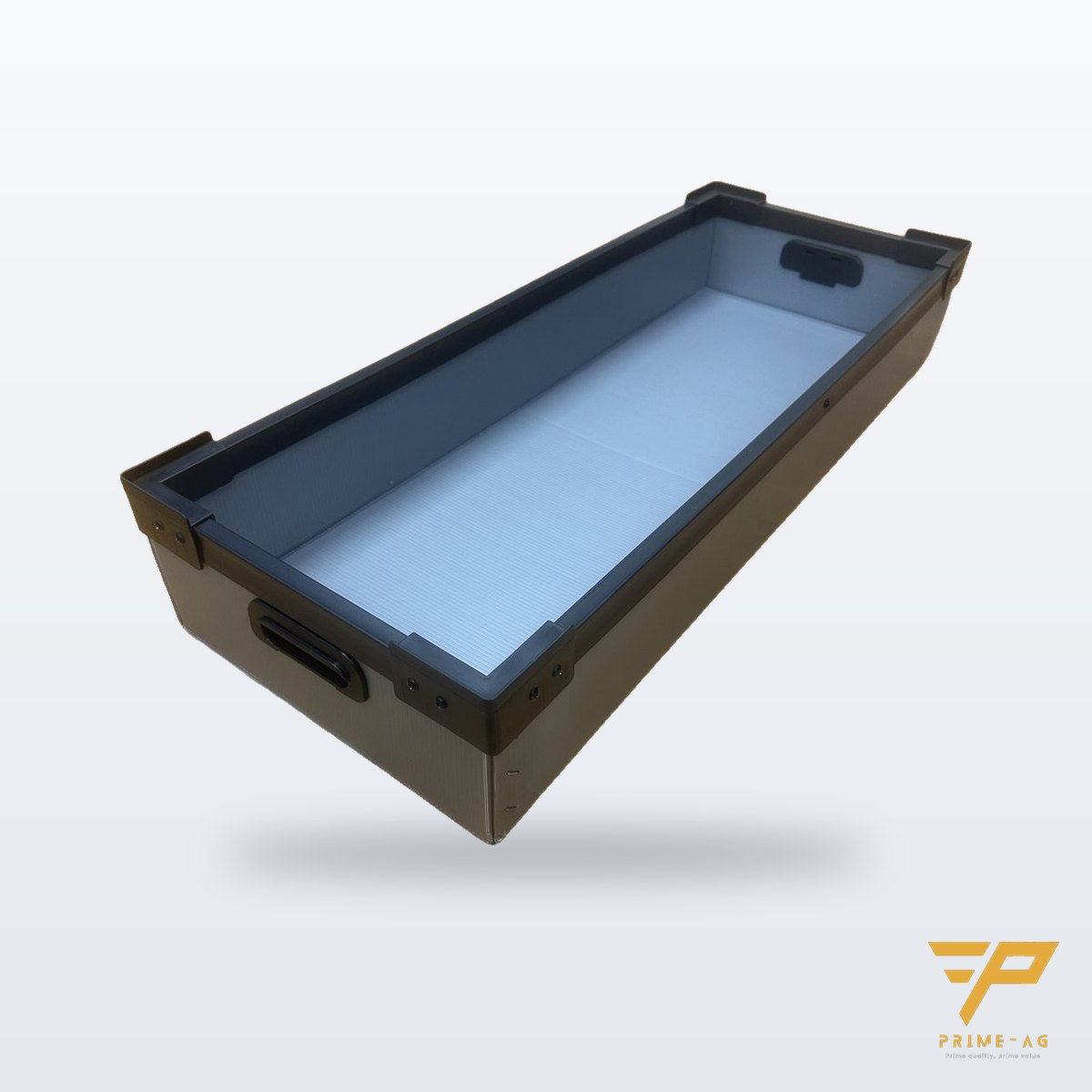
Code: EJ-KN · ESD plastic tray 450×300×60, stackable. Dissipative (D) 10⁶–10⁹ Ω — safe for placing PCBs, components and sub-assemblies directly; state it when ordering if you need the conductive 10⁴–10⁶ Ω version. Made to order: small quantities 3–7 working days, 1,000 trays in about 10 days, trays from a custom mould 30 days.
A shallow flat-bottom tray for PCBs, sub-assemblies and loose components on workbenches and line racks. Low 60 mm walls for quick picking, ribbed base against sagging, stackable when full. The 450×300 size fits half of a 600×400 bin, and two trays sit side by side on a 1200 bench. PRIMEAG supplied 1,000 trays of this size to an electronics factory in Binh Duong (09/2026).
Company logo printing available on request.
Specifications
- Material: PP with carbon compounded throughout
- Surface resistance: 10⁶–10⁹ Ω (10⁴–10⁶ optional)
- External size: 450 × 300 × 60 mm
- Internal size: ≈ 420 × 270 × 55 mm
- Load: 8 kg
- Stacking: yes; nests when empty (tapered walls)
- Compartments: none (loose dividers optional)
- Colour: black
- Temperature: 0 to 80 °C (PP is brittle below 0 °C, avoid impact); not for baking above 100 °C
- Certification: RoHS; resistance report per lot
- Packing: 20 trays per stack, stretch-wrapped
- MOQ: 100 trays
How to choose
- PCBs and sub-assemblies on benches and line racks → this tray.
- Moving parts between workshops, stacking high → 610×420×390 bin (EB-6142).
- Many small component types → divider tray or Danpla tray made to drawing (ED-CUSTOM).
- ICs and reels to machine standards → JEDEC trays (EJ-xx).
MATERIAL: the tray is injection-moulded from polypropylene with carbon black compounded into the resin, so its dissipative property does not depend on humidity and is not lost by wiping — unlike chemically coated “antistatic” trays (usually pink or light blue). The 80 °C limit is a safe working limit: do not use this tray for baking components.
TESTING: resistance measured on samples with a report; instructions for re-measuring every 6 months. Inside the EPA the tray should sit on a grounded ESD bench or rack; when boards leave the EPA, put them in a shielding bag or a bin with a shielding lid.
FAQ
- Why are trays dissipative while bins are conductive? — Trays touch components directly, so they need slower discharge (10⁶–10⁹ Ω) to avoid sparks; bins only hold parts and can discharge fast.
- Is it safe to put boards directly on the tray? — Yes at 10⁶–10⁹ Ω; add ESD foam if the board has sharp leads.
- Do you have 600×400 trays? — Yes, heights 40–120, from existing moulds.
- Custom sizes? — Injection-moulded from 2,000 trays in 30 days, or ESD Danpla from 200 pieces in 7 days.
REQUEST A QUOTE: send quantity, height and resistance range — PRIMEAG quotes within 30 minutes.
Hotline/Zalo +84 906 108 292 · info@primeag.vn
Written by the PRIMEAG technical team.