
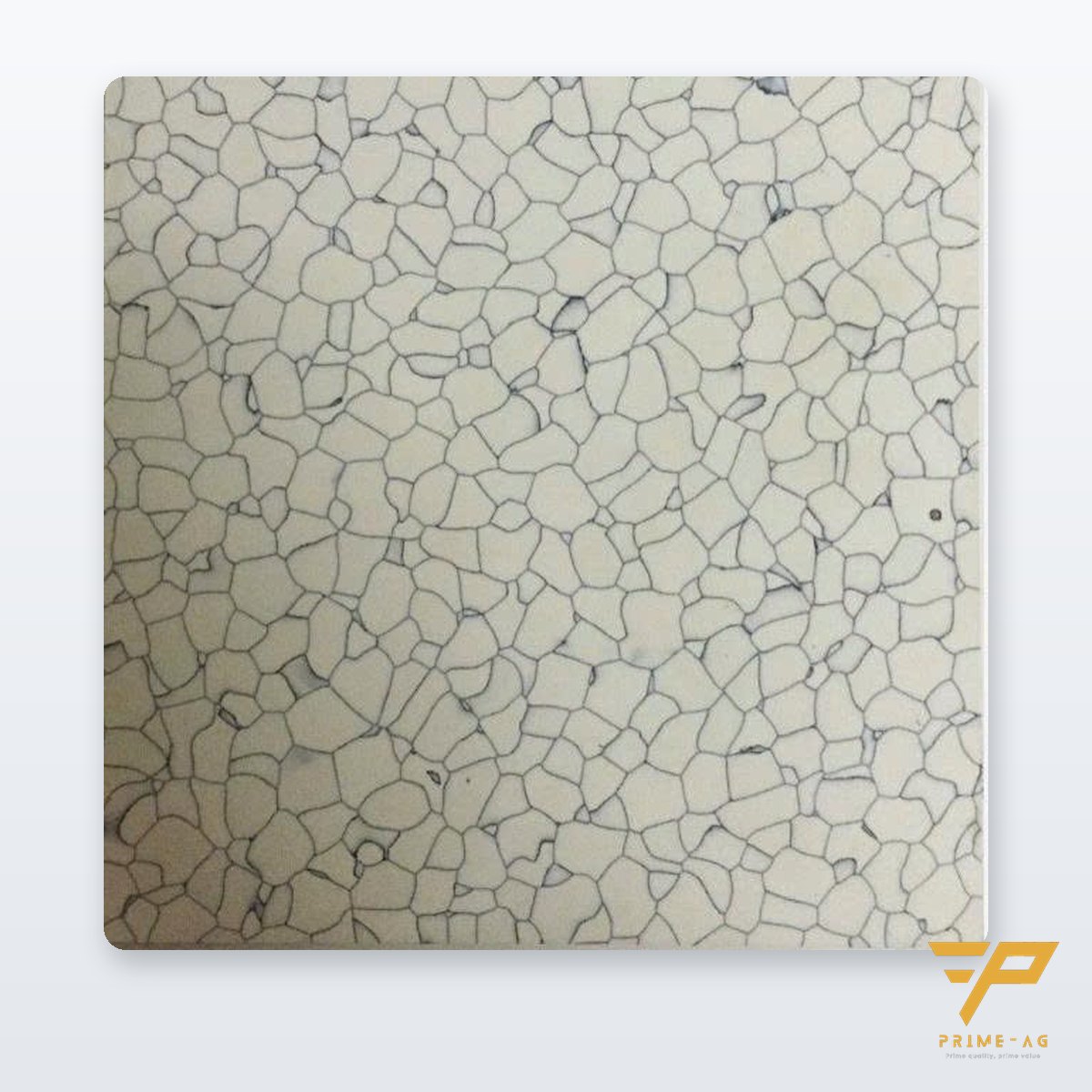
Code: FT-6620 · Homogeneous ESD PVC floor tile 600 × 600 × 2.0 mm: conductive (C) 10⁴–10⁶ Ω or dissipative (D) 10⁶–10⁹ Ω, resistance to ground per ANSI/ESD STM7.1. SGS-tested. Grey marble 500 m² in stock, other colours 15 days; installation about 300 m² per day.
Homogeneous PVC tiles — conductive chips distributed through the full thickness, not a surface coating — for electronics cleanrooms, SMT areas and EPAs. Laid with conductive adhesive on a grounded copper-strip grid to form an ESD floor system to S20.20. PRIMEAG supplies tiles only or full turnkey installation with a resistance-tested acceptance — the biggest difference from buying loose tiles.
Because conductivity runs through the whole tile, the floor stays ESD-effective as the surface wears (unlike paints or ESD waxes that work only at the surface), the low plasticiser content keeps the tiles dimensionally stable with low emissions, and deep scratches or burns can be repaired locally without replacing a whole area.
Specifications
- Material: homogeneous PVC, conductive chips through the full thickness
- Size: 600 × 600 × 2.0 mm (2.5 / 3.0 mm optional) — 2.78 tiles/m²
- Surface resistance: C 10⁴–10⁶ Ω · D 10⁶–10⁹ Ω (method and conditions per supplier test report)
- Resistance to ground (installed system): C ≤ 10⁶ Ω · D ≤ 10⁹ Ω (ANSI/ESD STM7.1)
- Body voltage when walking (with ESD footwear): < 100 V (STM97.2)
- Fire rating: per supplier test report (class stated)
- Abrasion: group T
- Certificates: SGS (test report), RoHS
- Colours: light grey marble; blue, cream, white marble optional
- Installation materials: conductive adhesive 0.3 kg/m², copper strip grid 3 × 3 m, ground point every 100 m²
- Warranty: 24 months on materials; 12 months on installation
How to choose
- Fast refurbishment over existing tiles or epoxy → 600×600 glued tiles (this product).
- Cleanrooms needing a seamless, easy-to-clean floor → 2×20 m sheet flooring with welded seams (FR-2020D).
- Standard assembly lines only → dissipative D version, about 15 % cheaper.
- Server and control rooms → ESD raised floor (PRIMEAG refers a partner).
- Individual benches, no flooring → ESD rubber mat (MT-12) + ESD slippers.
TURNKEY INSTALLATION (FS-INSTALL): substrate survey (moisture ≤ 4 %, flatness ≤ 3 mm/2 m), substrate preparation, 3×3 m copper strip grid, conductive adhesive, tile laying, welded seams (optional), grounding, acceptance test to ANSI/ESD STM7.1 on the grid after 72 h adhesive cure, handover report + grounding diagram. about 300 m² per day, out of hours or at weekends so production does not stop.
MEASURED BY PRIMEAG (10/2026): loose 600×600 ESD PVC tile: 4.03 × 10⁵ Ω (TR1800, 5 lb electrode, 86.2 %RH, 29.3 °C), conductive range, below the 10⁹ Ω limit of ANSI/ESD S7.1. This is a loose-tile value; a finished floor needs conductive adhesive, the copper grid and ground points, and point-to-ground is measured after installation. High humidity lowers resistance, so our acceptance reports always state %RH and temperature.
FLOOR + FOOTWEAR: the floor is only half of the system. When the floor–footwear system is the primary operator grounding method, ANSI/ESD S20.20 requires both person–footwear–floor resistance to ground < 1×10⁹ Ω (STM97.1) and walking body voltage < 100 V (STM97.2) — a floor that passes on resistance can still fail the walking test, so evaluate it with the footwear your operators actually wear. Carts, chairs and forklifts on the ESD floor also need dissipative or conductive wheels.
TESTING: resistance-to-ground report for every 3×3 m grid cell and walking body voltage (STM97.2) with your own ESD footwear; guidance on re-testing every 6 months. The floor needs no surface coating — wax and ordinary cleaners or polishes change contact resistance and can destroy ESD performance; re-test after any major maintenance.
FAQ
- Conductive or dissipative — which does my factory need? — Semiconductor, optics, robotics → C; general electronics assembly → D. Japanese and Korean customer audits usually accept either with an STM7.1 test report.
- What if workers wear ordinary shoes on the ESD floor? — The system does not work; the floor is only effective with ESD shoes or slippers. PRIMEAG tests the person–footwear–floor system at acceptance.
- Can it be laid over old ceramic tiles? — Yes, if the tiles are not loose; they are sanded and the joints levelled. A weak substrate needs self-levelling compound.
- What is the copper grid spacing and where does it connect? — 3×3 m copper strip grid, collected to a ground point every 100 m² and connected to the factory earth system (<1 Ω).
- How long does 500 m² take? — About 3–5 days of installation (depending on the substrate) + 3 days of adhesive cure before testing and use.
- What should the floor be cleaned with? — Water or an ESD cleaner; no wax, no silicone.
REQUEST A QUOTE: send the area, the substrate condition and whether you need installation — PRIMEAG quotes per m² within 30 minutes; site surveys by appointment. SGS report and datasheet available on request.
Hotline/Zalo +84 906 108 292 · info@primeag.vn
Written by the PRIMEAG technical team.