
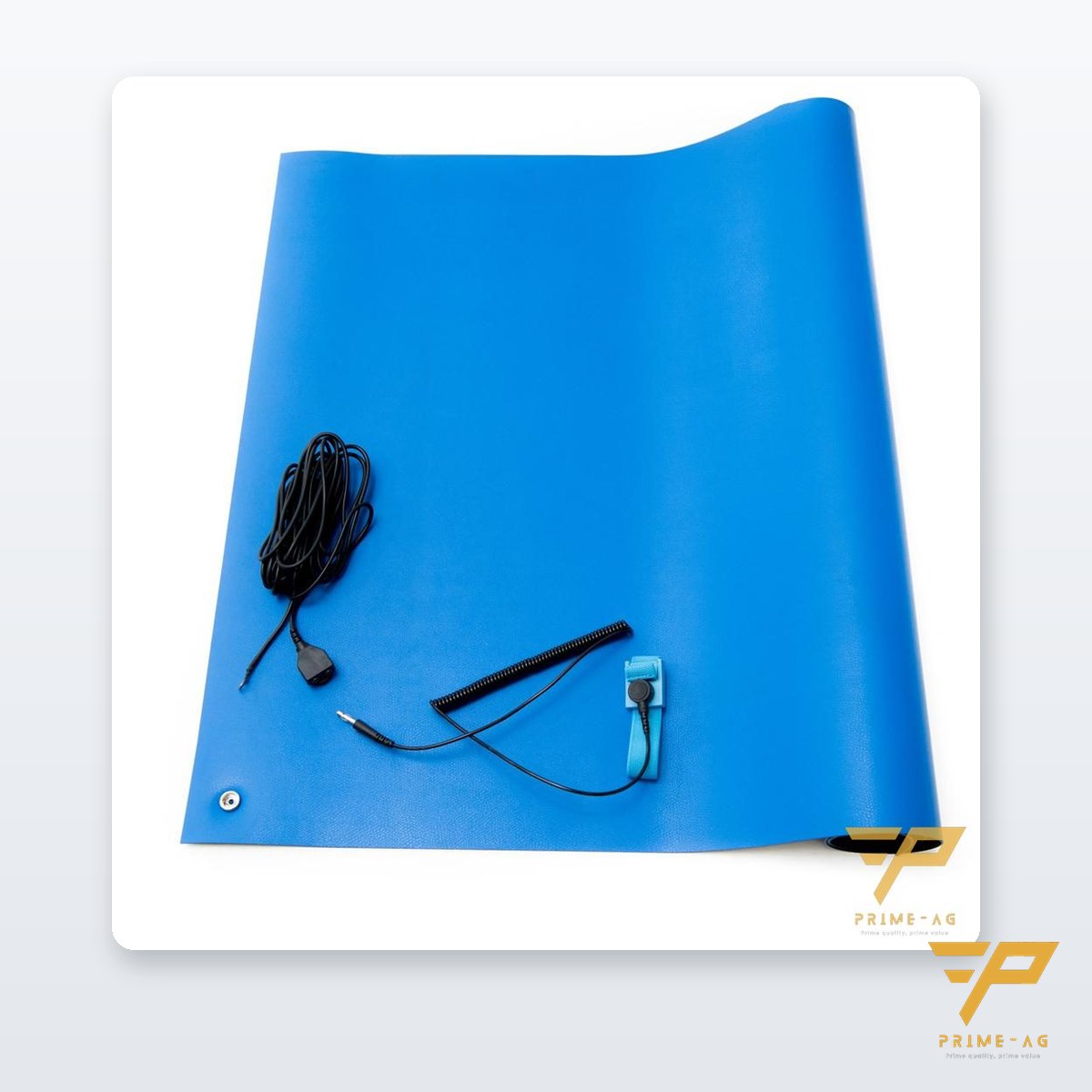
Code: MT-12 · 2-layer ESD rubber table mat, 1.2 m × 10 m × 2 mm. Dissipative top 10⁶–10⁹ Ω, conductive bottom 10³–10⁵ Ω — meets ANSI/ESD S4.1 when grounded through a 1 MΩ cord. In stock in 3 colours, delivery 24–48 h; cut to bench size in 2 days.
Mat for workbenches and shelving in the EPA. The dissipative top layer lets components discharge slowly, without sparking; the conductive bottom layer carries the charge to ground through a 10 mm stud and ground cord. It withstands brief contact with a soldering iron and can be wiped with IPA without losing its ESD properties.
Made of vulcanised nitrile rubber (NBR) with conductive carbon filler, the two layers heat-pressed into one sheet. NBR does not melt or burn when a soldering iron or a hot solder drop touches it, and resists mineral oil, dilute acids and alkalis and alcohol — which is why rubber is chosen over PVC/vinyl mats for soldering and repair benches.
Specifications
- Construction: 2 layers of vulcanised rubber, 2.0 mm total (top layer 0.5 mm)
- Top layer resistance: 10⁶–10⁹ Ω (STM11.11)
- Bottom layer resistance: 10³–10⁵ Ω
- Point-to-ground resistance (grounded): < 10⁹ Ω (S4.1)
- Width × length: 1.2 m × 10 m (0.8 / 1.0 m on request)
- Surface: matte (light texture, anti-glare) or glossy
- Colours: green, blue, grey
- Heat: brief soldering-iron contact ~300 °C; working range −10 to 60 °C
- Solvent resistance: IPA, ethanol
- Hardness: Shore A 70 ± 5
- Weight: about 34 kg per 1.2 m roll, about 28 kg per 1.0 m roll — two people to handle and lay
- Accessories: 10 mm ground stud + 1 MΩ ground cord (available with EG-3S)
- Packing: one roll per carton, labelled with size, colour, glossy/matte (Shiny/Dull) and top/bottom resistance; cartons strapped on wooden pallets
- Warranty: 12 months on ESD performance
How to choose
- Soldering and assembly benches → matte version (anti-glare under LED lighting).
- Visual inspection benches, showrooms → glossy version, easy to wipe.
- Standing work >4 hours → ESD anti-fatigue mat (MF-6914); do not use a bench mat underfoot.
- Whole-room flooring → ESD PVC floor tiles (FT-6620), not roll mats.
MEASURED BY PRIMEAG (10/2026): top surface (green), 2 rolls from the same lot: 10⁶–10⁸ Ω/sq, dissipative (screening with an LED meter). Bottom (black): 8.90 × 10³ Ω (TR1800, 5 lb electrode, 60.9 %RH, 28.5 °C), conductive, as a grounding layer should be.
GROUNDING: fit a 10 mm snap stud at a corner of the mat (through both layers) → ground cord → the bench common ground point (the same point as the wrist strap jack) → factory earth. Without grounding the mat gives no ESD protection — it is just a sheet of rubber.
TESTING & HANDOVER: PRIMEAG measures surface and point-to-ground resistance of every roll and supplies a test record; we show you how to re-test every 6 months (ESDA TR20.20 recommends at least quarterly). Measure before cleaning, not straight after. Replace the mat when it reads above 10⁹ Ω, tears, hardens or delaminates; ESD service life is typically 2–3 years.
FAQ
- What is the difference between 2-layer and 1-layer mats? — 1-layer mats are usually only conductive (fast discharge, risk of sparking); a 2-layer mat has a dissipative layer that protects sensitive components, as S20.20 requires.
- Does it need grounding, and how? — Yes, it is mandatory. Fit a 10 mm stud at a corner of the mat → 1 MΩ cord → grounding point or common ground point.
- What should I clean it with so it stays ESD? — IPA or an ESD mat cleaner; no wax or silicone.
- Can it be cut for a 1200×700 bench? — Yes, PRIMEAG cuts it to size and supplies ground studs.
- Matte or glossy — which lasts longer? — The same; glossy is easier to wipe, matte reduces glare and hides scratches.
REQUEST A QUOTE: send the number of benches and sizes, or the number of rolls — PRIMEAG quotes with the grounding kit within 30 minutes.
Hotline/Zalo +84 906 108 292 · info@primeag.vn
Written by the PRIMEAG technical team.