
Written by the PRIMEAG engineering team. Measured 10/2026.
“Anti-static mat” and “anti-static floor” are used very loosely. In practice a mat or floor only counts as ESD when its resistance falls in a specific range, measured by a specific method. This article presents real readings PRIMEAG took on mats, floors and casters before delivery, compared against ANSI/ESD S20.20 and IEC 61340-5-1, and how to choose a meter.
1. Reference ranges used for evaluation
The results below are compared against the ANSI/ESD ranges: dissipative materials 10⁴ – < 10¹¹ Ω (ANSI/ESD S541); worktops, mats, floors, casters and chairs to ground < 1 × 10⁹ Ω; for worktops and mats, buy the 10⁶ – 10⁹ Ω grade. For the full table by item, test frequency and how to write the report, see ESD resistance testing for incoming acceptance.
2. Real readings on PRIMEAG stock


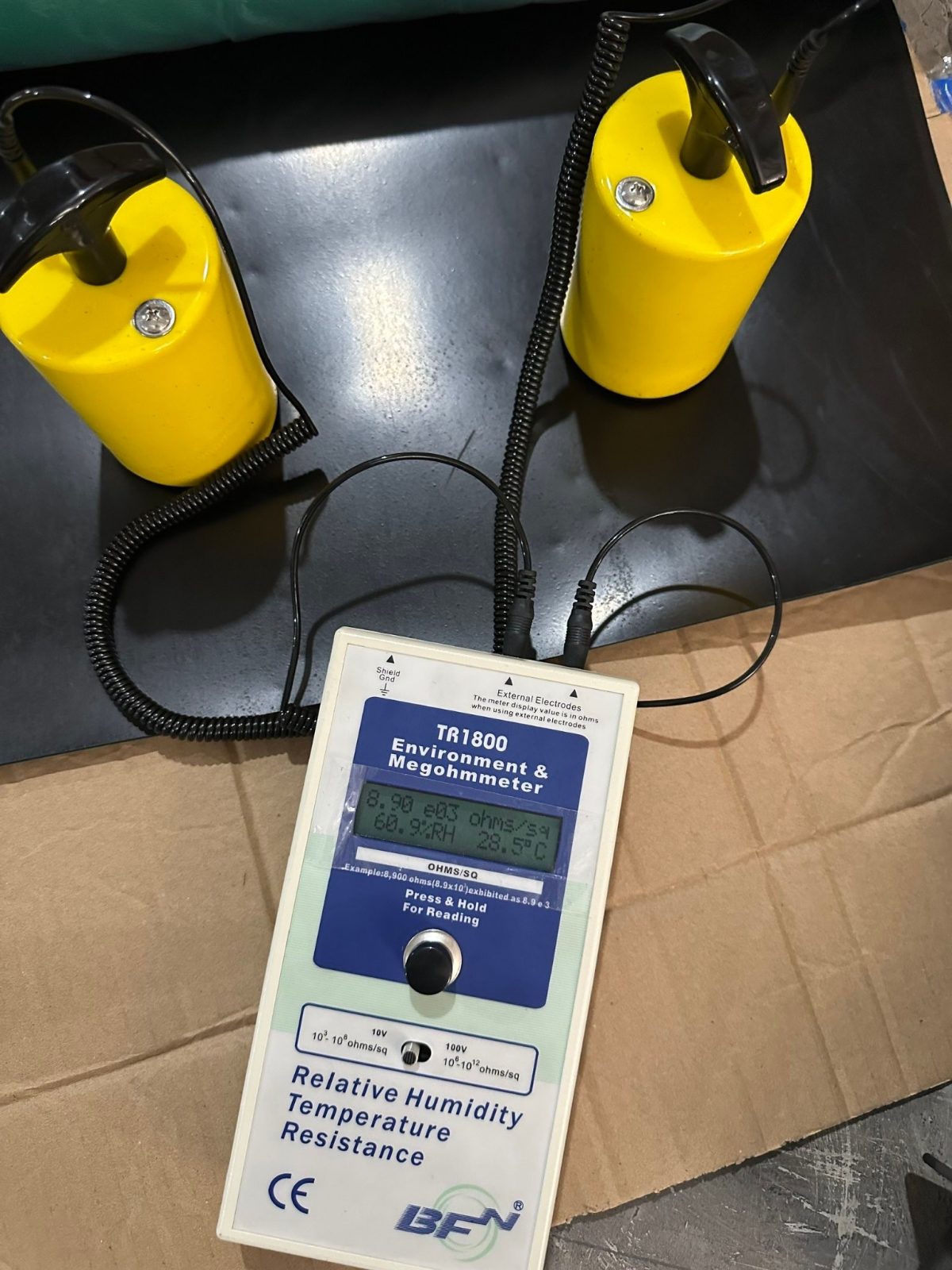
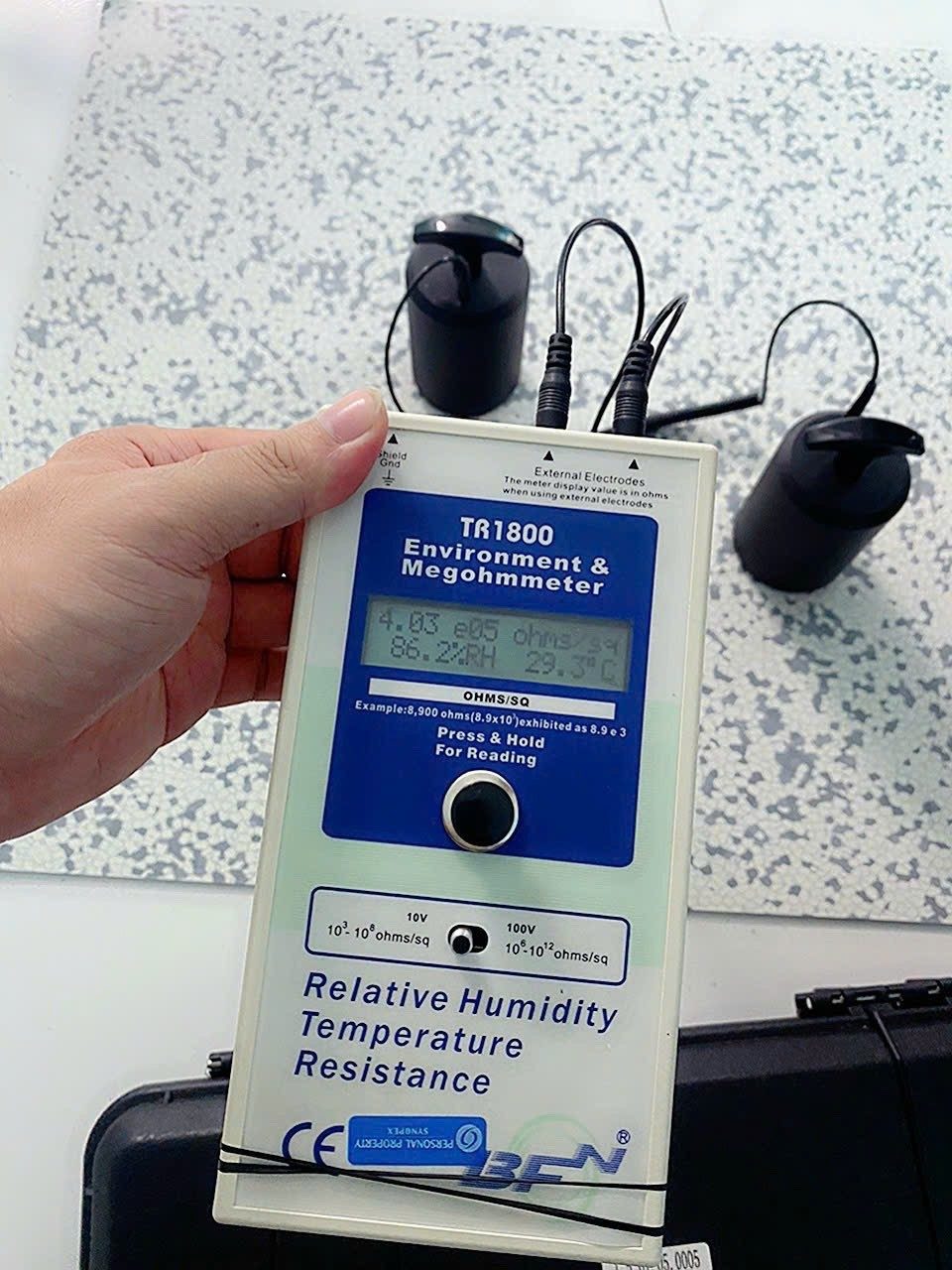
| Sample | Result | Range | Verdict |
|---|---|---|---|
| Green rubber mat – top surface | 10⁶ – 10⁸ Ω/sq | Dissipative | Pass for workbench tops |
| Rubber mat – black bottom layer | 8.90 × 10³ Ω | Conductive | Pass; grounded via 10 mm snap |
| 600×600 ESD PVC floor tile | 4.03 × 10⁵ Ω (86 %RH) | Dissipative | Pass STM7.1; needs conductive adhesive + copper grid so the whole floor reads < 10⁹ Ω |
| 5-inch turquoise PU caster (labelled “ESD”) | 4.3 – 8.1 × 10⁹ Ω (10 V) | Above the 10⁹ Ω limit | Fail for ESD trolleys – this lot is not shipped as ESD; see the caster test |
3. Two types of meter and when to use each

- LED meter (“ohms per square” type): 10 LEDs from 10³ to 10¹², showing only which range the material falls into. Fast and cheap — good for quick checks at goods-in or periodic checks on the line. Accuracy about half a decade; no recorded values.
- TR1800 digital meter (megohmmeter): shows an actual value (e.g. 4.03 e05), two test voltages 10 V / 100 V, measures both surface resistance (Ω/sq, built-in electrode per STM11.11) and point-to-point / point-to-ground resistance (Ω, 5 lb electrodes per S4.1, STM7.1), and displays %RH and °C. This is the instrument for acceptance reports and audit answers.
PRIMEAG uses the LED meter to screen incoming goods and the TR1800 to measure and report values with every lot of ESD mats, floors, casters, bins and trays. Any lot that fails (like the caster lot above) is not shipped as ESD. If your factory has no meter yet, we can test on site at handover.
Email: info@primeag.vn · Tel/Zalo: +84 906 108 292