
The three cleanroom nitrile glove lines PRIMEAG supplies – Nitrilstat (Riverstone), Shirudo 7th Sense (Cleanera, part of the Kossan group) and ASAP (Multisafe) – are all made in Malaysia, 12 inches long, powder-free and ambidextrous, packed 100 gloves (50 pairs) per bag and 10 bags per carton. They differ in thickness, cleanliness class, vulcanisation accelerators and how the maker proves ESD performance. This guide compiles the makers’ datasheets and certificates of analysis so you can match each glove to the right process step.
- ISO 5 (Class 100) cleanrooms, wafer, optics; operators with itchy hands: Shirudo DC – thin, accelerator-free, Class 100.
- EPA areas that must prove the glove is ESD-safe while worn: Shirudo OC – person-glove system resistance < 10⁹ Ω per ANSI/ESD SP15.1.
- Handling sharp-edged parts, solvent wiping, need a tougher glove: ASAP 5.5 mil – almost twice as thick at the fingertip, Class 1000.
- Products sensitive to extractables and ions: Nitrilstat Low Extractable (LE, white label).

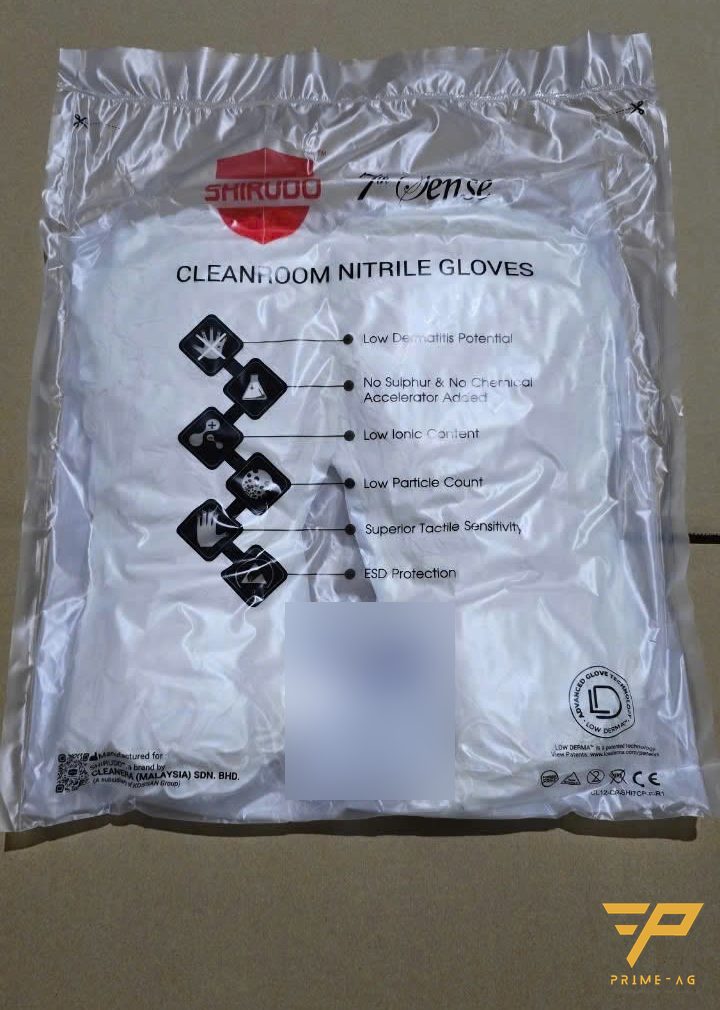

Specification comparison
| Item | Shirudo DC | Shirudo OC | ASAP CR 5.5 mil | Nitrilstat SF1 (green label) / LE (white label) |
|---|---|---|---|---|
| Manufacturer | Cleanera (Malaysia), Kossan group | Multisafe Sdn Bhd (Malaysia) | Riverstone Resources (Malaysia) | |
| Cleanliness | Class 100; particles ≥0.5 µm < 1,200/cm² | Particles ≥0.5 µm < 3,000/cm² | Class 1000 (per label) | Per line datasheet |
| Min. single-wall thickness | Fingertip 0.08 mm · palm 0.06 · cuff 0.05 | Fingertip 0.08 mm · palm 0.06 · cuff 0.05 | Measured, lot 12/2024: fingertip 0.14–0.15 mm · palm 0.10–0.11 · cuff 0.06–0.09 | 3.5 mil (≈ 0.09 mm) – part no. RSNS-3.5M |
| Vulcanisation accelerators | None (accelerator-free), sulphur-free | None (accelerator-free), sulphur-free | Not declared by maker | Per line datasheet |
| ESD | Surface resistance ≤ 10⁹ Ω; static decay ≤ 0.5 s | System resistance < 10⁹ Ω, body voltage < 100 V (ANSI/ESD SP15.1) | No ESD claim on label | Per line datasheet |
| Surface | Finger-textured | Finger-textured | Finger-textured | — |
| Length | Min. 290 mm | Min. 295 mm | 296–302 mm (measured) | 12 inch |
| Packing | 100 gloves (50 pairs)/bag, 10 bags/carton = 1,000 gloves (500 pairs) | |||
| Lot control | CoA per lot on request; made under ISO 13485, ISO 9001 | CoA per lot: pinholes AQL 1.5 (ASTM D3578-19) | RoHS (SGS, 2022): all 10 restricted substances not detected | |
| Reference price | From 5,500 VND/pair | From 4,000 VND/pair | From 4,200 VND/pair | SF1 (green): from 4,500 VND/pair LE (white): from 5,500 VND/pair |
| Shelf life | Printed on bag and carton labels | 3 years from manufacture | 3 years from manufacture | |
Reference prices as of 10/2026; they vary with quantity, size and lot – formal quotations are sent by Zalo/email. Data sources: Cleanera datasheets (Shirudo DC, OC), ASAP CoA lot 0800070112 (12/2024), SGS RoHS reports for Nitrilstat (2022) and Shirudo (2023), actual packaging labels. 1 mil = 0.0254 mm: 0.08 mm ≈ 3.1 mil; 0.14 mm ≈ 5.5 mil; Nitrilstat at 3.5 mil sits between Shirudo and ASAP. Other Nitrilstat SF1/LE data (cleanliness, ESD) are sent with the quotation together with the datasheet and CoA.
Choosing by process step
SMT assembly, visual inspection (ISO 6–8)
Prioritise dexterity and cost. Shirudo OC (from 4,000 VND/pair) or Nitrilstat SF1 is enough; inside an EPA, choose a glove with published ESD data (Shirudo OC, DC).
Wafer, optics, displays (ISO 5)
You need low particles and low ions: Shirudo DC (Class 100, particles < 1,200/cm², chloride ≤ 1 µg/cm²) or Nitrilstat LE.
Sharp-edged parts, IPA wiping, packing
ASAP 5.5 mil is almost twice as thick as Shirudo at the fingertip (0.14–0.15 mm vs 0.08 mm) and tears less. The trade-off is less feel when picking small components.
Full-shift wear, operators with itching or allergy
The usual cause is vulcanisation accelerators (thiurams, carbamates) in nitrile. Shirudo DC and OC are declared accelerator-free and sulphur-free. Trial one bag with the affected operators before switching the whole plant.
Trial gloves on the line before switching supplier
- Take one bag of each type in the same size and give them to the same group of operators for one week.
- Record torn gloves per shift and feedback on feel and skin irritation.
- In the EPA: measure person-glove-ground resistance with a wrist-strap/footwear tester before and after the shift.
- Ask for the CoA of the exact lot to be delivered (particles, ions, pinholes) for your audit file.
FAQ
What is the difference between Class 100 and Class 1000? These are cleanliness classes from the former FED-STD-209E, equivalent to ISO 5 and ISO 6. Class 100 gloves are washed and particle-controlled more tightly for higher-grade cleanrooms.
Are nitrile gloves anti-static by themselves? Not all of them. Rely only on the maker’s measured data (resistance, decay time, or testing per ANSI/ESD SP15.1); if the label makes no ESD claim, test the glove before using it in an EPA.
What is a mil? 1 mil = 1/1000 inch = 0.0254 mm. Glove thickness is usually measured single-wall at the fingertip, palm and cuff.
How many gloves per bag and per carton? All three brands: 100 gloves (50 pairs) per bag, 10 bags per carton = 1,000 gloves (500 pairs).
Can I buy a single bag? Sample bags are available for trials; regular orders are by the carton, and recurring customers get prices held for 6 months and stock reserved by size.
See also: cleanroom nitrile glove product page · Choosing gloves by process step (12 glove types). Send PRIMEAG your cleanroom class, process step, hand sizes and monthly quantity: we quote all three brands to the same specification for comparison, with datasheets and CoA.
Email: info@primeag.vn · Phone/Zalo: +84 906 108 292
Written by the PRIMEAG engineering team