
In an ESD protected area (EPA), components and boards pass through many types of packaging: trays on the workbench, totes moving between operations, boxes on kitting racks. The three most common are ESD plastic trays, molded plastic bins and corrugated plastic (danpla) boxes. They are not fully interchangeable: they differ in resistance range, load capacity, ability to be made to size, and price. This guide helps you choose the right type for each position.
- Components and PCBs placed directly on the bench: EJ-KN ESD plastic tray – dissipative, 10⁶–10⁹ Ω.
- Transfer between storage, SMT and assembly, heavy loads: EB-6142 ESD plastic bin – 10⁴–10⁶ Ω, 30 kg, stacks 5 high.
- Kitting, line-side racks, custom sizes: ED-3516 ESD danpla box – lightweight, made to drawing from 200 pieces.
- Taking items out of the EPA: add an ESD shielding bag.
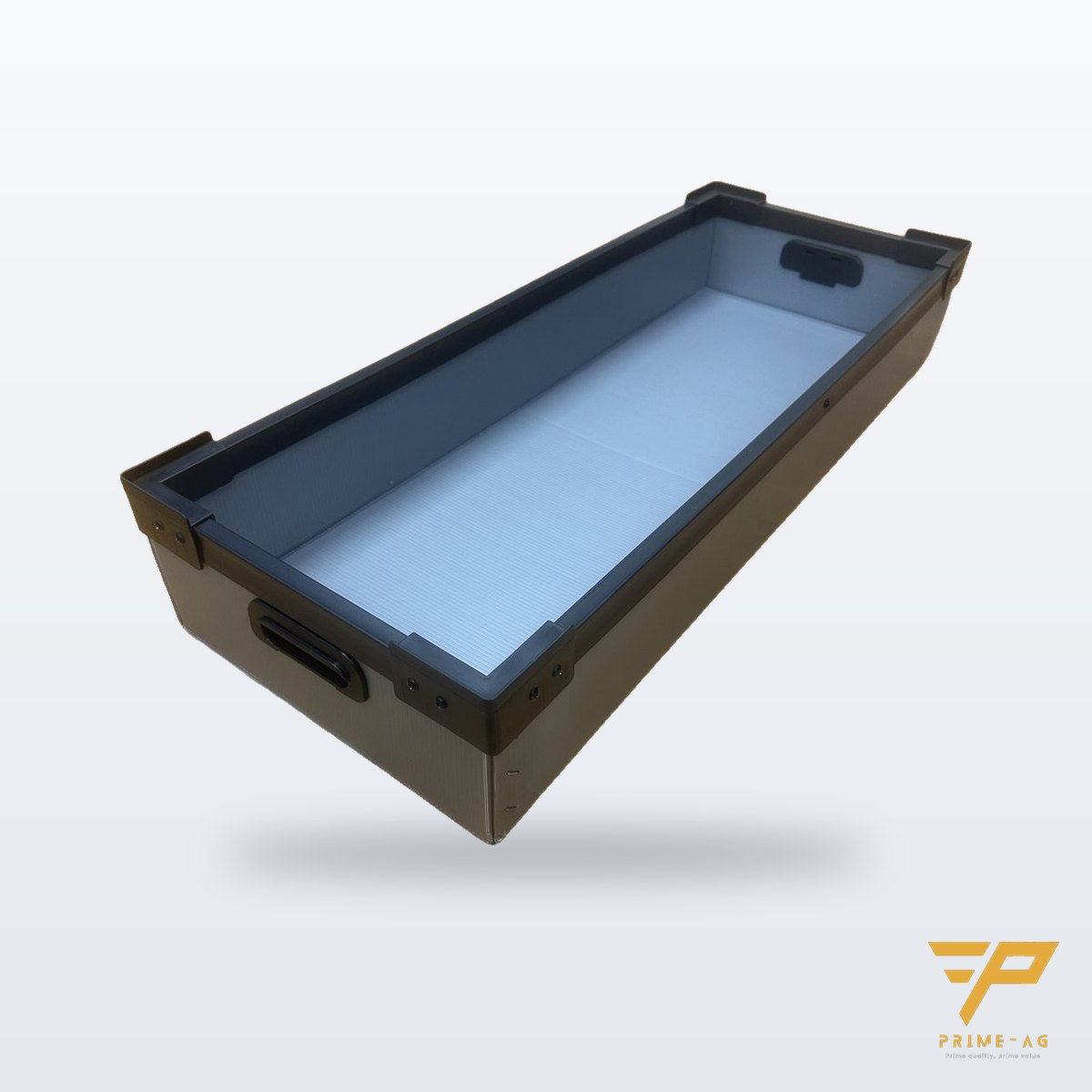
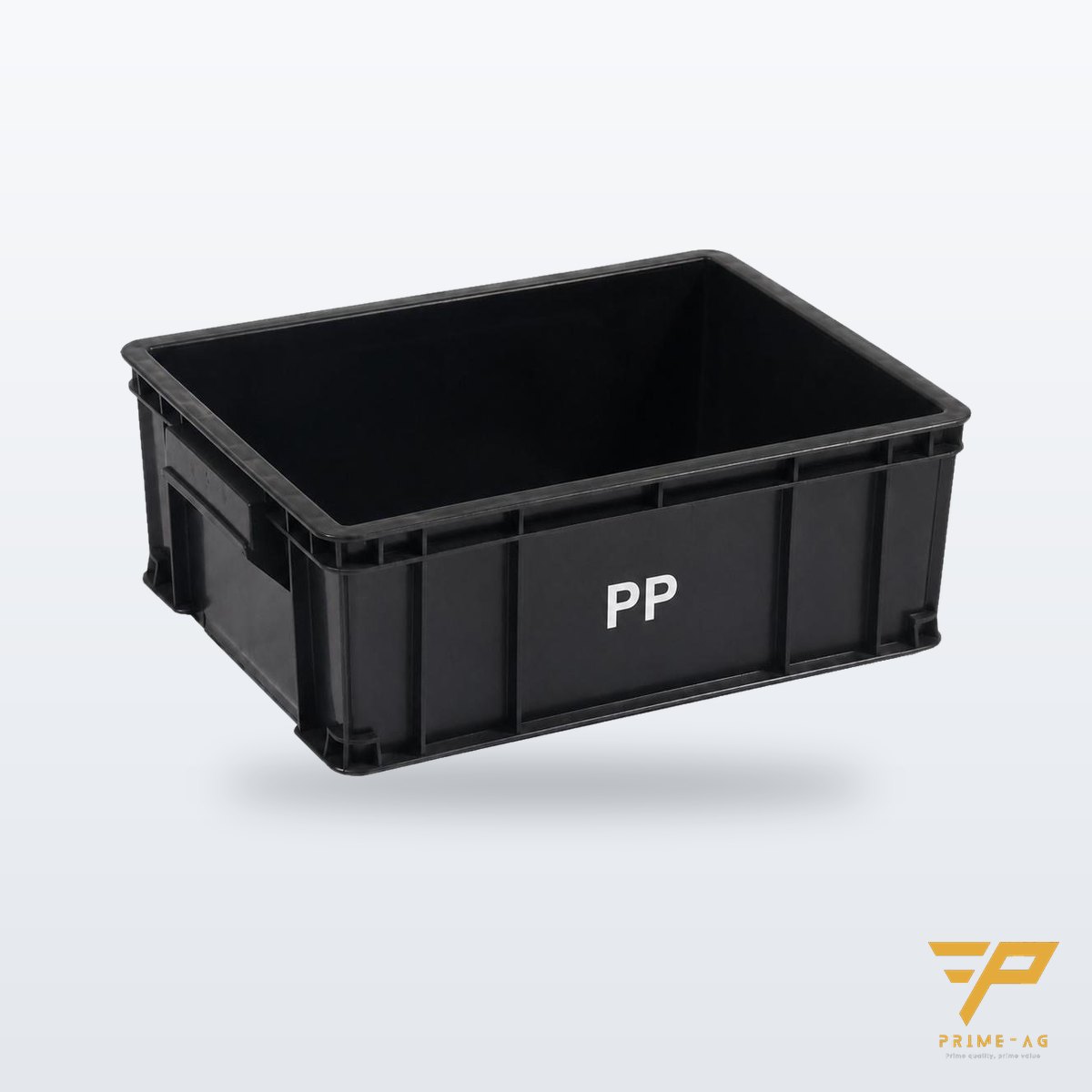

Quick comparison of the 3 types
| Criterion | ESD plastic tray | ESD plastic bin | ESD danpla box |
|---|---|---|---|
| PRIMEAG code | EJ-KN | EB-6142 | ED-3516 (made to drawing) |
| Material | Fully carbon-loaded PP, injection molded | Fully carbon-loaded PP, injection molded | Black carbon-loaded corrugated PP sheet (danpla), 4 mm thick |
| Surface resistance | 10⁶–10⁹ Ω (10⁴–10⁶ optional) | 10⁴–10⁶ Ω | 10⁶–10⁹ Ω |
| External dimensions | 450 × 300 × 60 mm | 610 × 420 × 390 mm | 350 × 160 × 200 mm or to drawing |
| Load capacity | 8 kg | 30 kg | 5 kg |
| Stacking | Yes; nests when empty | 5 high when full | 4–5 high when full; folds flat when empty |
| Compartments | Removable dividers (optional) | No | Removable dividers to drawing |
| MOQ | 100 trays | 50 bins | 200 pieces |
| Custom sizes | Requires a dedicated mold; viable at large volumes | Existing molds only | Easy: redrawn to your requirements, samples in 3 days |
| Logo printing | Yes | Yes | Yes |
Figures from PRIMEAG product pages. By PRIMEAG’s estimate, danpla boxes are about 70 % lighter and about 50 % cheaper than molded PP bins of the same volume, in exchange for lower load capacity and service life.
Why trays use 10⁶–10⁹ and bins use 10⁴–10⁶
Under ANSI/ESD S541, both ranges are dissipative (10⁴ to below 10¹¹ Ω); below 10⁴ Ω is conductive. Trays hold components directly, so they use the middle range of 10⁶–10⁹ Ω: charge drains fast enough, but not too abruptly when a charged component touches the tray. Transfer bins mostly hold items already in trays or bags and sit on grounded trolleys, racks and floors; the 10⁴–10⁶ Ω range lets the bin discharge quickly and consistently. If highly sensitive components go straight into a bin, line it with a dissipative tray or bag.
Fully carbon-loaded or surface-coated only
ESD packaging comes in two kinds: fully carbon-loaded plastic (uniformly black inside and out) and ordinary plastic with an antistatic coating. The coating wears off with IPA wiping and impacts, and can lose its effect after a few months. How to tell them apart: lightly scrape an edge or a hidden spot; if the inside is a different color or the resistance at the scraped spot jumps, it is the coated type. PRIMEAG’s trays, bins and danpla boxes are all fully carbon-loaded, with resistance test reports per lot.
When taking items out of the EPA
Inside the EPA, floors, benches and people are all grounded, so dissipative trays and bins are sufficient. Outside the EPA (general warehouse, delivery trucks, shipments to suppliers), packaging must also provide discharge shielding: put boards in an ESD shielding bag before placing them in the bin, or use a closed bin with a lid and shielding layer. An open bin cannot protect components from external electrostatic discharges.
Suggested layout by process
| Position | Recommended |
|---|---|
| Component store, receiving | ESD bins on racks; loose components in divided danpla boxes |
| SMT, AOI | ESD trays for PCBs after reflow; ESD bins for transfer to the next process |
| Assembly, kitting | Danpla kit boxes on line-side racks with kanban label holders; trays on the bench |
| Final inspection, packing | ESD trays on the bench; shielding bags before leaving the EPA |
Periodically check the surface resistance of trays and bins with a surface resistance meter (per ANSI/ESD STM11.11) and log the results; replace them when cracked, warped or out of the resistance range.
Frequently asked questions
Can components be placed directly in an ESD plastic bin? Yes, for ordinary components. Highly static-sensitive components should first go into a 10⁶–10⁹ Ω dissipative tray or bag, then into the 10⁴–10⁶ Ω bin.
Is an ESD danpla box as durable as a molded plastic bin? No. Danpla is lighter, cheaper and can be made to size, but its load capacity is about 5 kg and its service life is shorter than a molded bin; it suits kitting, line-side racks and light items.
How can I tell whether a tray is carbon-loaded or only coated? Lightly scrape an edge: a carbon-loaded tray is uniformly black inside and its resistance does not change; a coated tray has a differently colored core or its resistance jumps at the scraped spot.
Which type is fastest to order in a custom size? Danpla boxes: send dimensions or a drawing; PRIMEAG quotes in about 2 days, makes samples in 3 days, and produces from 200 pieces.
Email: info@primeag.vn · Phone/Zalo: +84 906 108 292
Written by the PRIMEAG engineering team