
Plastic-packaged electronic components (ICs, LEDs, modules) absorb moisture from the air. During reflow, the moisture inside expands suddenly and causes package cracking and delamination – defects usually found only after soldering. In a hot, humid climate like Vietnam’s, a component store without humidity control is a frequent source of defects. This guide focuses on the storage side: room humidity, dry cabinets and floor-life tracking. Packing in moisture barrier bags, sizing desiccant and reading HIC cards for shipment are covered in a separate guide: packing moisture-sensitive components per J-STD-033.
- Unused components: keep in moisture barrier bags with desiccant packs and HIC cards.
- Opened components: track floor life according to MSL level; bake once it is exceeded.
- Storage: control room humidity with a dehumidifier; store sensitive components in dry cabinets.
MSL and floor life
Moisture-sensitive components are assigned an MSL (Moisture Sensitivity Level) under J-STD-020/033. The higher the level, the shorter the time they may be exposed to the shop-floor environment after the bag is opened (floor life). The MSL is printed on the bag label; after opening, record the opening time and track it. Once floor life is exceeded, components must be baked before soldering.
Moisture barrier bags, desiccant and HIC cards
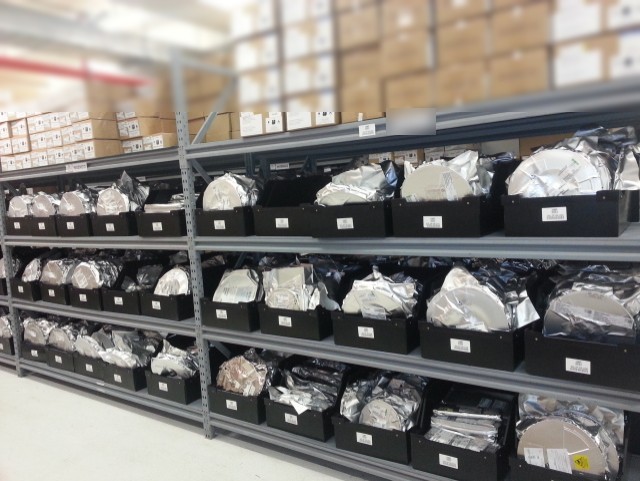
Unused components are kept in sealed moisture barrier bags with desiccant and an HIC card. When taking components out of a bag, read the HIC first: for MSL 2a–5a, a color change at the 10 % spot means the components must be baked before soldering. Desiccant is sized in units (MIL-D-3464), not grams; for the calculation and how to repack, see packing moisture-sensitive components. PRIMEAG supplies cobalt-free HIC cards.
Humidity control in storage
- Place a thermo-hygrometer in the component store and log readings daily.
- In enclosed stores, use a dehumidifier to keep humidity stable; open doors as little as possible and keep components away from entrances.
- High-MSL components with opened but partly used bags: reseal in a moisture barrier bag with fresh desiccant, or store in a dry cabinet.
- Keep component racks away from exterior walls, where condensation forms easily.
- Write the bag-opening time on the label of each reel and tray of MSL 2a and higher components; keep a log so you know which reels are about to run out of floor life.
- Store components from opened bags in a dry cabinet; the conditions for pausing or resetting floor life during dry-cabinet storage follow the table in J-STD-033.
Frequently asked questions
What should we do when the HIC changes color? Check the components’ MSL; for MSL 2a–5a, a color change at the 10 % spot means the components must be baked before soldering and the desiccant replaced.
Can desiccant packs be reused? Non-woven fabric packs can be regenerated by drying at about 120 °C for 2 hours; paper packs cannot be regenerated.
What humidity should a component store be kept at? It depends on the component type and the manufacturer’s requirements; what matters is measuring, logging daily and keeping it stable, with moisture-sensitive components always kept in bags or dry cabinets.
Email: info@primeag.vn · Phone/Zalo: +84 906 108 292
Written by the PRIMEAG engineering team