
When an assembly line’s output is low, the cause is usually not the machines but the method: operators walking to fetch parts, work-in-process (WIP) piling up between operations, tools with no fixed place. Lean workstation improvement tackles exactly these three points at low cost, and can be rolled out one station at a time. This guide summarizes how PRIMEAG designs workstations for FDI factories.
- Too much walking: bring parts to the station with an upper shelf and a flow rack replenished from the back.
- WIP buildup: limit storage space between two operations; use line-side trolleys with exactly the number of tiers needed.
- No 5S: one place for every tool: shadow boards, hooks, tool balancers, floor marking.
- Fatigue and handling errors: table height fitted to the operator, task lights, anti-fatigue mats, chairs with backrests.
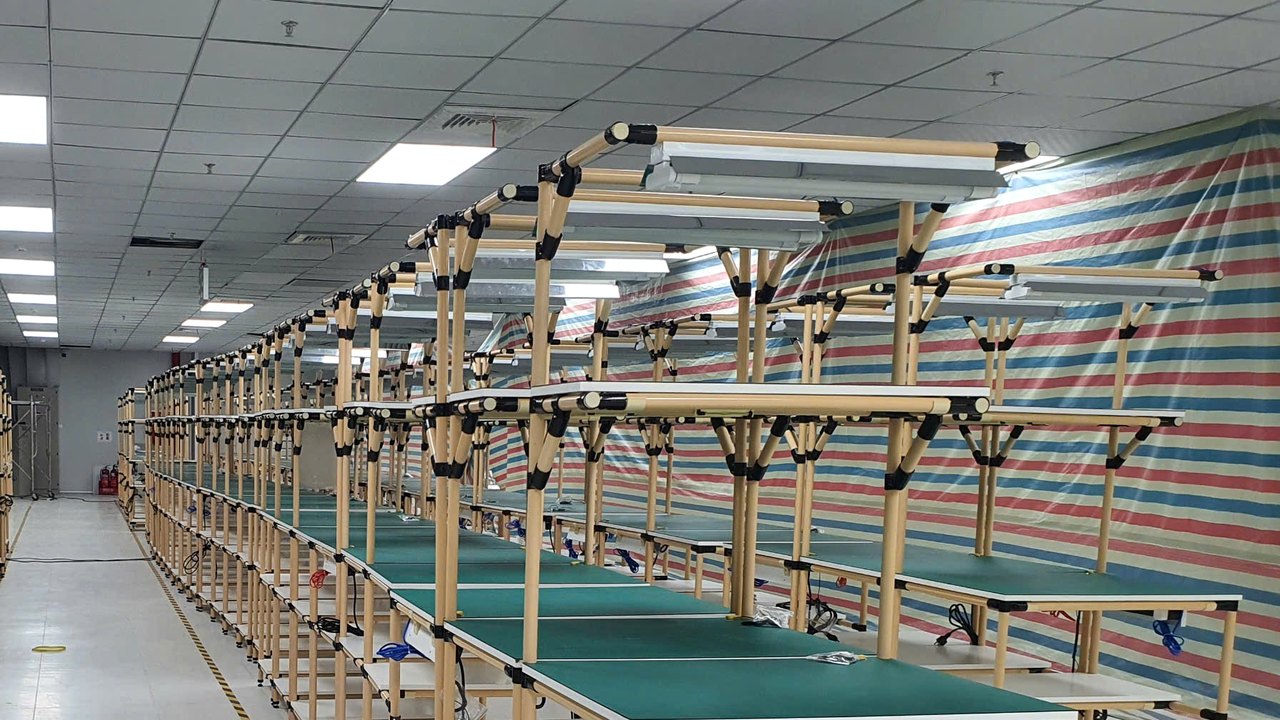

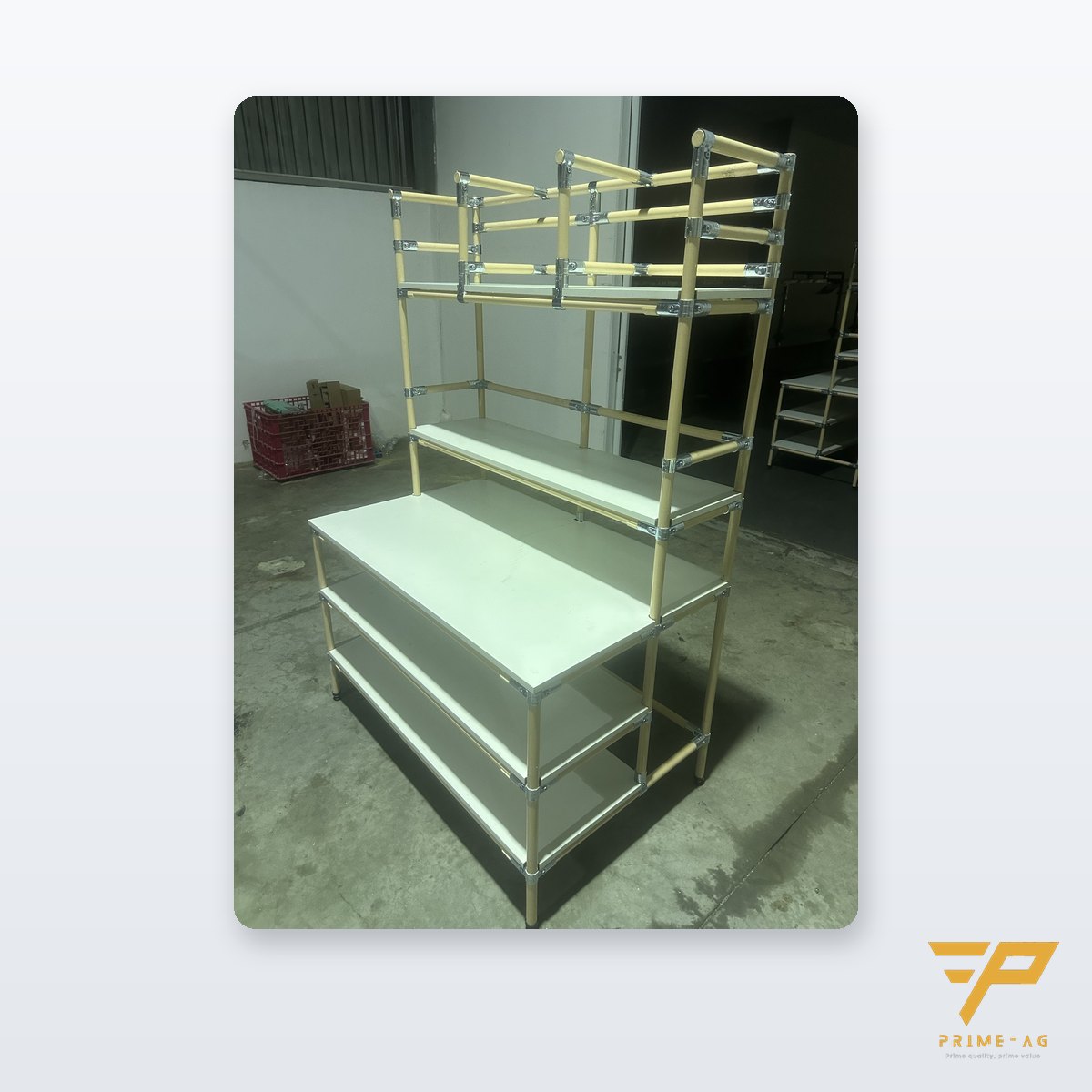
1. Less walking: parts must come to the operator
Every time an operator gets up to fetch parts, tens of seconds are lost and mis-picks become more likely. Place frequently used parts within seated reach, on an upper shelf or an angled tray in front of the operator. For parts consumed by the box, a gravity flow rack attached to the table lets the material handler load from the back without interrupting the operator.
2. WIP control: limit storage space
WIP piling up between operations hides the line’s real bottleneck. Instead of adding extra side tables, limit storage: each station has only one buffer shelf sized for a fixed quantity. When the buffer is full, the upstream operation stops – and the bottleneck shows immediately. A multi-tier trolley or an aluminum profile trolley built with exactly the number of tiers needed is another way to cap WIP.
3. 5S at the station: a place for everything
Hand tools hang on a shadow board or a tool balancer right above the work surface, with outlines or location labels so a missing tool is obvious at a glance. Aisles, trolley parking and inspection waiting areas are marked with floor marking tape or floor marking paint.
4. Ergonomics: less fatigue, fewer errors
Operators who are tired after half a shift make more handling errors. Three points to settle when designing the table: work surface height for the type of task (precision or force), enough light on the surface (a task light or shelf-mounted LED light), and the right standing or seating setup – anti-fatigue mats for standing stations, chairs with backrests for seated stations.
Why plastic-coated steel pipe (lean pipe)
Lean improvement is a process of continuous adjustment. A Φ28 plastic-coated steel pipe workbench is assembled with bolted joints, so you can change its height, add shelves, add lights or convert a table into a trolley right on the shop floor. When higher rigidity and a cleaner look are needed, use a 40×40 aluminum profile workbench. Detailed comparison: Choosing workbenches for electronics lines.
Real projects
| Project | Scope |
|---|---|
| Taiwanese-invested electronic components factory, Đà Nẵng (2024–2025) | About 500 ESD workbenches with lights, power sockets and grounding cords, delivered in 4 batches |
| US-invested FDI factory, Cần Giuộc (2025–2026) | 400 custom plastic-coated steel pipe trolleys |
| E-bike factory (03/2026) | 50 trolleys with ESD tops |
Customer names are withheld by agreement. See more on the Projects page.
Start with one station
- Film one operator at the slowest operation for 10 minutes; count how many times they stand up and reach far.
- Send PRIMEAG the video, the area dimensions and the list of parts used at the station.
- PRIMEAG draws a model station, builds 1–2 tables for a trial run, and only rolls it out to the whole line after adjustments.
Frequently asked questions
How is a lean pipe workbench different from a welded steel table? A lean pipe workbench is assembled from Φ28 plastic-coated steel pipe and bolted joints, so height, shelves, lights and hooks can be changed – or the table converted into a trolley – right on the shop floor; a welded table is fixed and must be cut and re-welded.
What is the right table height? It depends on the task: high-precision work needs a higher surface, force-intensive work a lower one. The safest approach is to build 1 height-adjustable sample table, let operators try it for a few days, then fix the height for the whole line.
Do workstations need to be ESD? Yes, if the operation handles static-sensitive electronic components: ESD work surface, grounding cord, wrist strap and ESD chair. Mechanical assembly and general packing do not require it.
Can we trial 1 table first? Yes. PRIMEAG recommends building 1–2 model stations and running them on the line before mass production; standard sample tables take about 5–7 days, new designs 10–15 days.
Email: info@primeag.vn · Phone/Zalo: +84 906 108 292
Written by the PRIMEAG engineering team