
Under-torqued screws loosen gradually under vibration, cause poor electrical contact and local hot spots in battery packs; over-torqued screws strip threads, crack plastic housings, snap screws or spin threaded inserts. Both defects are hard to see and often only surface at the customer. Electric screwdrivers with shut-off clutches have removed most human error, but the number on the adjustment ring is not N·m, and actual torque still varies with clutch wear, power supply and joint type. The only way to know how tight a screw really is, is to measure it.
- Put torque values in the work instructions: every screw position has an N·m value and tolerance, not just “setting 5”.
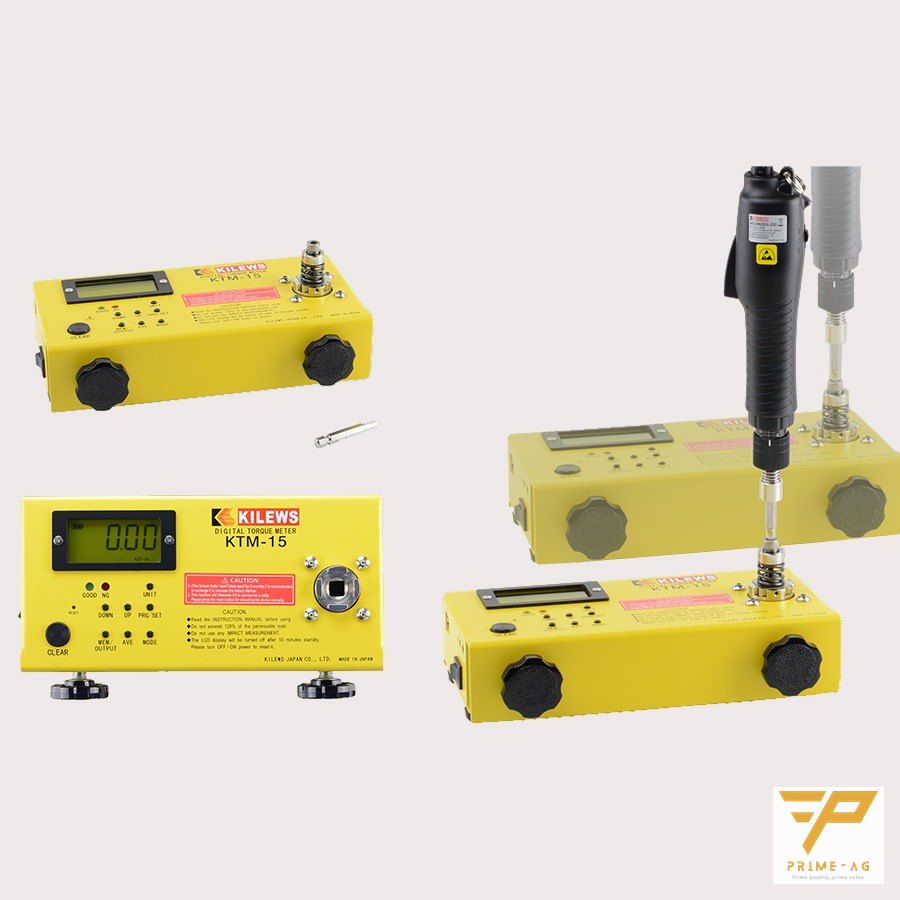
- Measure at start of shift, after adjustment, after a drop: run 3–5 cycles on a Kilews KTM-15 torque tester or Kilews KTM-150 torque tester and compare with the tolerance.
- Understand hard vs soft joints: at the same setting, actual torque can differ.
- Keep the screwdriver in the right position: a tool balancer keeps the screwdriver on axis and reduces hand fatigue.


Why screws are tightened to the wrong torque
| Cause group (5M1E) | Common symptoms |
|---|---|
| Machine | Worn clutch, spring weakened over time; unstable power supply/adapter; worn bit slipping out of the recess. |
| Man | Releasing the trigger before the clutch shuts off; re-tightening a second time “to be sure”; holding the screwdriver at an angle. |
| Material | Screws from a different lot or with different plating; threaded inserts in plastic from a different supplier. |
| Method | Work instructions state only the ring setting, with no N·m value or tolerance. |
| Measurement | No torque tester, or one that is not used periodically or logged. |
| Environment | Model changed without readjusting the screwdriver; one screwdriver used for several positions with different torques. |
Hard joints and soft joints
Once the screw head seats on the part, torque rises quickly or slowly depending on the joint. ISO 5393 (test method for threaded fastener tools) defines a hard joint as reaching target torque within about 30° of rotation (metal to metal), and a soft joint within about 720° (with gaskets, spring washers, elastic plastic parts). With the same screwdriver and the same setting, the torque measured on the two joint types can differ. So when checking, use the torque tester’s joint simulator and compare with actual values on the product when needed.
Daily torque check procedure
- Set the standard: each screw position has a nominal torque and tolerance (e.g. 0.60 N·m ± 10 %) in the work instructions.
- Set limits on the tester: enter upper/lower limits; the tester shows a pass/fail light.
- Measure at start of shift: run each screwdriver 3–5 times on the joint simulator and read the maximum, minimum and average.
- Act on results: if out of tolerance, readjust the setting ring and measure again; if it still fails, replace the screwdriver and send it for clutch repair.
- Log or export the data: date, shift, screwdriver ID, measured values, person measuring. This is your evidence in customer audits.
- Measure again: after a model change, a setting adjustment, or when a screwdriver has been dropped or repaired.
The tester itself must also be calibrated periodically by a calibration lab (usually every 12 months, according to the plant’s internal rules).
Kilews KTM-15 or KTM-150
Kilews is a brand of electric screwdrivers and torque testing equipment widely used in electronics plants; the KTM tester series carries the Kilews Japan label and is made in Japan (Made in Japan). The KTM series is designed for testing shut-off clutch electric screwdrivers. The two models PRIMEAG supplies:
| Specification | KTM-15 | KTM-150 |
|---|---|---|
| Range (N·m) | 0.015 – 1.500 | 0.15 – 15.00 |
| Range (kgf·cm) | 0.15 – 15.0 | 1.5 – 150.0 |
| Range (lbf·in) | 0.15 – 13.0 | 1.5 – 130.0 |
| Accuracy | ±0.5 % or ±1 digit | ±0.5 % or ±1 digit |
| Joint simulators included | 2 (AJ-15, AJ-3) | 3 (AJ-150, AJ-50, AJ-15K) |
| Power | 4.8 V Ni-MH rechargeable battery; about 3 hours charging, about 12 hours use | Same as KTM-15 |
| Dimensions, weight | 230 × 125 × 65 mm; about 1.8 kg | 230 × 125 × 65 mm; about 1.8 kg |
| Reference price | from 39,000,000 VND/unit | from 41,000,000 VND/unit |
| Suitable for | Small screws, torque below 1.5 N·m: PCBs, cameras, phones, wearables | Torque 1.5–15 N·m: housings, battery packs, UAV frames, electrical equipment |
Specifications from Kilews product pages (kilews.com.tw). Both models feature auto-zero, upper/lower limit settings with indicator lights, max/min/average statistics, tightening and loosening direction measurement, and a USB port for exporting data to a PC.
Usage notes (from the label on the unit): do not apply more than 120 % of rated load; do not use it to test impact tools (impact wrenches); the display turns off after 10 minutes idle – switch it back on to reset. If the unit is stored unused for a long time, charge it about every 3 months to preserve battery life.
Choosing a model: take the highest and lowest torque on the line. All small screws below 1.5 N·m → KTM-15 (resolution down to 0.001 N·m). All screws from 1.5 N·m upward → KTM-150. For lines with both groups, many plants use both testers, one for each range, for more precise readings.
Accessories that help achieve correct torque
- Tool balancer: suspends the screwdriver above the bench and keeps it on axis, so operators don’t hold its weight all shift.
- Workbench light: clear view of screw heads and recesses, less bit slipping.
- Lean pipe workbench with an overhead frame for mounting balancers, lights and screwdriver holders in the right positions.
Frequently asked questions
The electric screwdriver already has a setting – why measure? The number on the adjustment ring is a clutch spring step, not an N·m value. Actual torque changes with clutch wear, power supply and joint type, so it must be measured with a torque tester to know the true value.
What is the difference between the Kilews KTM-15 and KTM-150 torque testers? The KTM-15 measures 0.015–1.500 N·m for small screws; the KTM-150 measures 0.15–15.00 N·m. Both have ±0.5 % accuracy, a rechargeable battery, a USB port and pass/fail limit settings. Reference prices at PRIMEAG: KTM-15 from 39,000,000 VND, KTM-150 from 41,000,000 VND.
How often should torque be checked? Typically at the start of every shift for each screwdriver, plus after a setting adjustment, model change, drop or repair. The tester is calibrated periodically, usually every 12 months.
Can a KTM be used to test manual torque wrenches? Kilews designed the KTM series for shut-off clutch electric screwdrivers. Manual torque wrenches should be checked with equipment intended for hand tools per ISO 6789.
Email: info@primeag.vn · Phone/Zalo: +84 906 108 292
Written by the PRIMEAG engineering team