
Stocked item: delivered in 1–2 working days in Ho Chi Minh City, Binh Duong and Dong Nai; free delivery for orders from VND 20,000,000; defective items exchanged within 7 days. Shipping & return policy
Product code: ES-CLOTH · Specification: ESD fabric shoulder bags, cleanroom PVC grid bags, ESD fabric covers for trolleys and bins
ESD Fabric Shoulder Bags, Cleanroom PVC Grid Bags & ESD Covers for Trolleys and Bins
Common sizes: shoulder bags with 1–2 zipped compartments; PVC grid bags, shoulder or waist type; covers 660×440×880 and 1,500×600×1,600 mm.
Delivery: stocked items are delivered in 24–48 hours (Ho Chi Minh City, Binh Duong, Dong Nai); made-to-order items 3–7 working days; covers sewn to size in 5–7 days.
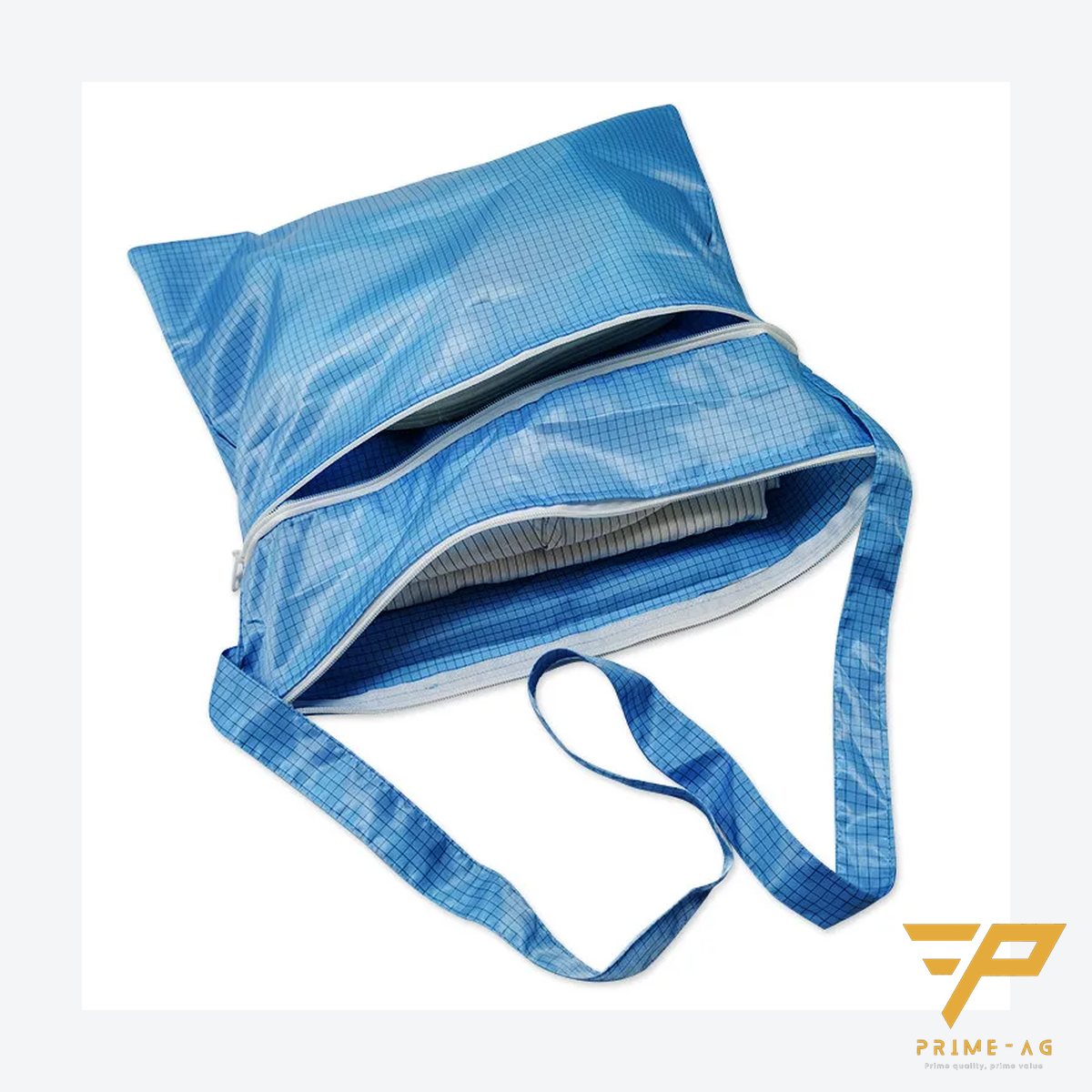
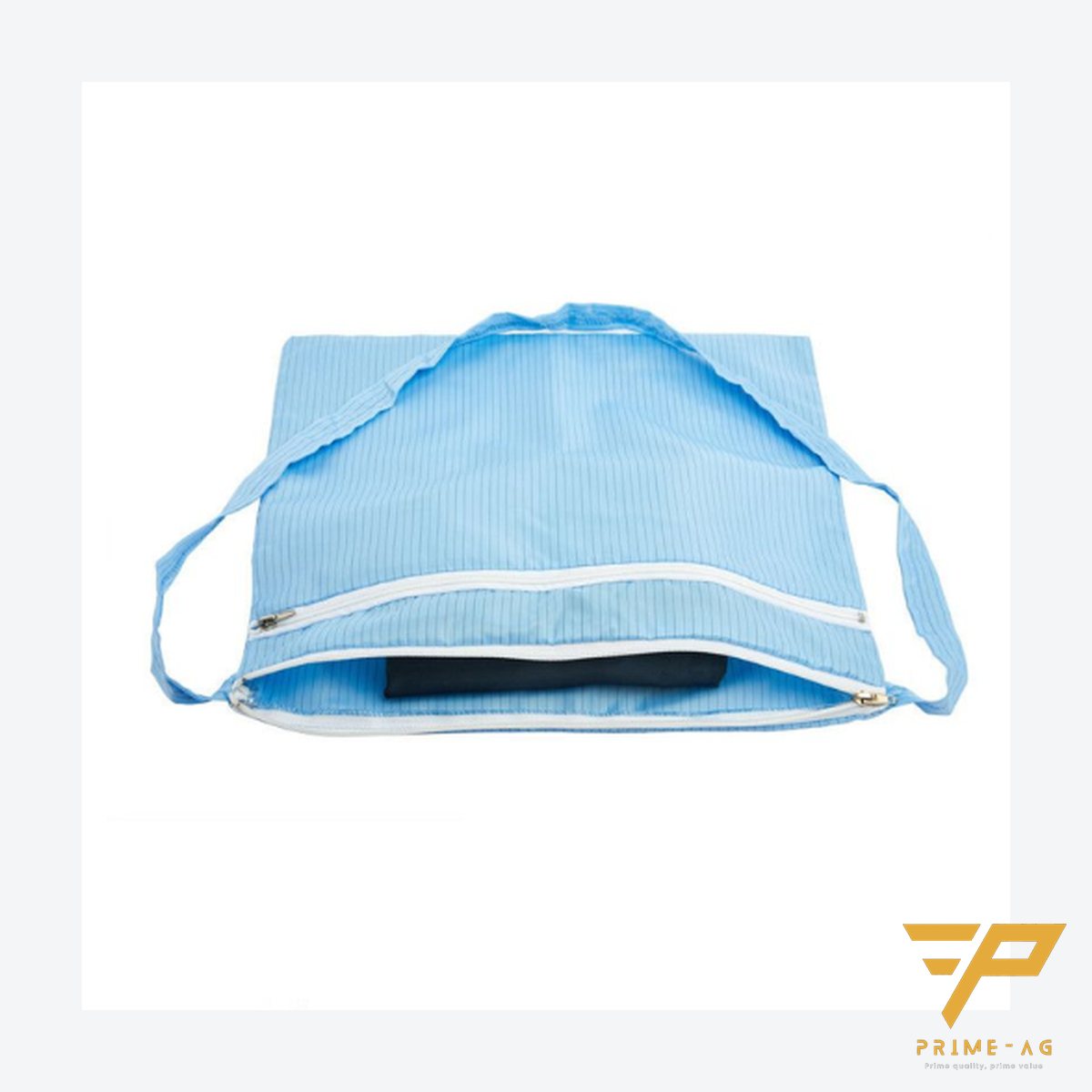
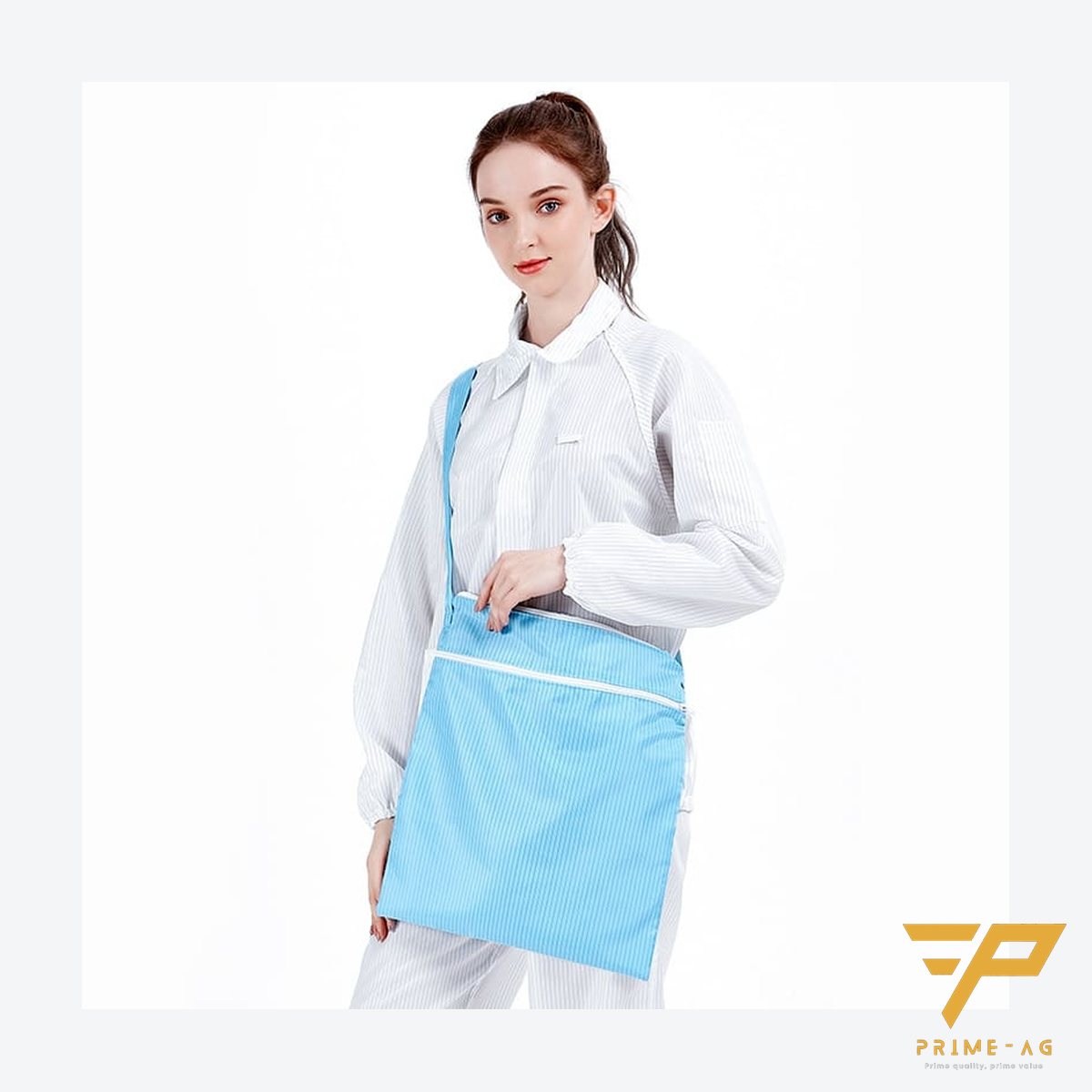
ESD fabric shoulder bags (polyester woven with carbon yarn in stripes or grid, zip, shoulder strap) carry cleanroom garments, documents and personal items into and out of the EPA and clean areas. Clear PVC grid bags (shoulder or waist type) show the contents for security checks and wipe clean quickly. ESD fabric covers are sewn to the exact size of magazine rack trolleys, 3-tier carts and plastic bins: front zip, PVC window for viewing labels, drawstring at the bottom — they keep dust off and replace ordinary PE sheeting (which becomes charged). ESD fabric bags do not replace shielding bags when boards leave the EPA.
Fabric bags and cleanroom bags
| Type | Material, construction | Used for |
|---|---|---|
| ESD fabric shoulder bag | Polyester woven with carbon yarn (stripes or grid); 1–2 zipped compartments; shoulder strap in the same fabric | Carrying clean/used cleanroom garments, documents and personal items into the EPA |
| Clear PVC grid bag | Clear PVC with reinforcing fibre mesh, edge binding and zip; shoulder or waist type | Carrying phones, wallets and small tools into clean areas; security can see the contents |
| Covers for trolleys and bins | 5 mm carbon-stripe polyester, 10⁶–10⁹ Ω, optional 200 g/m² knitted fabric; YKK zip, 0.3 mm PVC window, drawstring, carry handle | Keeping dust off boards on trolleys, magazine racks and plastic bins during transport or overnight waiting |
Sizes: shoulder bags in stock designs or sewn to order; covers to suit the trolley/bin, e.g. 660 × 440 × 880; 1,500 × 600 × 1,600; 175 × 95 (curtain cover). Printing: logo, “ESD” label from 10 pieces. Covers: sewn in 5–7 days; MOQ 2 pieces.
Note on PVC grid bags: PVC is an insulating material and charges easily through friction. In the EPA, do not place PVC bags on workbenches or close to boards and components; keep them in lockers or on hooks away from the work area. If items must be carried close to the workstation, use an ESD fabric bag.
FAQ
– Can you make covers for our own trolleys? — Send the L×W×H dimensions and a photo; PRIMEAG prepares a design drawing within 1 day.
– ESD fabric shoulder bag or PVC grid bag — which one? — Entering the EPA, carrying ESD garments: ESD fabric bag. Clean areas where security must see the items brought in, with no component handling: PVC grid bag.
– Are they washable? — Fabric bags can be washed in warm water with a neutral detergent; re-measure resistance after washing. Wipe PVC bags with a damp cloth or IPA.
How is anti-static fabric made?
The fabric used for the covers is polyester woven with conductive yarn (carbon-containing yarn) in a stripe or grid pattern. Polyester itself is an insulator and charges easily through friction. The carbon yarn forms a conductive network throughout the fabric, allowing charge to spread out and drain away when the fabric touches the trolley frame or a grounded object.
- Conductive yarn woven into the fabric is the long-term solution: performance does not depend on a surface coating.
- Fabric treated with anti-static chemicals (sprayed or soaked) is cheaper, but these agents usually rely on absorbing moisture to conduct and are gradually depleted over time and with washing — performance drops sharply in dry air.
- Heavy knitted fabric is soft, wrinkles less and keeps dust out better; woven carbon-stripe fabric is lighter, more breathable and cheaper.
What does an ESD fabric bag protect against, and what not?
A cover mainly does two things: it keeps dust off boards on trolleys and magazine racks during transport or overnight waiting; and it replaces PE sheeting and ordinary plastic film — insulating materials that charge strongly when pulled over or removed right next to components.
It is important to understand the limits: carbon-grid fabric is a dissipative material, not a closed Faraday cage. According to ESDA, when static-sensitive components are taken outside the EPA, the packaging must have a discharge shielding structure (a shielding layer with surface resistance ≤ 1×10³ Ω, or a sufficiently large air gap). Therefore:
- Moving within the EPA, or between EPAs in the same workshop: an ESD cover is suitable.
- Leaving the EPA, passing through uncontrolled areas, or delivering to customers: each board must still be in a shielding bag (ES-BAG) or a closed container with a shielding layer.
Use with ESD trolleys
- According to ESDA, trolleys used for unpackaged components must have dissipative or conductive castors in contact with an ESD floor; insulating castors block the discharge path. A cover is only effective when the trolley frame already has a path to ground.
- The cover must touch the metal trolley frame or ESD rack so that the fabric can discharge through the frame. Do not put it over an insulating powder-coated frame without a conductive contact point.
- The clear PVC window is an insulating material. Keep the window small, position it over the label area and do not let it press against boards.
Resistance testing
- Dissipative fabric with a resistance in the 10⁶–10⁹ Ω range is suitable for items used in the EPA. Measure with a resistance meter and standard electrodes (e.g. point-to-point resistance per ANSI/ESD STM2.1 or IEC 61340-4-9) at several positions (including seams and near the zip).
- Measure on receipt, after each wash cycle, and periodically as part of the factory’s ESD equipment verification plan.
- Note: acceptable resistance does not necessarily mean the material generates little charge. ESDA stresses that these two properties must be evaluated separately.
Washing, storage and service life
- Wash in warm water with a neutral detergent; do not use fabric conditioner or softeners — they leave a film on the fibres that changes the electrical properties.
- Do not use chlorine bleach; do not iron the carbon-stripe areas at high temperature.
- Close the zip and turn the item inside out when washing to protect the PVC window and zip.
- Dry completely before refitting; damp fabric easily develops odours and mould.
- Replace the bag when the fabric is torn, the carbon stripes are broken, the zip is damaged, or the measured resistance is out of range.
Common mistakes
- Using PE sheeting, raincoats or ordinary plastic film to cover trolleys carrying boards.
- Treating an ESD cover as a shielding bag and taking unpackaged boards out of the workshop.
- Sewing covers too tight: lots of friction when fitting and removing, and the fabric rubs against tall components on the board.
- Not re-measuring after repeated washing.
Technical references
- ESDA – Fundamentals of ESD, Part 3 (packaging, ANSI/ESD S541, garments, trolleys)
- Wikipedia – Antistatic agent (migrating and permanent anti-static agents)
- Wikipedia – Antistatic bag (pink PE, black PE, shielding bags, moisture barrier bags)
- Desco – Choosing ESD packaging: risks of pink poly, S20.20 section 6.2.4.2
- Wikipedia – Polyvinyl chloride (flexible PVC, plasticisers)
Price: from 62,000 VND (excl. 8% VAT).
REQUEST A QUOTE: send the quantity and specifications you need — PRIMEAG quotes within 30 minutes.
Hotline/Zalo +84 906 108 292 · info@primeag.vn
Written by the PRIMEAG engineering team.
Related guides:Dust on injection-molded parts: neutralize static at the mold…Cleanroom and ESD garments: how to launder them, how…
Related products:ESD Shielding Bags, Moisture Barrier Bags & PE/PA Vacuum…
Updated: 2026-10-24
Giao tận nhà máy TP.HCM, Bình Dương, Đồng Nai, Long An, Tây Ninh · Kèm biên bản đo điện trở ESD theo lô · Hotline 0906 108 292