
Stocked item: delivered in 1–2 working days in Ho Chi Minh City, Binh Duong and Dong Nai; free delivery for orders from VND 20,000,000; defective items exchanged within 7 days. Shipping & return policy

Product code: CH-01 · Specification: Cleanroom bouffant caps & shoe covers
Cleanroom Bouffant Cap, ESD Hood & Shoe Covers
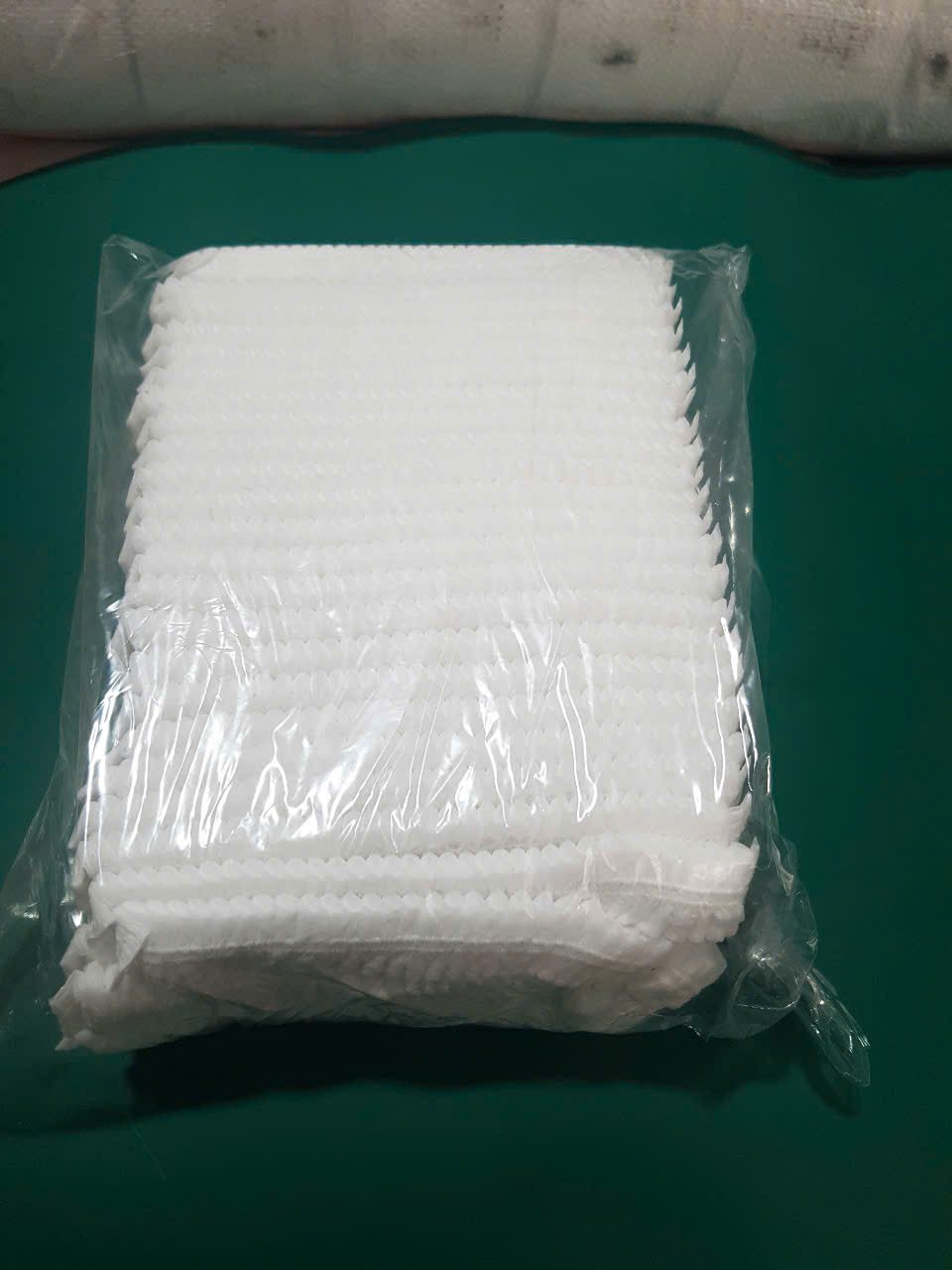
Also called: “cleanroom hair cover”, “caterpillar cap”, “shoe covers”, “medical shoe covers” — what is different: both disposable types and washable ESD fabric types, packed in warehouse-standard bags of 100.
Delivery: in stock, delivered within 24–48 hours (Ho Chi Minh City, Binh Duong, Dong Nai); lead time for large quantities confirmed at quotation.
Supplies for the cleanroom entrance: caps to cover hair and shoe covers so visitors and maintenance staff can enter clean areas without a full garment. Disposable nonwoven PP caps for visitors; washable ESD carbon-stripe fabric caps for operators; thin PE shoe covers for dry areas, thick anti-slip CPE for wet areas.
Company logo printing available on request.
| Item | Nonwoven cap CH-01 | ESD fabric cap CH-ESD | PE shoe cover SC-01 | CPE shoe cover SC-CPE |
|---|---|---|---|---|
| Material | Nonwoven PP 12 g/m² | Polyester + 5 mm carbon stripe | PE 2.5 g | CPE, textured sole (weight per supplier lot) |
| Size | 19–21″ | S/M/L, drawstring | 15 × 40 cm | 15 × 41 cm |
| ESD | No | 10⁶–10⁹ Ω | No | No (ESD optional) |
| Use | Single use | Washable ≥ 50 times | Single use | Single use |
| Color | White / blue | White / blue | Blue | Blue |
| Packing | 100/bag · 20 bags/carton | 10/bag | 100/bag · 20 bags/carton | 100/bag · 10 bags/carton |
| MOQ | 1 carton | 20 pcs | 1 carton | 1 carton |
Choose by user
– Visitors, contractors on short visits → nonwoven cap + PE shoe covers.
– Daily EPA operators → ESD fabric cap + ESD slippers (SL-PVC) instead of shoe covers.
– Note: ordinary (non-ESD) PE/CPE shoe covers are insulators and must not replace ESD shoes/slippers on an ESD floor.
– Wet floors, cold stores → anti-slip CPE shoe covers.
– ISO 5–6 cleanrooms → hooded coverall (CA-1P) + boots, no shoe covers.
Documents per lot: RoHS, CO/CQ; sample 10 pcs.
Repeat orders: price held for 6 months, minimum stock of 1 carton per type.
FAQ
– Are PE shoe covers slippery on epoxy floors? — They can be; on glossy floors use CPE with a textured sole.
– Does the nonwoven cap cover all the hair? — The 21″ cap is for long hair; women with long hair should tie it up first.
– Does the ESD fabric cap need to be grounded? — No; the cap only reduces static generated by hair, it is not a path to ground.
– Do you have ESD shoe covers? — Yes, CPE with a trailing conductive strap, order 7 days in advance.
Why cover hair and shoes at the cleanroom entrance?
In a cleanroom, people themselves are the largest source of contamination: shed hair, dandruff, skin flakes, lint from clothing and dirt under shoe soles. U.S. FDA guidance requires garments to cover skin and hair, forming a barrier between the body and the product. EU GMP Annex 1 (2022) states that even at the lowest grade (Grade D), hair and beards must be covered and dedicated disinfected shoes or overshoes must be worn.
Electronics plants add a static factor: in the triboelectric series published by the ESD Association (ESDA), human hair sits on the positive side, near the top — meaning hair charges very easily when rubbed against caps and garments made of synthetic fibers.
Materials: nonwoven PP, PE film and CPE
- Nonwoven PP cap (spunbond): polypropylene pellets are extruded into fibers and laid directly into a web, bonded by heat — no weaving step, so it is cheap, light and breathable, ideal for single use. 12 g/m² is a light grade, enough to cover hair for visitors and short-term entrants. Where better particle barrier is needed, SMS fabric (spunbond – meltblown – spunbond) with an ultra-fine fiber middle layer is available on the market.
- ESD fabric cap: filament polyester blended with carbon yarn, washable, reduces charge from hair for operators who wear it every day.
- PE shoe covers: thin, waterproof, cheap film — but with a slippery surface.
- CPE shoe covers: thicker, more flexible film with a textured sole for better floor grip; suits wet floors and glossy epoxy floors.

Choosing caps and shoe covers by area
| Area | Head cover | Foot cover |
|---|---|---|
| Visitors, short-visit contractors, non-ESD areas | Nonwoven cap CH-01 | PE shoe covers (dry floor) or CPE (wet, glossy floor) |
| EPA with ESD floor, daily operators | ESD fabric cap or baseball cap CH-CAP | ESD shoes/slippers or ESD shoe covers with conductive strap — not ordinary PE shoe covers |
| ISO 7–8 cleanroom | Fabric hood cap or nonwoven cap | Shoe covers or dedicated cleanroom shoes |
| ISO 5–6 cleanroom | Hood with shoulder cape CH-HOOD | Cleanroom boots, trouser legs tucked inside the boots |
Ordinary shoe covers break the static discharge path
In EPAs that ground operators through an ESD floor + ESD footwear system, ordinary PE/CPE shoe covers are an insulating layer between the shoe sole and the floor: charge on the body no longer has a path to ground. ESDA advises avoiding insulating footwear when handling exposed static-sensitive components. So visitors entering an EPA in PE shoe covers must wear a grounded wrist strap when touching product, or use ESD shoe covers with a conductive strap tucked into the shoe, in contact with the skin/sock.
On safety: cleanroom soles should be smooth so they do not carry dust in, but they must not be slippery. On epoxy floors, glossy vinyl floors and wet floors, use CPE shoe covers with a textured sole.
Correct donning and doffing sequence
- Tie up long hair, put the cap on first, and pull the rim down to cover the fringe, sideburns and ears.
- Sit on a chair (or the step-over bench), put on shoe covers one foot at a time, placing each covered foot on the clean side.
- Wash or sanitize hands after touching shoes.
- On exit: remove shoe covers at the boundary line, then the cap, and put them in a lidded bin. Do not walk out into the corridor in used shoe covers and caps and then come back in.
Storage and common mistakes
- Keep bags sealed until use, in a dry, dust-free place; put cap and shoe cover dispensers right at the gowning room door.
- Disposable caps and shoe covers — do not reuse; replace immediately if torn (FDA requires torn or damaged garments to be replaced immediately).
- Wearing the cap with the fringe or nape exposed — the most common mistake among female operators with long hair.
- Walking on an ESD floor in ordinary PE shoe covers and assuming you are grounded.
- Wearing shoe covers outdoors or through dirty areas and then returning to the clean area.
Technical references
- U.S. FDA – Guidance: Sterile Drug Products Produced by Aseptic Processing
- European Commission – EU GMP Annex 1 (2022), section 7: cleanroom garments
- ESDA – Fundamentals of ESD, Part 1: An Introduction to ESD
- ESDA – Fundamentals of ESD, Part 3: Basic ESD Control Procedures and Materials
- Wikipedia – Nonwoven fabric (spunbond, SMS)
- Wikipedia – Cleanroom (ISO 14644-1 and FED-STD-209E classes)
Price: from 1,500 VND (excl. 8% VAT).
REQUEST A QUOTE: send the monthly quantity of each type — PRIMEAG quotes within 30 minutes.
Hotline/Zalo +84 906 108 292 · info@primeag.vn
Written by the PRIMEAG engineering team.
Related guides:Cleanroom Boots Cracking, Peeling or Slipping in Wet Areas:…
Related products:ESD SmocksESD Shirts and Shirt-Cap SetsDisposable Non-Woven Shoe CoversHooded ESD Cleanroom Coverall
Updated: 2026-10-24
Giao tận nhà máy TP.HCM, Bình Dương, Đồng Nai, Long An, Tây Ninh · Kèm biên bản đo điện trở ESD theo lô · Hotline 0906 108 292