
Stocked item: delivered in 1–2 working days in Ho Chi Minh City, Binh Duong and Dong Nai; free delivery for orders from VND 20,000,000; defective items exchanged within 7 days. Shipping & return policy
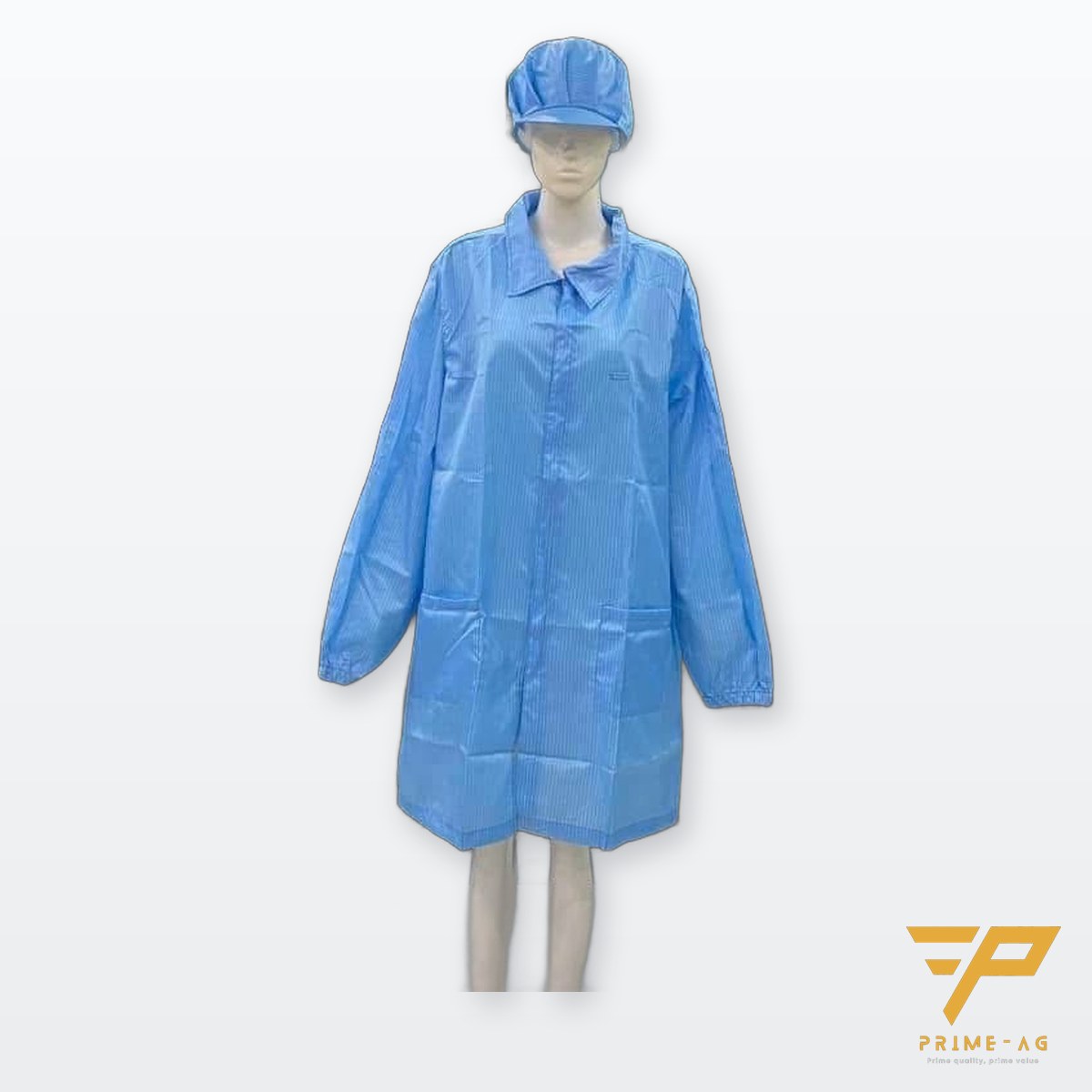
Code: CA-COAT · Specification: ESD (anti-static) smock (ESD lab coat). Delivery: in stock, delivered within 24–48 hours (Ho Chi Minh City, Binh Duong, Dong Nai); lead time for bulk orders is confirmed with the quotation.
Also known as: “ESD coat”, “anti-static lab coat”, “cleanroom jacket”, “ESD smock” — the difference: same fabric as the CA-1P suit so colours match, short-sleeved version for hot areas, 10 colours for departments, logo embroidery from 20 pieces.
Common specification: white, sky blue, navy, S–3XL.
The smock is the most common ESD garment for technicians, QC, managers, visitors and office staff coming onto the line: worn over ordinary clothes, fastened with snaps, stand-up collar, below-knee length. Polyester fabric with 5 mm carbon stripes (or check), resistance 10⁶–10⁹ Ω, sufficient for EPAs and ISO 7–8 cleanrooms when combined with an ESD cap and footwear. The short-sleeved version is for hot areas; the long-sleeved version with elastic cuffs is standard.
Company logo printing available on request.
| Item | Value |
|---|---|
| Fabric | 98 % polyester + 2 % carbon, 5 mm stripe / check, 100–110 g/m² |
| Surface resistance | 10⁶ – 10⁹ Ω (IEC 61340-4-9) |
| Style | Long sleeves with elastic cuffs / short sleeves; stand-up collar; snap buttons; 2 lower pockets, 1 chest pocket |
| Length | Below the knee, 90–110 cm depending on size |
| Size | S / M / L / XL / 2XL / 3XL / 4XL / 5XL |
| Colour | White, sky blue, navy, pink, yellow, grey, purple + check |
| Washing | 60 °C, ESD retained for ≥ 50 washes |
| Logo | Embroidery/printing from 20 pieces |
| Packing | 1 piece/bag · 25 pieces/carton |
| MOQ | 10 pieces/colour |
Choose by user
– Engineering, QC, managers entering and leaving the EPA → long-sleeved smock.
– Visitors, contractors → smock + cap + shoe covers.
– Workers seated the whole shift → two-piece suit (CA-2P) or coverall (CA-1P) for more coverage.
– ISO 5–6 cleanrooms → no smocks; use a hooded coverall.
Documents per batch: fabric resistance report, RoHS. Recurring orders: price held for 6 months.
What does an ESD smock do?
Ordinary clothing — especially synthetic fibres and wool — charges when rubbed. According to ESDA, a worker seated at a bench can reach up to 6,000 V at 10–25 % humidity. Because ordinary clothing is insulated from the skin, charge on the fabric does not drain to ground through the wrist strap, but instead creates an electric field around the work area.
An ESD smock woven with carbon fibres covers the outside and reduces the electric field from the clothing underneath — like a “Faraday cage” worn on the body. For this to work, the smock must fully cover the torso and arms near the product: all snaps fastened, sleeves down to the wrist.
Three types of ESD garment and where the smock fits
| Type (per ESDA) | How it is used | Requirement |
|---|---|---|
| 1 – Static control garment | Not grounded; the person is grounded by wrist strap/footwear | Point-to-point resistance measured per ANSI/ESD STM2.1 |
| 2 – Groundable static control garment | Garment has its own grounding point | Better electric-field shielding than type 1 |
| 3 – Groundable garment system grounding the person | Grounds the person through the garment | Total resistance person + garment + cord < 35 MΩ |
Standard smocks are used as type 1. Most ESD garments are not conductive enough to ground the person, so a wrist strap or ESD footwear on an ESD floor is still required.
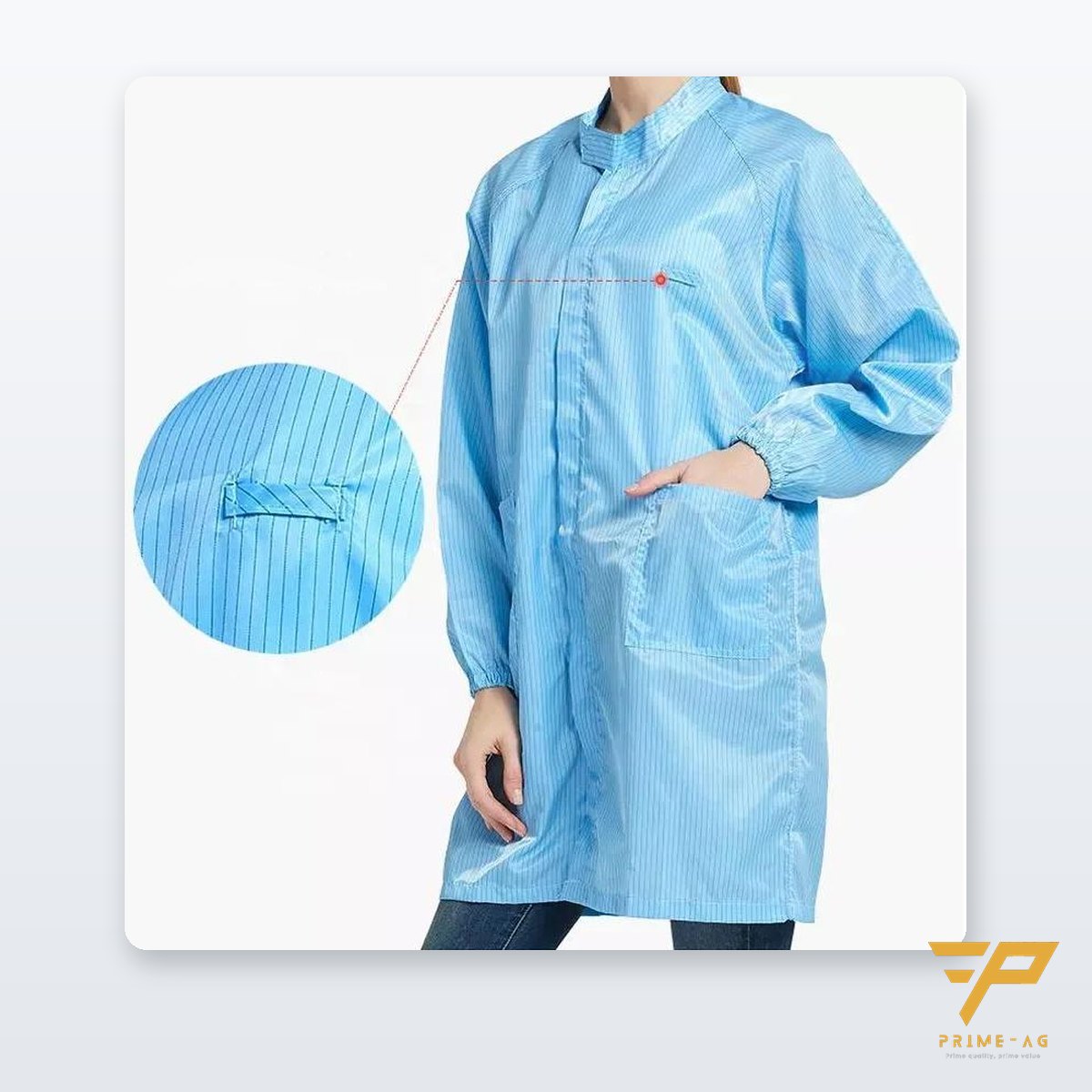
Design: why snaps, below-knee length and elastic cuffs?
- Snaps: quick on and off when entering and leaving the EPA many times a day; following lab-coat practice, snaps also allow the coat to be removed quickly in an emergency.
- Below-knee length: covers the thighs — the area that contacts the bench edge when seated at work.
- Elastic cuffs: keep sleeves from dangling onto components and equipment, and keep ordinary sleeves underneath from showing.
- Stand-up collar: covers the collar of the clothing underneath.
Smocks in cleanrooms
Smocks suit EPAs and ISO 7–8 cleanrooms, where general protective garments are sufficient. A smock is open at the bottom and has no attached hood, so it is not for ISO 5–6 — those areas need the CA-1P hooded coverall, boots and a hood with shoulder cape. Pharma reference: at higher grades, EU GMP Annex 1 requires garments with wrist cuffs and a high neck, and at the highest grade, a hood tucked into the collar and trouser legs tucked into boots.
Periodic testing and washing
- Measure point-to-point resistance (e.g. sleeve-to-sleeve) per ANSI/ESD STM2.1 or IEC 61340-4-9 on receipt and periodically; record by garment code.
- Wash separately from ordinary clothes, without fabric softener or bleach; check the snaps after washing — broken snaps mean the smock cannot be fully closed.
- Annex 1 recommends defining a maximum number of wash cycles and replacing garments when damage is found.
Common mistakes
- Wearing the smock with the front snaps open — ordinary clothing is exposed right where it is closest to the product.
- Rolling sleeves up to the elbow, or wearing a wool jacket or windbreaker over the smock.
- Shirt collars or hoodie hoods turned out over the smock collar.
- Carrying plastic bags, paper or phones in the smock pockets — insulators that come into the EPA with the person.
- Wearing the smock to the canteen or outdoors and then returning to the line.
FAQ
- Does the smock meet S20.20? — S20.20 does not certify garments; it sets point-to-point resistance limits for garments, and the smock meets the S20.20 garment limit when measured per ANSI/ESD STM2.1. In use, it must be fully fastened and worn with a wrist strap/ESD floor; an unfastened smock loses its effect.
- Is the short-sleeved version worse for ESD? — The fabric is no worse; only the forearms are exposed, so use it where components are not touched.
- Are there separate women’s sizes? — Same size chart; women usually take S–M.
- How often to replace after washing? — Measure resistance every 6 months, replace when >10¹¹ Ω.
Technical references
- ESDA – Fundamentals of ESD, Part 1: An Introduction to ESD
- ESDA – Fundamentals of ESD, Part 3: Basic ESD Control Procedures and Materials
- ESDA – Fundamentals of ESD, Part 6: ESD Standards (STM2.1, TR2.0-01)
- Wikipedia – Antistatic device (antistatic garments)
- Wikipedia – White coat (lab coat)
- European Commission – EU GMP Annex 1 (2022), section 7: cleanroom garments
Price: from 90,000 VND (excl. 8% VAT).
REQUEST A QUOTE: send quantities by size, colour, long/short sleeves and logo — PRIMEAG quotes within 30 minutes.
Hotline/Zalo +84 906 108 292 · info@primeag.vn
Written by the PRIMEAG engineering team.
Related guides:ESD Smock Fails Sleeve-to-Sleeve Test Above 10¹¹ Ω: Causes…
Related products:ESD Shirts and Shirt-Cap SetsDisposable Non-Woven Shoe CoversCleanroom Head Covers and Shoe CoversHooded ESD Cleanroom Coverall
Updated: 2026-10-28
Giao tận nhà máy TP.HCM, Bình Dương, Đồng Nai, Long An, Tây Ninh · Kèm biên bản đo điện trở ESD theo lô · Hotline 0906 108 292