
ESD finger cots that tear, slip or leave marks are usually the wrong size, powdered or not chlorinated, worn too long, or stored somewhere hot. PRIMEAG recommends sizing by finger (M for 16–18 mm fingers), using powder-free chlorinated latex, and replacing cots when torn or at the end of the shift.
A hazy white mark on connector pins right after the automated optical inspection station often traces back to the smallest item on the bench: the finger cot. Operators, for their part, complain that cots tear, slip and make fingers sweaty.
- Size decides grip: too tight tears the tip, too loose slips off.
- Marks on boards: caused by powder, a tacky surface or aged rubber.
- Telling types apart: only ESD finger cots have resistance measured per lot.
- If the palm also touches: switch to PU fingertip-coated gloves.
Seven causes, checked in order
1. Wrong size
Size M fits fingers 16–18 mm in diameter; S is for women with small hands, L is usually for thumbs. Issue one size to a whole team and large fingers tear the tips while small fingers let the cots slide off.
2. Powdered or not chlorinated
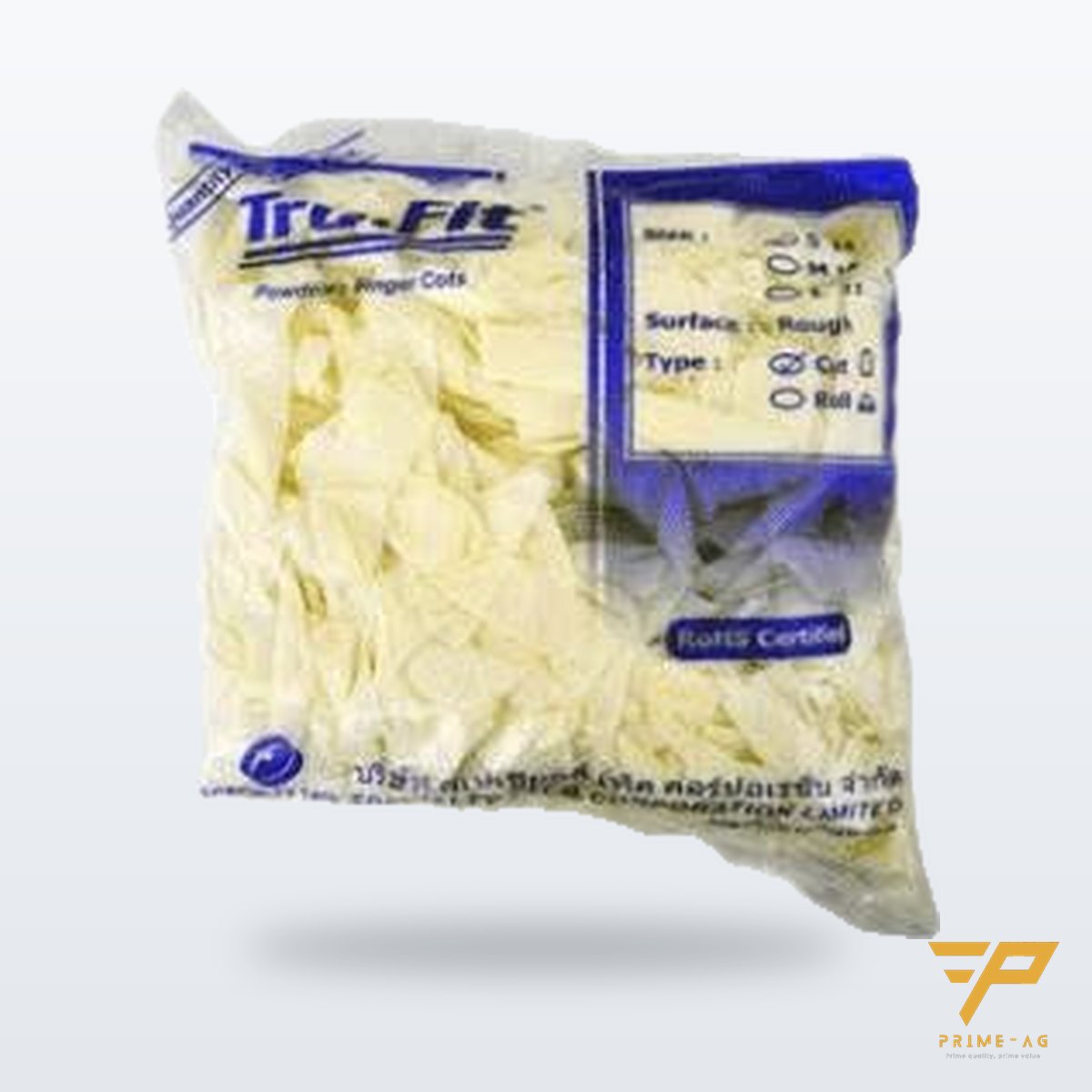
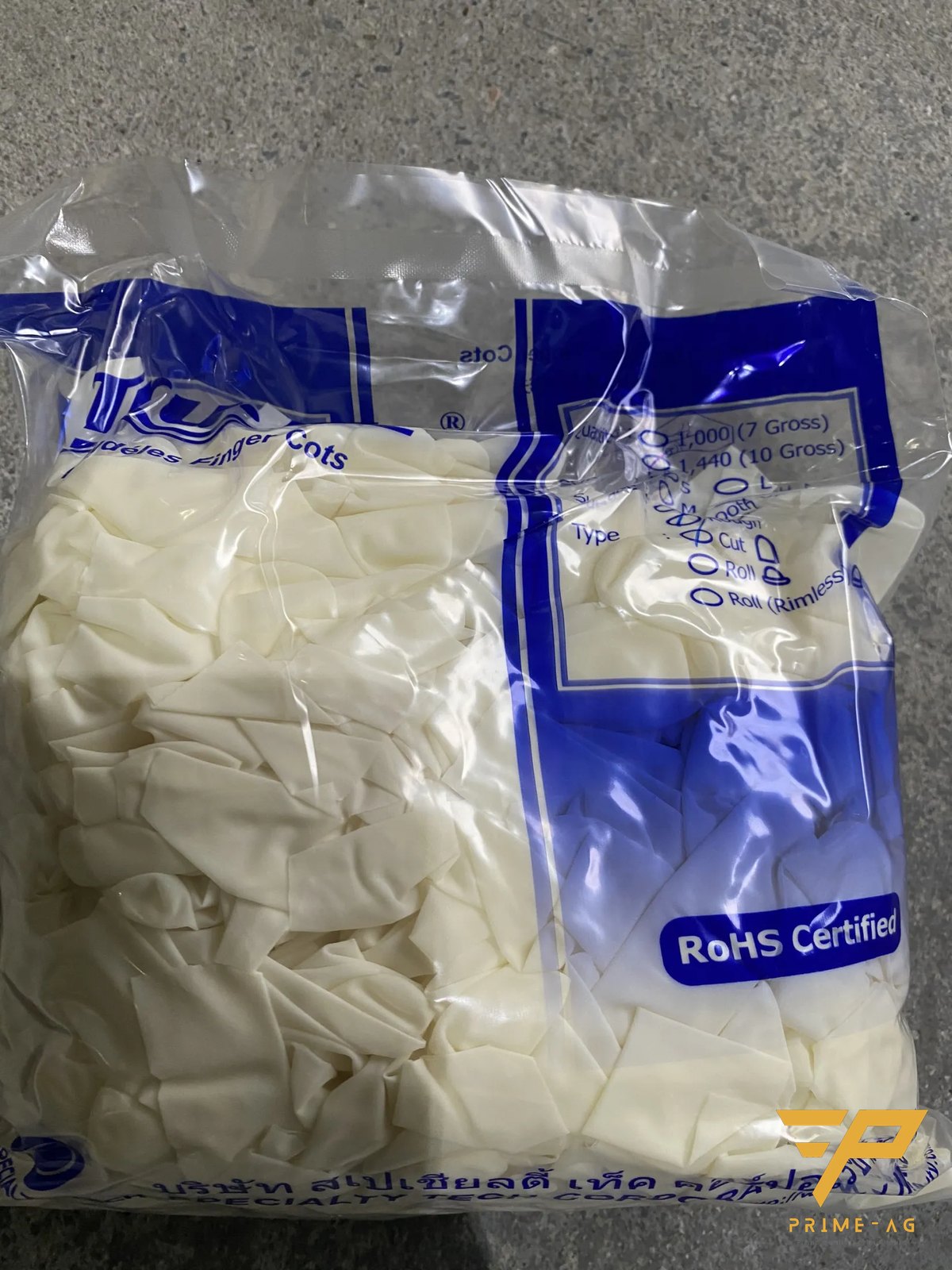
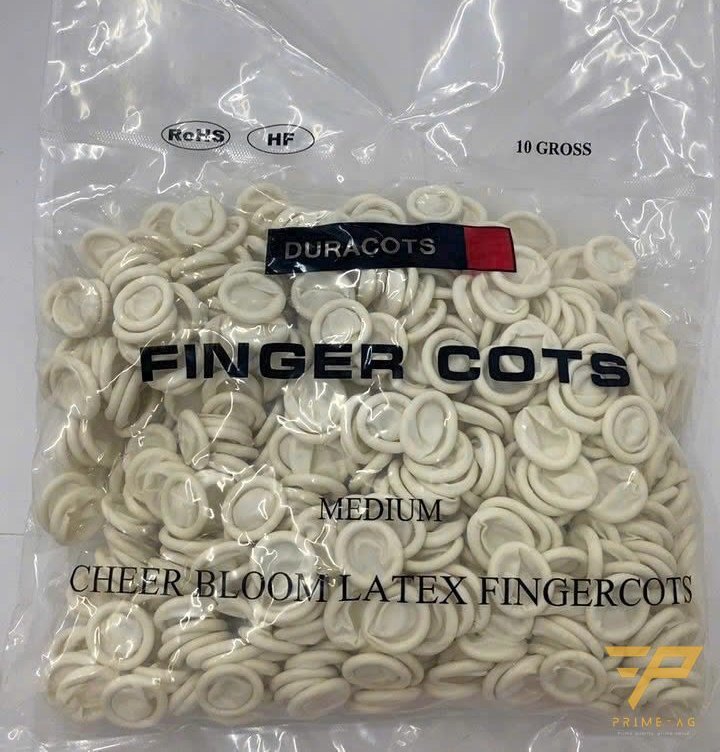
Powder is a particle source that settles on PCBs, glass and connectors as white marks. Powder-free cots that are not chlorinated have a tacky surface that attracts dust and leaves prints. Trufit ESD finger cots are powder-free natural latex, chlorinated, 0.08–0.10 mm thick, Class 100 cleanliness.
3. Rolled rim not fully unrolled
The remaining roll forms a tight ring that stretches the tip, so it tears and slips easily. Unroll all the way to the base of the finger.
4. Long nails, sharp edges
Long nails puncture the tip when putting a cot on; board edges and component leads cut the sides.
5. Worn too long
Sweat softens and stretches latex, making it stuffy and loose. Replace when torn or at the end of the shift; operators with very sweaty hands should change mid-shift.
6. Hot storage
Stored under a metal roof, next to hot machines or in sunlight, rubber turns brittle and tacky. Store in a cool, dry place and use the oldest lot first.
7. Latex allergy
If skin itches or reddens after a few days of wear, switch that person to latex-free nitrile finger cots (order in advance).
ESD finger cots vs. regular finger cots
Regular latex is insulating: the wrist strap still grounds the person, but the fingertip touching the component is blocked by an insulating layer. Trufit ESD cots have a measurable resistance, printed on the lot CoA; regular cots only reduce powder and lint. When ordering, ask for the CoA.
Finger cots are only one link in the workstation. To find out whether your bench tops, mats and wrist straps still pass, plants in Ho Chi Minh City, Binh Duong or Dong Nai can book a free on-site measurement by PRIMEAG of the ESD materials in use, including items bought elsewhere, with no obligation to buy; the readings are for reference only.
Choosing by process
| Process | Type | Notes |
|---|---|---|
| SMT, board handling, cleanroom | Plain Trufit, powder-free | S/M/L, 1,440 pcs/bag |
| Reel handling, grip needed | Yellow band, textured surface | Basic anti-static, 500 pcs/bag |
| Latex allergy | Latex-free nitrile | Order in advance |
| Whole hand touches the product | PU fingertip-coated gloves | 10⁵–10⁸ Ω per test report |
When to switch to gloves
If the palm also makes contact, or cots must be changed constantly, use Carbon Top PU fingertip-coated gloves, still worn with a wrist strap; failures specific to this type are covered in PU fingertip-coated gloves peeling or wearing through at the fingers. Where shirt cuffs must be covered, use 12-inch cleanroom nitrile gloves; if these tear in large numbers, read nitrile gloves tearing at the fingertips in bulk. Marks already printed on boards or glass can be wiped off with polyester 1009 cleanroom wipers and IPA.
Where to start
- Collect the failed cots from one shift and sort them into torn tip, torn side and slipped off.
- Measure a few operators’ fingers and reassign sizes.
- Move finger cot bags away from hot spots.
- Request a 50-piece sample to test on the line.
Trufit comes in bags of 1,440 pcs, MOQ 1 bag, with CoA (resistance, ions, particles) and RoHS. Send your process and headcount via the consultation page for a quote within 30 minutes.
Frequently asked questions
- Which fingers should wear ESD finger cots? — Thumb, index and middle fingers – the three that touch components most; size L is often used for the thumb.
- How can I tell if finger cots are really ESD-safe? — Ask for the lot CoA. ESD cots have a resistance value on the CoA; cots without a measured value cannot be used as a substitute in an EPA.
- Do finger cots smell of rubber or leave powder? — Powder-free chlorinated latex is almost odorless and leaves no powder. If you still see powder on boards, check which type is being issued to the line.
Updated: 2026-10-28 — PRIMEAG engineering team
Email: info@primeag.vn · Phone/Zalo: +84 906 108 292
Written by the PRIMEAG engineering team
Updated: 2026-10-29