
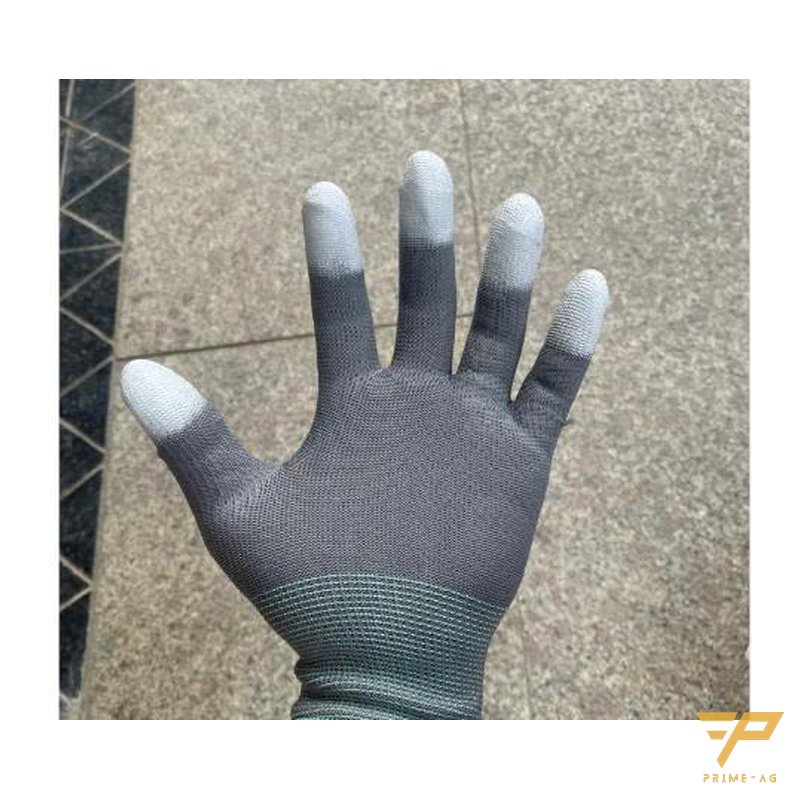
When PU fingertip-coated gloves peel or wear through after one shift in a Vietnam factory, the usual cause is a task beyond what the glove can handle: Grey/White Top gloves rated EN 388 3131 have only cut level 1, oversized gloves fold at the fingertips, and solvents or heat weaken the PU. PRIMEAG recommends checking the six causes in order and replacing gloves when the PU wears through to the fabric, typically after 1–2 days.
New gloves are issued at the start of the shift, and by lunchtime some pairs already have PU peeling off the index finger and the fingertip showing through. Do not rush to change suppliers; first look at how the gloves are being used.
- Fingertip-coated gloves are for dexterity and keeping the product clean, not for handling sharp edges.
- Check in turn: the task, glove size, chemicals, heat, re-washing, coating type.
- Replace every shift or when the PU wears through to the fibers; typically 1–2 days.
- Worn Carbon Top gloves in the EPA must have their resistance re-measured.

What fingertip-coated gloves can withstand
Grey Top PU fingertip-coated gloves and White Top white PU fingertip-coated gloves share the same 13G polyester liner and EN 388 rating of 3131.
Reading the code: abrasion level 3 (minimum 2,000 cycles, tested on the coated area), cut level 1, tear level 3 (50 N), puncture level 1 (20 N). Carbon Top reaches only abrasion level 2, minimum 500 cycles.
Six causes, checked in order
1. The task exceeds the glove’s EN 388 rating
Cutting tape, handling stamped blanks, plastic flash, rubbing rough housings. Sign: a clean tear exactly on the finger that touches the edge.
2. Gloves too large
Issuing size M to the whole line is a common mistake. Oversized gloves shift the PU fingertip out of place, leave excess fabric and cause rubbing at the folds. Choose by palm circumference; White Top is also available in XS.
3. Contact with IPA, flux, adhesive or oil
Solvents and flux can soften and swell the PU until it peels off in patches. Replace the gloves immediately after contact with these substances.
4. Heat in the soldering area
Touching the soldering iron tip or handling boards straight out of the oven scorches the PU, and the polyester liner can melt; the hole has hard edges.
5. Washing and reusing
Repeated washing and hot drying make the PU stiff, crack and peel.
6. Wrong coating style for the process
Carrying trays and lifting cartons wears through the uncoated palm within a few hours. These processes should use white PU palm-coated gloves, EN 388 4131, abrasion level 4.
| Symptom | Common cause | Fix |
|---|---|---|
| Clean tear on the index finger or thumb | Sharp edges | Cut-resistant gloves for that process |
| Wear at the fingertip folds | Gloves too large | Measure hands and redistribute the size mix |
| PU peeling in patches, soft, sticky | IPA, flux, adhesive | Separate gloves for the solvent wiping area |
| Palm worn through, fingertips still fine | Lots of gripping, tray carrying | Switch to palm-coated gloves |
Carbon Top in the EPA: still conductive once worn?
Grey Top and White Top are not antistatic. In the EPA, use Carbon Top ESD fingertip-coated gloves, resistance 10⁵–10⁸ Ω per the lot test report. For heavy gripping in the EPA, choose Carbon Palm palm-coated gloves, with the same resistance range.
When carbon gloves are worn, have broken fibers, are contaminated with flux or have been washed many times, their resistance changes. Test on the line: wear the wrist strap snug against the skin, put on the glove and touch the wrist strap tester with a gloved finger; reject it if it fails. Glove test method: ANSI/ESD STM15.1.
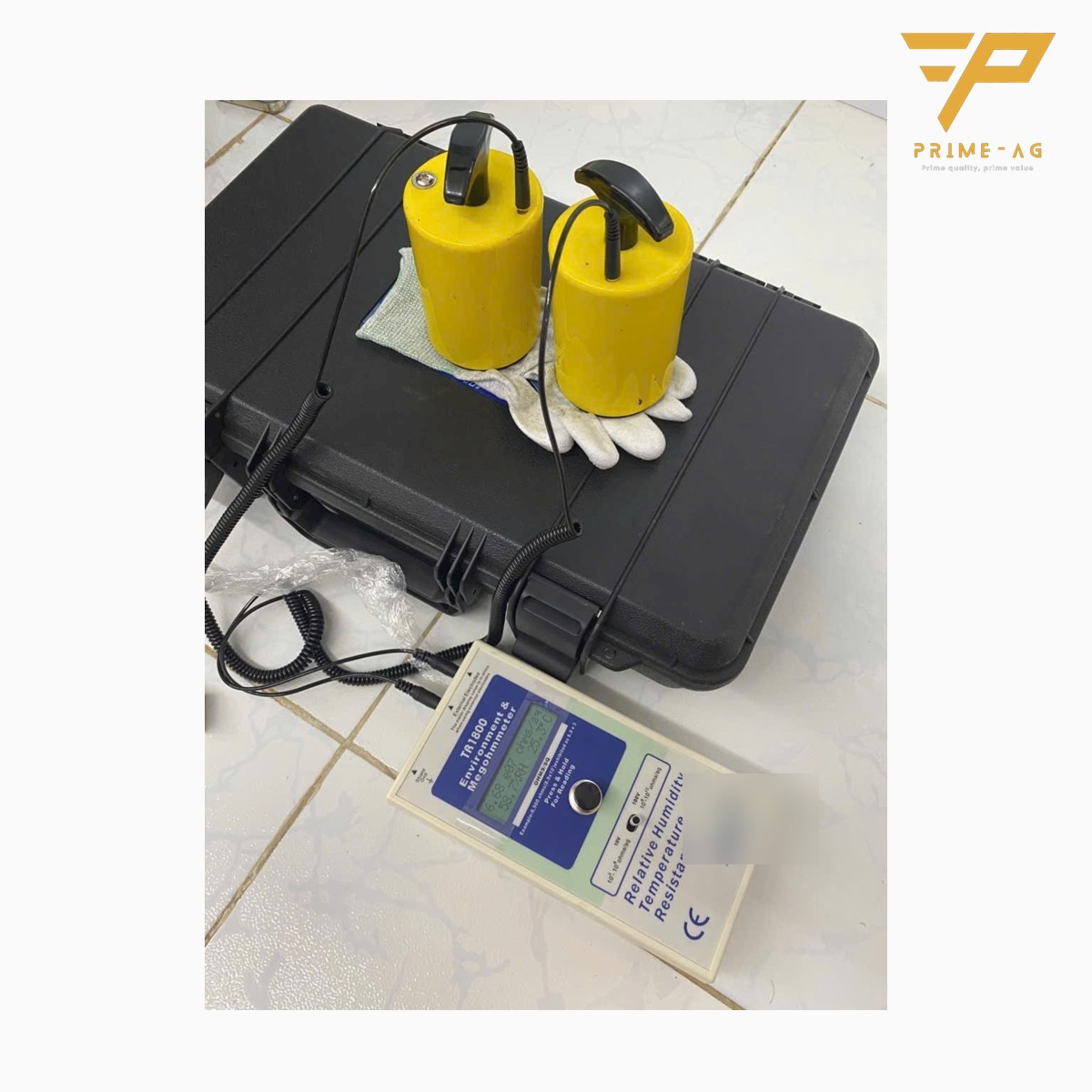
To find out whether worn carbon gloves, and the bench tops and mats where components are placed, still pass, PRIMEAG can bring a TR1800 meter and 5 lb electrode to factories in Ho Chi Minh City, Binh Duong or Dong Nai, Monday to Saturday, to measure the resistance of gloves, benches and mats in use free of charge, wherever those materials were bought; any number of points, no order commitment, and within 3–5 working days the factory receives a PDF file with readings for each location and illustrative photos, for reference only and not a substitute for audit documentation.
If you only need to cover three working fingers, use Trufit ESD finger cots; remove the finger cots for the start-of-shift wrist strap test.
Where to start
- Collect the damaged gloves from one shift, sort them by where the damage is and match them to the process.
- Measure workers’ hand circumference before ordering the next lot.
- Set rules for when to change: start of shift, after breaks, when visibly dirty.
Nitrile gloves tearing at the fingertips have different causes: cleanroom nitrile gloves tearing at the fingertips in large numbers. All 12 glove types: choosing gloves by process in electronics factories.
Frequently asked questions
- How long do PU fingertip-coated gloves last? — There is no fixed number of shifts. Replace them every shift or when the PU at the fingertips wears through to the fabric, typically after 1–2 days; replace immediately if they get adhesive, flux or oil on them.
- Can PU fingertip-coated gloves be washed and reused? — Grey/White Top 1–2 times, Carbon Top 3–5 times, in 40 °C water; the PU will stiffen and lose grip. Carbon gloves must have their resistance re-measured after every wash before going back to the line.
- Can Grey Top and White Top gloves be used in an EPA? — Not in areas with exposed components. These two products have a polyester liner and standard PU, and are insulating; in the EPA use Carbon Top or Carbon Palm together with a wrist strap.
Email: info@primeag.vn · Phone/Zalo: +84 906 108 292
Written by the PRIMEAG engineering team
Updated: 2026-10-27