
Stocked item: delivered in 1–2 working days in Ho Chi Minh City, Binh Duong and Dong Nai; free delivery for orders from VND 20,000,000; defective items exchanged within 7 days. Shipping & return policy
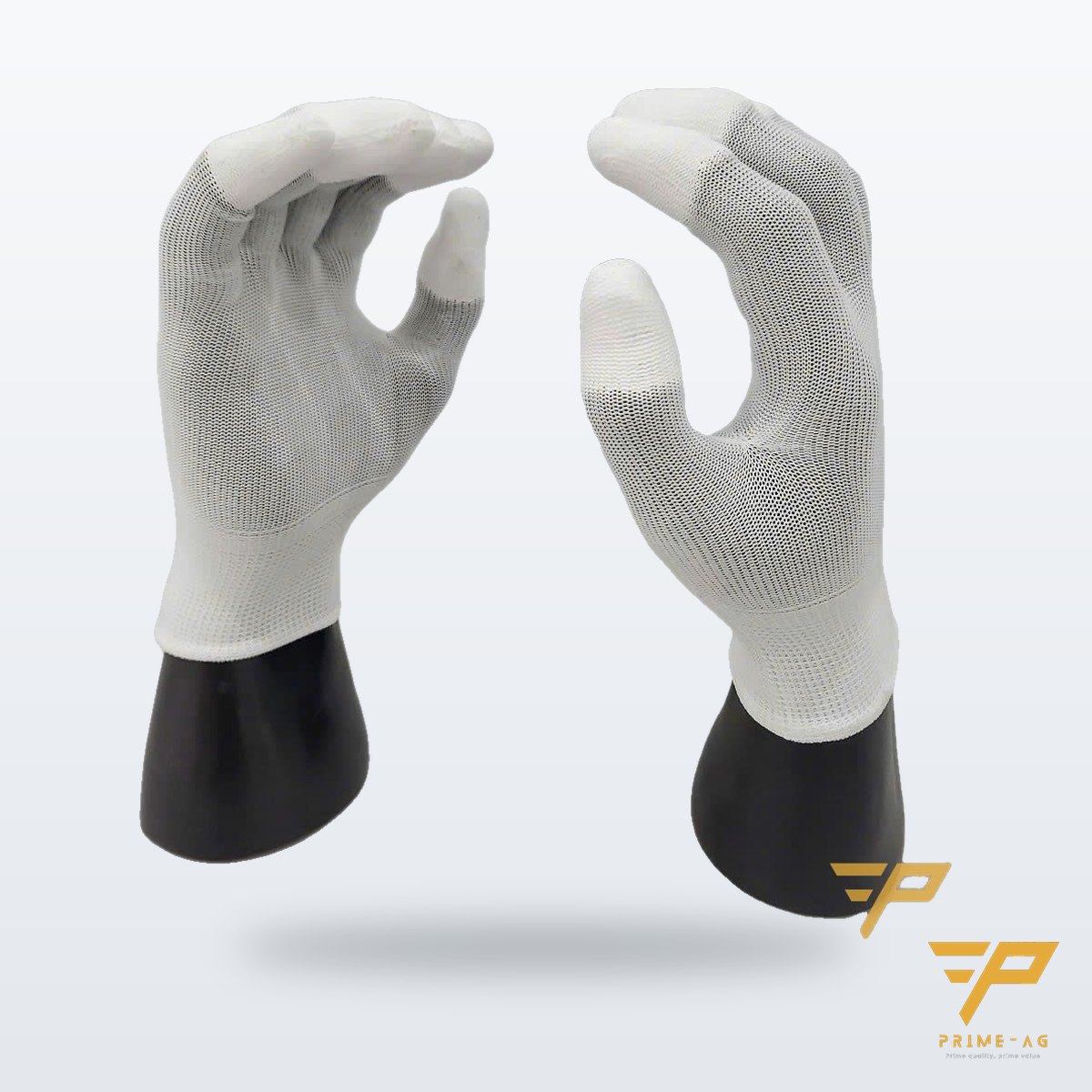
Product code: GP-W · Specification: White Top gloves with white PU fingertip coating
White Top PU Fingertip-coated Glove, 13G polyester
Equivalent to: “White Top”, “white fingertip-coated gloves”, “white PU fingertip gloves” — what is different: available in both standard and Overlock (serged cuff, no fraying threads) versions, full size range including XS for female workers with small hands, standard 100-pair cartons for warehouse handling.
Delivery: in stock, delivered within 24–48 hours (Ho Chi Minh City, Binh Duong, Dong Nai); lead time for bulk orders is confirmed with the quotation.
What is White Top? It is a white 13G polyester liner glove with PU coating on the 5 fingertips only. It has the same construction as Grey Top, but is white so that dirt shows up: supervisors can see at a glance that a glove is dirty and needs changing — the reason many Japanese and Korean factories specify white gloves for visual inspection, finished-goods packing and white rooms. This is the highest-consumption glove in the PU-coated group, with typical demand of 20,000–40,000 pairs/month for a factory of 1,000 workers.
| Item | Value |
|---|---|
| Liner | Seamless knitted 13G polyester, elastic knit cuff; Overlock version with serged edge |
| Coating | PU on all 5 fingertips, thin, no smearing |
| Colour | White (liner and PU) |
| ESD | Not measurable (choose Carbon Top if your audit requires it) |
| Sizes | XS / S / M / L / XL |
| Liner knit gauge | 13G (13 needles/inch) |
| Standards | EN 388 3131, EN ISO 21420:2020 (replaces EN 420), RoHS — checked against the supplier’s certificates per lot |
| Packing | 10 pairs/bag · 100 pairs/carton · ≈ 2.5 kg/carton · 48 cartons/pallet |
| MOQ | 1 carton |
Standard vs Overlock? The standard version has a conventionally sewn cuff edge and costs about 5 % less; the Overlock (serged) version locks the edge so threads do not fray onto the product and it lasts longer over several shifts. For areas with exposed components or optics → choose Overlock.
Selection by process step
– Visual inspection, finished-goods packing, white rooms → White Top (this item).
– General assembly, ordinary workshops, no need to show dirt → Grey Top (GP-F), about 5 % cheaper.
– Frequent handling, grip needed → White Palm with palm coating (GP-P).
– EPA areas requiring resistance measurement → Carbon Top (GC-O).
Documents per lot: RoHS, CO/CQ; free 5-pair trial sample.
Scheduled orders: monthly scheduled deliveries, price held for 6 months, minimum stock of 5 cartons of size M for customers using >10,000 pairs/month.
FAQ
– Do white gloves get dirty faster? — They get just as dirty, but it shows more clearly; that is the purpose — change them at the right time and never let a dirty glove touch the product.
– Who is size XS for? — Hand circumference under 17 cm, typically female workers; many electronics plants need 20–30 % of sizes XS/S.
– Do they shed lint? — The liner is seamlessly knitted, not cut and sewn, so lint is very low; ISO 5 cleanrooms should use nitrile.
– Can they be washed and reused? — Yes, 1–2 times at 40 °C, but the PU gradually stiffens; most factories use them for 1–2 shifts and then replace them.
How does fingertip coating differ from palm coating?
White Top is dipped in PU only at the 5 fingertips; the palm and back of the hand are bare liner fabric. This construction has three consequences:
- The most sensitive and breathable of the coated gloves: most of the hand has no coating film, so sweat escapes quickly — suitable for wearing a full shift in a hot workshop.
- Grip at the contact points: the fingertips are what touch components, housings and displays; the PU layer increases friction and stops oil and sweat on the fingertips transferring to the product surface.
- Not suitable for heavy handling: the palm is uncoated and wears quickly when carrying cartons and trays — use White Palm (GP-P) for those tasks.
In textile terms, a 13G liner means 13 needles per inch. According to SHOWA, this is the “balance” point between durability and dexterity; for handling very small components, thinner 18–21 gauge gloves are more sensitive.
Why do Japanese and Korean factories specify white gloves?
White gloves are a visual management tool: dirt, oil and metal dust show up immediately against the white background, and team leaders can see at a glance that a glove needs changing. In visual inspection areas, dirt on a glove means dirt about to transfer to the product. White gloves should therefore go together with clear change rules (start of shift, after breaks, when moving between process steps, or when dirt is visible) — otherwise the white colour is merely cosmetic.
Liner yarn, lint and the cuff edge
According to SHOWA, staple yarn has many free fibre ends that break easily and shed lint; continuous filament yarn sheds almost no lint and is therefore used for electronics. In a seamless knitted glove, the cuff edge is the only cut edge — the Overlock version serges the edge so the yarn ends do not fray. Even so, knitted gloves are not cleanroom gloves; ISO 5 areas use cleanroom nitrile gloves (GN-12).
Reading EN 388 3131 and the EN ISO 21420 requirements
| Digit | Property | Level | Threshold per EN 388 |
|---|---|---|---|
| 3 | Abrasion | 3 | ≥ 2,000 cycles |
| 1 | Cut (coup test) | 1 | Lowest level |
| 3 | Tear | 3 | ≥ 50 N |
| 1 | Puncture | 1 | ≥ 20 N |
Conclusion: the gloves resist scuffing and dirt well but are not cut resistant. Under EN ISO 21420:2020 (replacing EN 420), PU materials must have residual DMF solvent < 1,000 mg/kg and a pH of 3.5–9.5. The size table in this standard: size XS corresponds to a hand circumference of 152 mm, S 178 mm, M 203 mm — the difference between adjacent sizes is about 25 mm, so measure workers’ hands before setting the size split.
White gloves and ESD protected areas (EPA)
- White Top uses a standard polyester liner and standard PU: it has no charge-dissipation path and cannot be measured using ESD glove test methods.
- ESD gloves are evaluated to ANSI/ESD STM15.1, which includes in-use measurement while the glove is worn, using an electrode of fixed area and force.
- Even ESD gloves do not replace a wrist strap. The wrist strap must be worn in direct contact with the skin, not over the glove — wearing it over the glove increases the series resistance and the body voltage.
Use, washing and service life
- Replace immediately when the fingertips wear through to the yarn or the PU layer peels — peeled spots collect dirt and lint.
- If washing for reuse: wash gently at low temperature (makers such as Ansell recommend 40 °C for PU-coated gloves) and do not tumble-dry hot; cleanrooms and visual inspection areas should use new gloves.
- Do not use fingertip-coated gloves for oily parts: PU loses grip when oil is present.
Common mistakes
- Using White Top for handling cartons — the bare palm wears through after a few hours.
- Issuing white gloves without defining when to change them.
- Wearing gloves that are too large: the PU-coated tips do not sit on the fingertips and the grip is lost.
Technical references
- SHOWA – Fiber foundations: staple, filament and gauge
- SATRA – EN 388:2016+A1:2018 (gloves protecting against mechanical risks)
- Wenaas – EN ISO 21420:2020 (replacing EN 420): general requirements, size table
- ESDA – ANSI/ESD STM15.1 (resistance testing of gloves and finger cots)
- ESDA Forum – Best practices for ESD gloves
- Ansell – HyFlex 11-600 (PU-coated glove, EN 388 data)
Price: from 3,600 VND (excl. 8% VAT).
REQUEST A QUOTE: send the number of pairs per month by size and type (standard/Overlock) for a carton price — PRIMEAG quotes within 30 minutes.
Hotline/Zalo +84 906 108 292 · info@primeag.vn
Written by the PRIMEAG engineering team.
Related guides:Fingerprints on Glossy Molded Parts: Glove Selection by StationPU Fingertip Gloves Peeling or Holed After One Shift:…Choosing Gloves by Process Step in Electronics Manufacturing: 12…
Related products:Carbon Palm PU Palm-Coated ESD GlovesCarbon Top ESD Gloves, PU Fingertip CoatedGrey Top PU Fingertip Coated GlovesPVC Dotted Work Gloves
Updated: 2026-10-24
Giao tận nhà máy TP.HCM, Bình Dương, Đồng Nai, Long An, Tây Ninh · Kèm biên bản đo điện trở ESD theo lô · Hotline 0906 108 292