
Made to order: delivered and installed as quoted, covered by warranty, no returns. Shipping & return policy
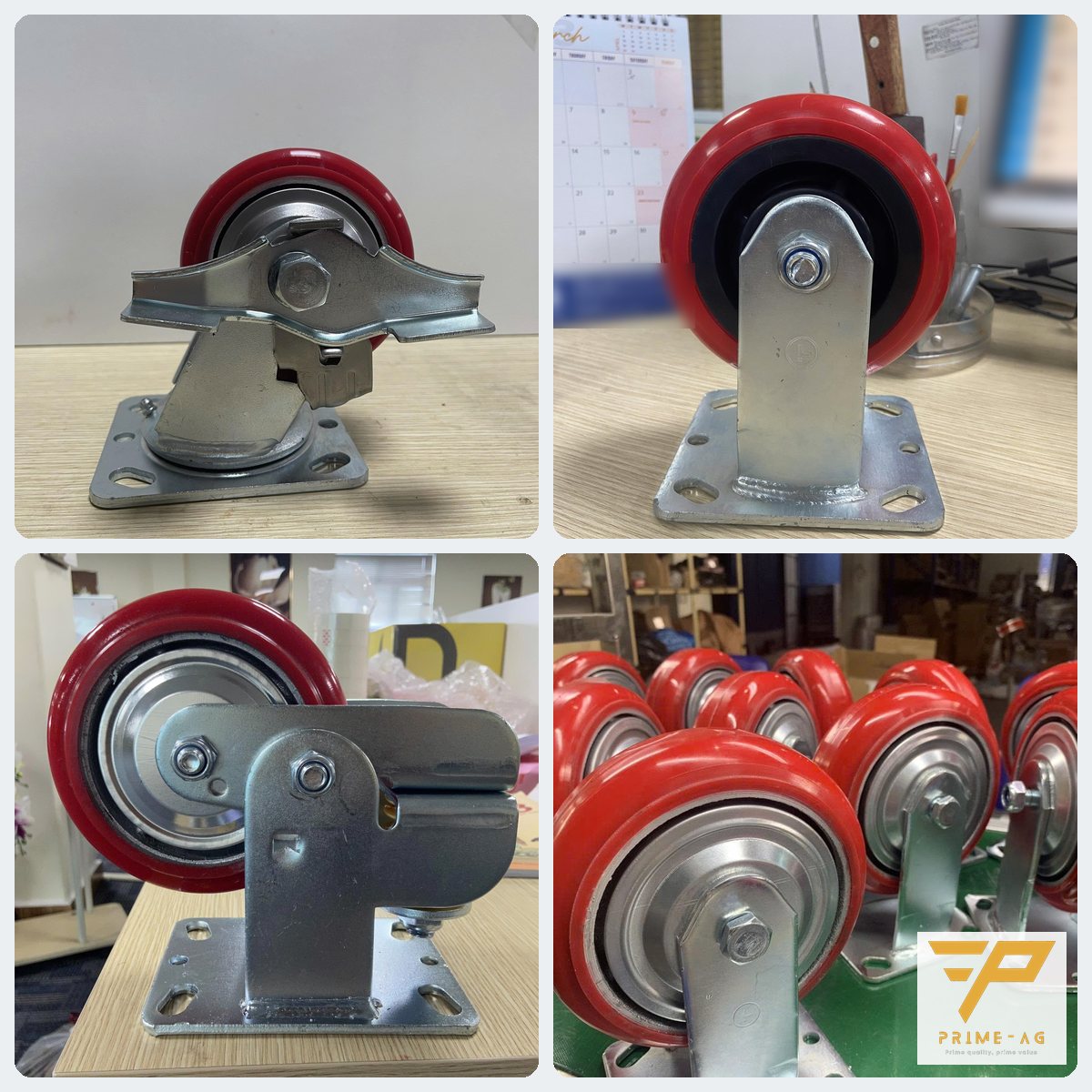
Product code: LP-WHEEL · Specification: Industrial PU / ESD castors (swivel, braked, fixed)
Industrial Casters – PU, rubber, nylon, ESD; zinc-plated or stainless steel 304
Common specifications: D75 PU swivel/braked, D100 PU, D75 ESD.
Delivery: stocked items are delivered in 24–48 hours (Ho Chi Minh City, Binh Duong, Dong Nai); made-to-order items 3–7 working days; availability is confirmed with the quotation.
Castors differ in 4 respects: material (tyre and fork), size, load capacity and operating environment. Choose correctly and the trolley pushes easily, runs quietly, lasts long and stays reasonably priced; choose wrongly and the castors wear quickly, become noisy, mark the floor or jam.
No need to choose yourself: just tell PRIMEAG about your trolley/rack/machine, the load and the floor type, and PRIMEAG will select and recommend the right castor. Or send a photo of the castor you currently use to buy exactly the same type.
Choosing the right industrial castor – quick guide
A castor consists of 3 parts: the tyre (the part rolling on the floor), the fork (the bracket holding the wheel axle) and the mounting (the part fixed to the trolley, rack or machine). Choose them in order using the 4 steps below.
Step 1 – Calculate the load per castor
Load per castor = (trolley weight + heaviest load) ÷ 3. Divide by 3 rather than 4, because floors are never perfectly flat, so usually only 3 castors carry the load. Example: a 40 kg trolley carrying 200 kg → 240 ÷ 3 = 80 kg/castor → choose a D100 castor (100–130 kg). If the trolley often crosses thresholds or rails, or is subject to impacts, go one size up.
Step 2 – Choose the size
| Diameter | Load/castor | Tyre | Fork | Mounting |
|---|---|---|---|---|
| D50 | 40 kg | PU / nylon | Swivel, braked | Plate, M10 threaded stem |
| D75 | 60–80 kg | PU, PVC, ESD | Swivel, braked, fixed | Plate, M12 threaded stem |
| D100 | 100–130 kg | PU, rubber, ESD | Swivel, braked, fixed | Plate, M12 threaded stem |
| D125 | 150–200 kg | PU, rubber | Swivel, braked, fixed | Plate |
| D150 | 250–300 kg | PU, rubber, nylon | Swivel, braked, fixed | Plate |
The larger the wheel, the easier it is to push and the better it crosses gaps and thresholds, but it also makes the trolley taller. Floors with gaps or rails: D100 minimum. A marking on the wheel such as “4×2” means a diameter of 4 inches (≈ 100 mm) and a tyre width of 2 inches (≈ 50 mm).
The load per castor in the table is a reference value and varies by manufacturer and tyre material; PRIMEAG confirms it against the catalogue of the specific model when quoting.
Step 3 – Choose the tyre material
| Tyre | Characteristics | Use when |
|---|---|---|
| PU (polyurethane) | Quiet, durable, non-marking, resistant to oil and grease | Electronics factories, epoxy floors, component trolleys, mobile racks – the default choice |
| PU on cast-iron / aluminium centre | Like PU but with higher load capacity and less deformation | Mould trolleys, machines, heavy racks |
| Grey elastic rubber (TPR) | Very smooth and quiet, good floor grip, non-marking | Hospitals, offices, cleanrooms, tiled floors |
| Standard black / red rubber | Low cost, medium load; black rubber may leave marks on light-coloured floors | Warehouses, machine shops, concrete floors |
| PVC | Cheapest, light loads, harder and more brittle when cold; develops flat spots when left standing | Light trolleys, occasional use |
| Nylon / PP (white) | Very hard, easy to push, chemical-resistant; noisy and slippery on hard floors | Wash areas, chemicals, smooth flat floors |
| Cast iron / steel | Very high load and heat resistance, but noisy and can damage floors | Drying ovens, heavy workshops (ask PRIMEAG first) |
| Conductive ESD (black / grey) | Conducts static charge to the floor; whether conductive or dissipative, and the resistance range, are per the datasheet of each model | Trolleys in the EPA; only effective when the floor is also an ESD floor |
Step 4 – Choose the fork, brake type and mounting
- Fork material: zinc-plated steel for dry environments (common, good value); stainless steel 304 for wet areas, wash-down, food, cleanrooms and mild chemicals.
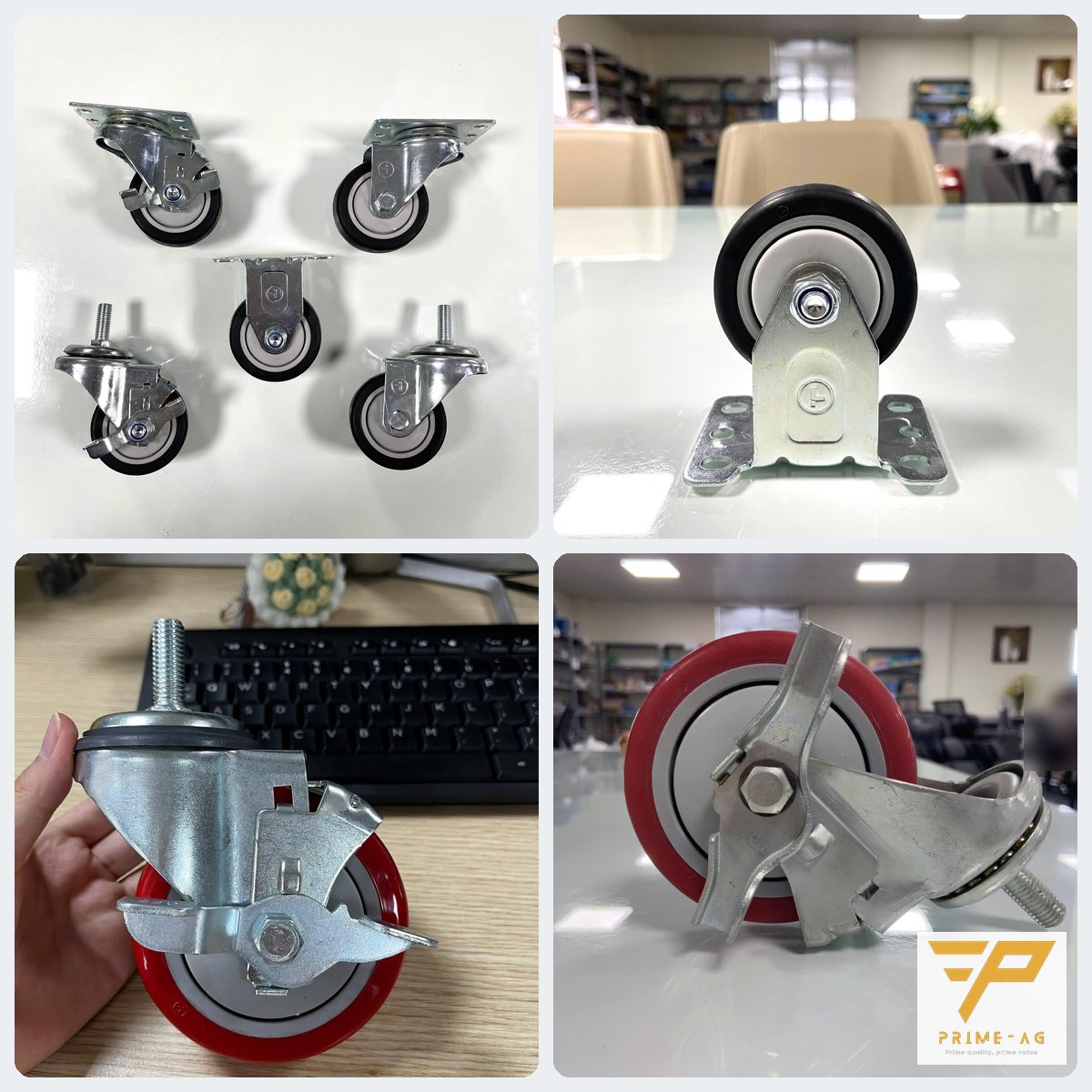
- Fork type: swivel (easy to change direction), fixed (runs straight, holds direction), swivel with brake. A wheel brake only stops the wheel from rolling; a total lock stops both the wheel rolling and the fork swivelling – the trolley stands firm while working on the line.
- Mounting type: 4-hole top plate for steel frames, racks and machines; M10/M12 threaded stem for bench legs, aluminium profiles and lean pipe; bolt hole for a through bolt. When replacing castors, measure the hole centre distance of the top plate or the size of the old thread.
- Standard trolley configuration: 2 swivel castors with brake + 2 fixed castors. Trolleys that must turn in narrow aisles: 4 swivel castors, 2 of them with brake.
Choosing by operating environment
| Environment | Recommended tyre | Recommended fork / mounting |
|---|---|---|
| Electronics factories, EPA | PU or conductive ESD | Zinc-plated steel; with a grounding chain/strap if required |
| Cleanrooms, wash-down, food, medical | PU or grey TPR rubber | Stainless steel 304 – does not rust under wet cleaning or disinfection |
| Warehouses, floors with gaps, rails, gentle slopes | Large D125–D150 wheels, elastic rubber or PU | Zinc-plated steel, heavy-gauge fork, double ball bearing |
| Offices, hospitals, quiet areas | Grey TPR rubber | Zinc-plated or stainless steel |
| Chemicals, oil and grease | PU or nylon | Stainless steel 304 |
| High temperature (near ovens, drying chambers) | Heat-resistant nylon or cast iron | Ask PRIMEAG based on the actual temperature |
Common selection mistakes
- Fitting ESD castors on a floor that is not an ESD floor – no anti-static effect.
- Using PVC or standard rubber castors for heavily loaded trolleys left standing for long periods – the tyres flatten and the trolley becomes hard to push.
- Using zinc-plated forks in wash-down areas – the forks rust within a few months and the castors jam.
- Choosing castors too small for floors with gaps or rails – the castors jam, the trolley is hard to push and loads can tip over.
- Using black rubber tyres on light-coloured epoxy floors – they leave wheel marks.
Ordering from PRIMEAG – 2 ways
Option 1 – Let PRIMEAG choose: tell us the type of trolley/rack/machine, the maximum load, the floor type, the environment (dry, humid, cleanroom, EPA, chemicals) and the mounting type (top plate or threaded stem). PRIMEAG recommends a suitable type and sends a quotation within 30 minutes.
Option 2 – Buy the type you already use: send a photo of the old castor (side view and mounting view), together with the wheel diameter, tyre width, top-plate hole spacing or thread size. PRIMEAG finds the exact model or an equivalent.
MOQ 4 castors. Send your request via Hotline 0906108292 or info@primeag.vn.
FAQ
– Are ESD castors needed on a normal floor? — They have no effect; they only work on an ESD floor.
– Do PU castors develop flat spots when left standing? — 95A PU very little; soft PVC does. For trolleys that are rarely moved, choose PU.
– What is a total lock? — It locks both rolling and swivelling; the trolley stands firm on the line.
– Are stainless steel 304 castors necessary? — Only when the trolley is often exposed to water, moisture or chemicals, or is used in areas with strict hygiene requirements; in dry environments zinc-plated is sufficient and cheaper.
– Don’t know what type your old castor is? — Send PRIMEAG a photo and we will identify it for you.
Inside a swivel castor
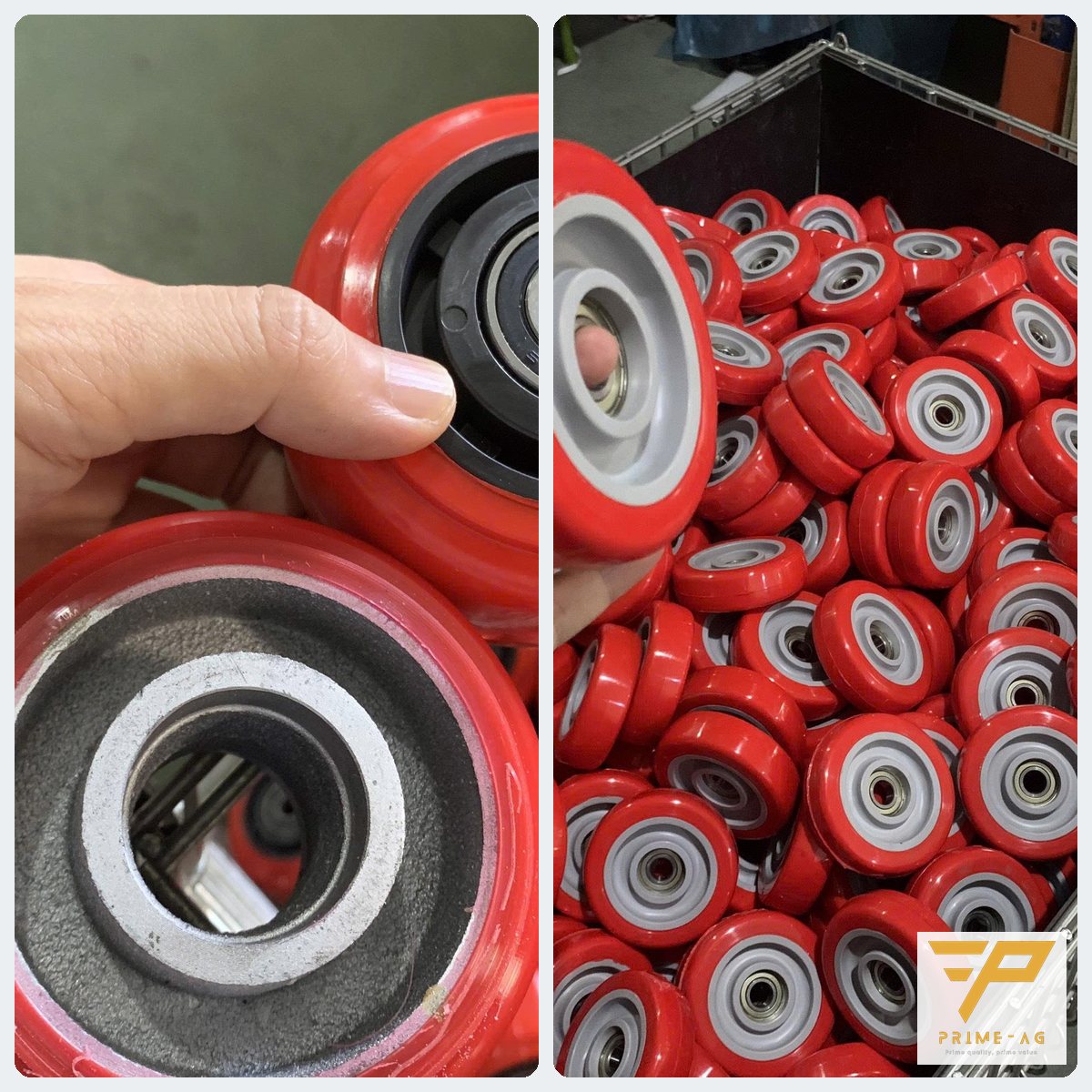
- Swivel bearing: two ball raceways between the top plate and the fork let the fork rotate 360°. The kingpin type is common and good value; the kingpinless type uses a large ball raceway, eliminating most causes of swivel bearing failure, and is used for heavy-duty trolleys subject to frequent impacts.
- Swivel offset: the wheel axle sits a certain distance behind the swivel axis. This makes the wheel automatically turn to follow the pushing direction; without the offset, the wheel does not follow but is dragged along.
- Wheel bearing: a ball bearing makes pushing easier and allows speeds above walking pace, but the permissible load decreases at higher speeds.
Castor flutter at certain speeds depends on the load and the offset. To reduce it: increase swivel bearing friction, increase the offset, use thicker grease, use a lighter wheel.
How is the rated load tested?
The load ratings in European manufacturers’ catalogues are determined by turntable tests according to DIN EN 12527–12533 (equivalent to ISO 22878–22884) under standard conditions: walking speed of 4 km/h, ambient temperature 15–28 °C, flat floor and evenly distributed load. Outside these conditions a safety factor must be applied. According to Blickle, the required load capacity per castor is:
T = (E + Z) ÷ n × S — E: trolley weight; Z: maximum payload; n: number of load-bearing castors; S: safety factor.
| Mode of movement | Environment | Obstacles | Factor S |
|---|---|---|---|
| Pushed by hand | Indoors | < 5 % of wheel diameter | 1.0–1.5 |
| Pushed by hand | Outdoors, potholes | > 5 % of wheel diameter | 1.5–2.2 |
| Towed by electric tractor | Indoors | < 5 % of wheel diameter | 1.4–2.0 |
| Towed by electric tractor | Outdoors, potholes | > 5 % of wheel diameter | 2.0–3.0 |
Example: a D100 castor regularly crossing rail thresholds higher than 5 mm already falls into the obstacle > 5 % group. This factor does not account for tyre wear. Dividing by 3 castors in Step 1 above is exactly the safe choice of n for a 4-castor trolley.
Pushing force and operator safety
- The Canadian Centre for Occupational Health and Safety (CCOHS) recommends that the whole-body force when pushing wheeled equipment while standing should not exceed 225 N (about 23 kgf); the limit must be lower when the hands are above shoulder height or below waist height, when pushing continuously for more than 5 seconds, or when pushing at an angle.
- Hard tyres (PU, nylon) roll more easily because they deform less; soft tyres are quieter but harder to push.
- Large wheels cross gaps and thresholds more easily; wide wheels carry more load but swivel with more effort as the load increases.
- Fit foot guards, position push handles at the right height and watch out for the risk of hands being trapped between the trolley and a wall.
Choosing the right brake type
- Basic wheel brake and swivel lock: light pedal force, suitable for light and medium loads.
- Adjustable high-holding-force friction brake: for medium to heavy loads.
- Central brake: one lever locks several castors at once — convenient for trolleys and machines with many castors.
- Automatic brake (dead-man): a spring applies the brake automatically when the operator releases the push handle.
The braking system is calibrated to the tyre type — replacing the tyre with a different material may reduce braking force.
ESD castors in the EPA
According to the ESD Association (ESDA), moving trolleys also generate charge and transfer it to the items they carry. An ESD floor can only dissipate this charge when the trolley uses conductive or dissipative castors in contact with the floor; insulating castors must be avoided when carrying unpackaged static-sensitive components. In practice you also need:
- A continuous conductive path from the shelf surface and trolley frame through the fork to the wheel — powder coating can insulate at screw points.
- Waxed floors and dirt on the tyres increase resistance; include trolleys in the periodic measurement list of the ESD programme.
Periodic maintenance
- Remove thread, hair, PE film and tape wrapped around the wheel axle — a common cause of stiff wheels and uneven wear.
- Grease the swivel and wheel bearings according to the manufacturer’s instructions; re-tighten the top-plate bolts or threaded stem.
- Replace the castor when the tyre is cracked, separating from the centre, worn flat, or the brake no longer holds the trolley.
Technical references
- Blickle – Load capacity of wheels and castors (formula, safety factor)
- Blickle – Trolley castors (tyre material comparison)
- Blickle – Castor wheels with brakes
- Wikipedia – Caster (swivel bearing, offset, flutter)
- CCOHS – Pushing & pulling: general
- ESDA – Fundamentals of ESD, Part 3 (trolleys, castors, floors)
Price: from 40,000 VND (excl. 8% VAT).
REQUEST A QUOTE: send the quantity and specifications you need — PRIMEAG quotes within 30 minutes.
Hotline/Zalo +84 906 108 292 · info@primeag.vn
Written by the PRIMEAG engineering team.
Related products:Lean Pipe & Aluminium Profile PartsCut-to-Size Moisture-Resistant MDF
Updated: 2026-10-24
Giao tận nhà máy TP.HCM, Bình Dương, Đồng Nai, Long An, Tây Ninh · Kèm biên bản đo điện trở ESD theo lô · Hotline 0906 108 292