
Stocked item: delivered in 1–2 working days in Ho Chi Minh City, Binh Duong and Dong Nai; free delivery for orders from VND 20,000,000; defective items exchanged within 7 days. Shipping & return policy
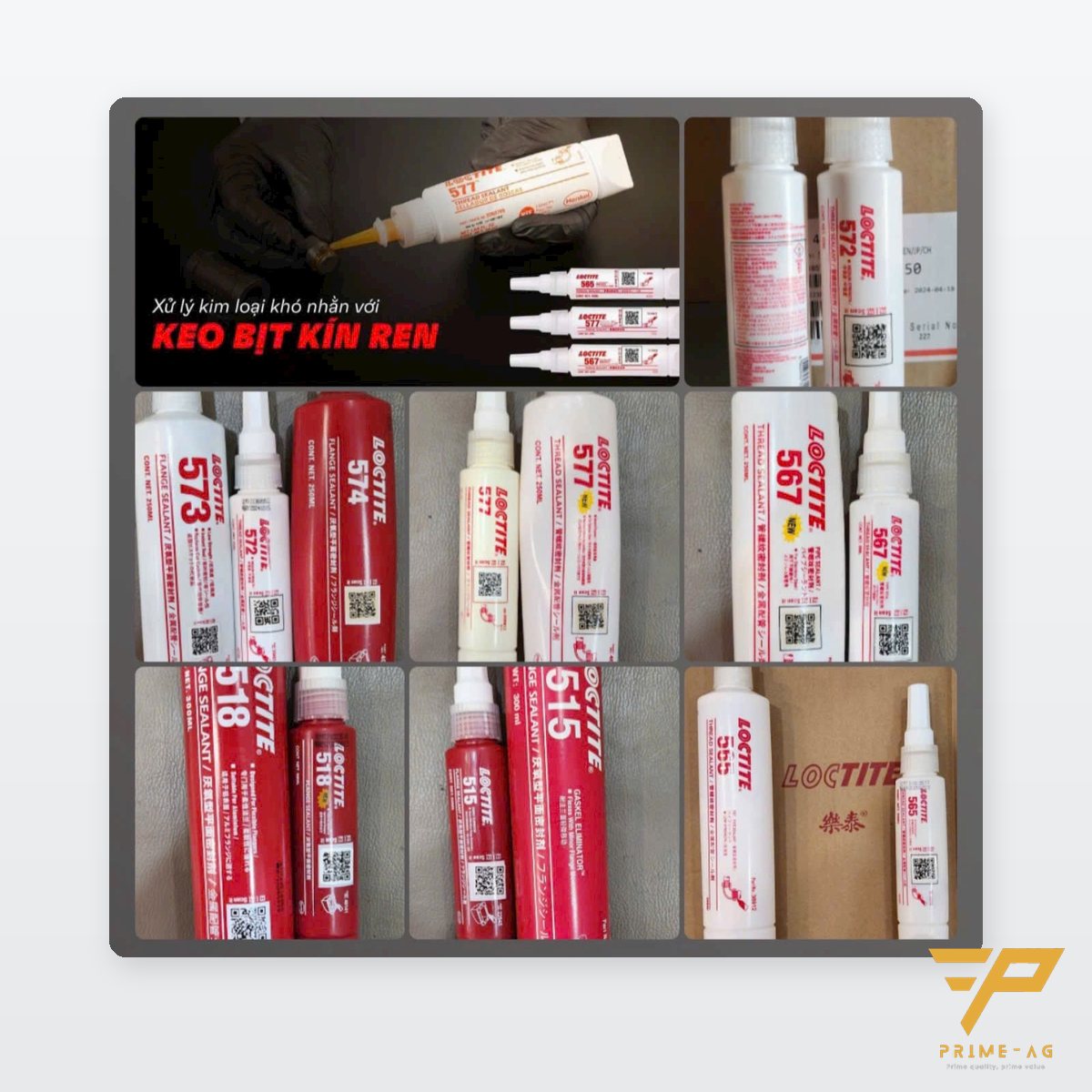
Code: LT-5XX · Specification: Loctite flange & pipe thread sealants (518, 577, 545, 5910…). Delivery: stocked items in 24–48 hours, made-to-order items 3–7 working days.
Two sealing groups. Flange sealing (formed-in-place gaskets): applied to metal flanges in place of a cut gasket: 518 red, general-purpose anaerobic (rigid flanges, gap ≤0.25 mm), 510 for 200 °C, 515 flexible, follows slight flange movement (gaps up to 0.25 mm), 5699 grey (rigid flanges, castings, gearboxes) and 5910 black (stamped sheet-metal covers, oil pans) RTV silicone, 587/596/598 blue/red/black high-temperature silicones rated 260–315 °C depending on the grade. Pipe threads: compressed air, hydraulics, water, gas: 577 yellow general-purpose for threads ≤3″, 545 low-viscosity hydraulic for small threads, 565 and 567 (PTFE; 567 for stainless steel, threads up to 3″), 572 removable, 542 fine threads on instruments, 55 thread-sealing cord for water/gas (no cure needed).
| Code | Group | Colour | Features | Packing |
|---|---|---|---|---|
| 518 | Flange | Red | Anaerobic, gap ≤0.25 mm, 150 °C | 50 / 300 ml |
| 510 | Flange | Pink | Rated 200 °C | 50 / 250 ml |
| 515 | Flange | Purple | Gaps up to 0.25 mm, flexible, follows slight flange movement | 50 / 300 ml |
| 5699 / 5910 | Flange | Grey / black | Oxime RTV silicone; 5699 rigid flanges, castings; 5910 stamped sheet-metal covers, large movement | 80 / 300 ml |
| 587 / 596 / 598 | Flange | Blue / red / black | High-temperature RTV per TDS: 587 up to 260 °C, 596 up to 315 °C (acetoxy, corrodes copper), 598 −54…260 °C | 80 / 300 ml |
| 577 | Pipe thread | Yellow | General-purpose, ≤ 3″, 150 °C, slow cure | 50 / 250 ml |
| 545 | Pipe thread | Purple | Hydraulic, pneumatic, small threads ≤ 2″ (PT 2) | 50 / 250 ml |
| 565 | Pipe thread | White | PTFE, specifications per Henkel TDS | 50 / 250 ml |
| 567 | Pipe thread | White | PTFE, ≤ 3″, 205 °C, stainless steel | 50 / 250 ml |
| 572 | Pipe thread | White | Removable, slow cure | 50 / 250 ml |
| 542 | Pipe thread | Brown | Fine threads, instruments, ≤ 3/4″ | 50 ml |
| 55 | Thread-sealing cord | White | Water, gas, immediate use | 50 / 160 m |
Order from 1 bottle/tube (MOQ 1).
Two different cure mechanisms
- Anaerobic sealants — 518, 510, 515, 577, 545, 567, 572, 542: stay liquid while exposed to air and cure only when confined between two closely fitting metal surfaces. Excess squeezed out does not cure and can be wiped off.
- RTV silicone — 5699, 5910, 587, 596, 598: cures with atmospheric moisture into an elastic rubber, fills larger gaps and follows the deformation of thin flanges. Per the TDS, the surface becomes tack-free after about 10–50 minutes depending on the grade; cure depth increases day by day, and Henkel recommends waiting about 7 days before heavy loading. Parts must be assembled within a few minutes of dispensing.
- LOCTITE 55: polyamide cord impregnated with an inert paste, needs no cure and can be used immediately.
Flange sealing: choose by flange rigidity
518 (per the 2021 TDS: red gel, fluoresces under UV) is for rigid metal flanges with gaps up to 0.25 mm; it cures even on passive metals such as aluminium and tolerates light residues of cutting oil and rust-preventive oil. Immediately after assembly, the uncured sealant already withstands low test pressure (Henkel recommends below 0.05 MPa). 515 (dark purple) also handles gaps up to 0.25 mm but is more flexible and follows small flange movements — pumps, thermostats, compressors, gearbox housings. 510 (pink) has AGA approval with an operating temperature of −10 to 200 °C.
| Silicone grade | Cure system | Temperature per TDS | Used for |
|---|---|---|---|
| 5699 (grey) | Oxime, non-corrosive | — | Rigid flanges, castings, gearboxes; good oil resistance |
| 5910 (black) | Oxime | — | Stamped sheet-metal covers (oil pans, timing chain covers), elongation ≥ 400 % |
| 587 (metallic blue) | Oxime | Up to 260 °C | Valve covers, oil pans, water pumps; bonding and repairing silicone gaskets |
| 596 (red) | Acetoxy | Up to 315 °C | Furnaces, boilers, exhaust pipes, hot-air ducts |
| 598 (metallic black) | Oxime | −54 to 260 °C | Oil pans, gearboxes; not for contact with petrol, not for cylinder head gaskets |
Acetoxy silicones (such as 596) release acetic acid while curing. Do not use them near copper, electronic circuits or sealed electrical cabinets — choose an oxime/neutral type.
Pipe thread sealing
- 577 (yellow): gaps up to 0.25 mm; cures on brass and on passive metals such as stainless steel and plated surfaces without an activator; tolerates light surface oil.
- 567 (off-white, low strength): high lubricity, prevents thread galling on stainless steel and aluminium; AGA approval −10 to 200 °C at a working pressure of 2,000 kPa.
- 545 (purple, medium viscosity): locks and seals metal pipes and fittings; its lubricity makes assembly easier.
- 572 (white, paste) and 542 (brown, low viscosity): seal metal pipe threads, medium strength.
- 55: for tapered threads in metal and plastic up to 4″ NPT, temperatures up to 149 °C; meets EN 751-2 (gas, hot water), and stays sealed when the thread is readjusted by 45° after tightening.
Henkel does not recommend anaerobic sealants for plastics, especially thermoplastics, as they may cause stress cracking. Use 55 cord on plastic threads. None of the grades are for pure oxygen systems or for sealing chlorine or strong oxidisers.
Correct application
- Clean both male and female threads with a degreasing solvent and let dry.
- Passive metals or cold weather, slow cure: spray activator SF 7471 or SF 7649 and let dry.
- Apply a 360° bead to the leading threads of the male thread, leaving the first thread clear, and work the sealant into the thread roots. Large threads: also apply to the female thread.
- Flanges: apply a continuous bead or roll a film onto one face, and tighten the flange as soon as possible so the sealant does not cure and leave a gap.
- Properly tightened threads seal immediately at moderate pressure; wait for full cure before testing at maximum pressure.
Storage and common mistakes
- Per the TDS, anaerobics and silicones are best stored at 8–21 °C, unopened, in a dry place. Do not pour excess sealant back into the bottle.
- Applying anaerobic sealant to plastic threads, or using it on gaps beyond the grade’s gap-fill capability.
- Dispensing silicone and waiting too long before assembly — the sealant has skinned over and lost adhesion.
- Using acetoxy silicone in electrical cabinets or near copper parts.
- Using sealant and PTFE tape on the same thread — the tape prevents the sealant from contacting the metal.
FAQ
- 518 or 5910? — Rigid metal flanges, little vibration → 518; thin stamped sheet-metal covers with large movement (oil pans, timing chain covers) → 5910.
- 577 vs 545? — 577 is general-purpose for threads up to 3″; 545 is thinner, for small high-pressure hydraulic threads.
- Can it replace PTFE tape? — 577/55 seal far better and last longer, with no shreds falling into the pipe.
Technical references
- Henkel – LOCTITE 518 Technical Data Sheet
- Henkel – LOCTITE 577 Technical Data Sheet
- Henkel – LOCTITE 567 Technical Data Sheet
- Henkel – LOCTITE 55 Technical Data Sheet
- Henkel – LOCTITE SI 5910 Technical Data Sheet
- Henkel – LOCTITE SI 596 RED Technical Data Sheet
Data from the LOCTITE 2025 catalogue
| Grade | Type | Operating temperature | Key data |
|---|---|---|---|
| 518 | Anaerobic, aluminium flanges | −55 to 150 °C | Gap ≤ 0.25 mm; shear strength 8.4 N/mm² |
| 510 | Anaerobic, high temperature | −55 to 200 °C | Gap ≤ 0.125 mm; shear strength 5 N/mm² |
| 515 | Anaerobic, flexible | −55 to 150 °C | Gap ≤ 0.25 mm; shear strength 6 N/mm² |
| 5699 | Oxime silicone | −55 to 230 °C | Elongation ≥ 100 %; tack-free time about 30 min |
| 5910 | Oxime silicone | −55 to 230 °C | Elongation ≥ 400 %; tack-free time about 40 min |
| 577 | Anaerobic, pipe threads | −55 to 150 °C | Pipe ≤ 80A (3″); breakaway torque 33 N·m (M10) |
| 545 | Anaerobic, filler-free | −55 to 150 °C | Thread ≤ PT 2; breakaway torque 2 N·m (M10) |
| 542 | Anaerobic, fine threads | −55 to 150 °C | Pipe ≤ 20A (3/4″); breakaway torque 15 N·m (M10) |
| 567 | Anaerobic with PTFE | −55 to 205 °C | Pipe ≤ 80A (3″); breakaway torque ≥ 1.7 N·m |
Breakaway torque measured on M10 steel bolts and nuts per ISO 10964; shear strength measured per ISO 4587. Grades 587, 596, 598, 565, 572, 55 have no data in the 2025 catalogue; their data follows Henkel TDS.
LOCTITE product catalogue 2025 (Henkel, Japanese edition, 52 pages, code C56-2502S): data tables for threadlocking, thread sealing, retaining, flange sealing, activators, instant adhesives and anti-seize. The data on this page has been cross-checked against the 2025 catalogue. The Vietnamese 2008 edition is still useful for the application-based selection charts, but some of its figures are out of date.
Download LOCTITE catalogue 2025 (PDF, 4.7 MB) · Vietnamese 2008 edition: maintenance selection charts
REQUEST A QUOTE: send codes, pack sizes and quantities — PRIMEAG quotes within 30 minutes.
Hotline/Zalo +84 906 108 292 · info@primeag.vn
Written by the PRIMEAG engineering team.
Related guides:Industrial Adhesives for Factories: Choosing by JobLeaking Pipe Threads and Flanges: Loctite Sealants Instead of…Bolts Loosening Under Vibration: How to Choose and Apply…
Related products:Loctite Instant AdhesivesLoctite Threadlocker AdhesivesLoctite Retaining Compounds for Shafts & BearingsLoctite Anti-Seize Lubricants
Updated: 2026-10-21
Giao tận nhà máy TP.HCM, Bình Dương, Đồng Nai, Long An, Tây Ninh · Kèm biên bản đo điện trở ESD theo lô · Hotline 0906 108 292