
Stocked item: delivered in 1–2 working days in Ho Chi Minh City, Binh Duong and Dong Nai; free delivery for orders from VND 20,000,000; defective items exchanged within 7 days. Shipping & return policy
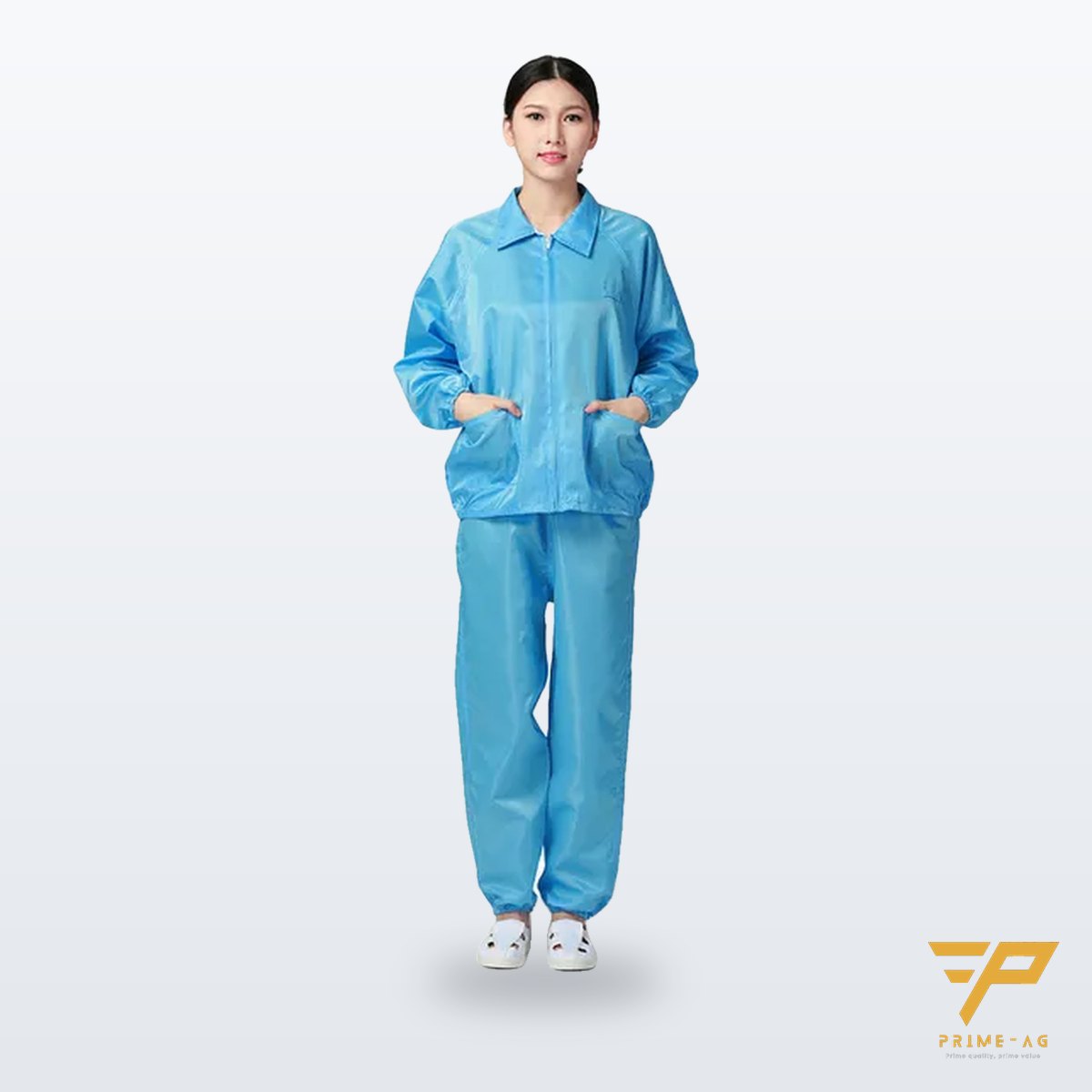
Code: CA-SM · Specification: ESD (anti-static) shirts & shirt + cap sets with embroidered logo. Delivery: in stock, delivered within 24–48 hours (Ho Chi Minh City, Binh Duong, Dong Nai); lead time for bulk orders is confirmed with the quotation.
Also known as: “ESD shirt”, “check cleanroom shirt”, “sky-blue anti-static shirt” — the difference: shirt cut worn as a uniform (no overgarment needed), 8 colours + check, sets with embroidered-logo caps from 50 sets.
Common specification: sky blue, white check, M–XL.
The ESD shirt is the main worker uniform in many Taiwanese/Chinese electronics factories: worn directly like an ordinary shirt, with turn-down collar, snap buttons, long sleeves with elastic cuffs or short sleeves, worn with separate ESD trousers. Carbon-stripe/check polyester fabric, more breathable than coveralls, quick-drying after washing. Colour-coded by department/level; many customers order matching shirt + peaked cap sets with embroidered logo.
Company logo printing available on request.
| Item | Value |
|---|---|
| Fabric | 98 % polyester + 2 % carbon, stripe / check, 100–110 g/m² |
| Resistance | 10⁶ – 10⁹ Ω |
| Style | Long sleeves with elastic cuffs / short sleeves; turn-down collar; snap buttons; chest pocket |
| Size | XS – 5XL |
| Colour | White, sky blue, navy, pink, yellow, orange, grey, green + check |
| Set with cap | Shirt + matching peaked cap, logo embroidered in 2 positions, from 50 sets |
| Washing | 60 °C; number of washes that retain ESD performance per the manufacturer’s recommendation, re-measure resistance periodically |
| Packing | 1 shirt/bag · 30 shirts/carton |
| MOQ | 20 shirts/colour; embroidered sets 50 |
Choose by user
– Line workers, full-shift wear, hot areas → short-sleeved shirt + ESD trousers.
– Logo uniforms, colour coding → shirt + embroidered cap set.
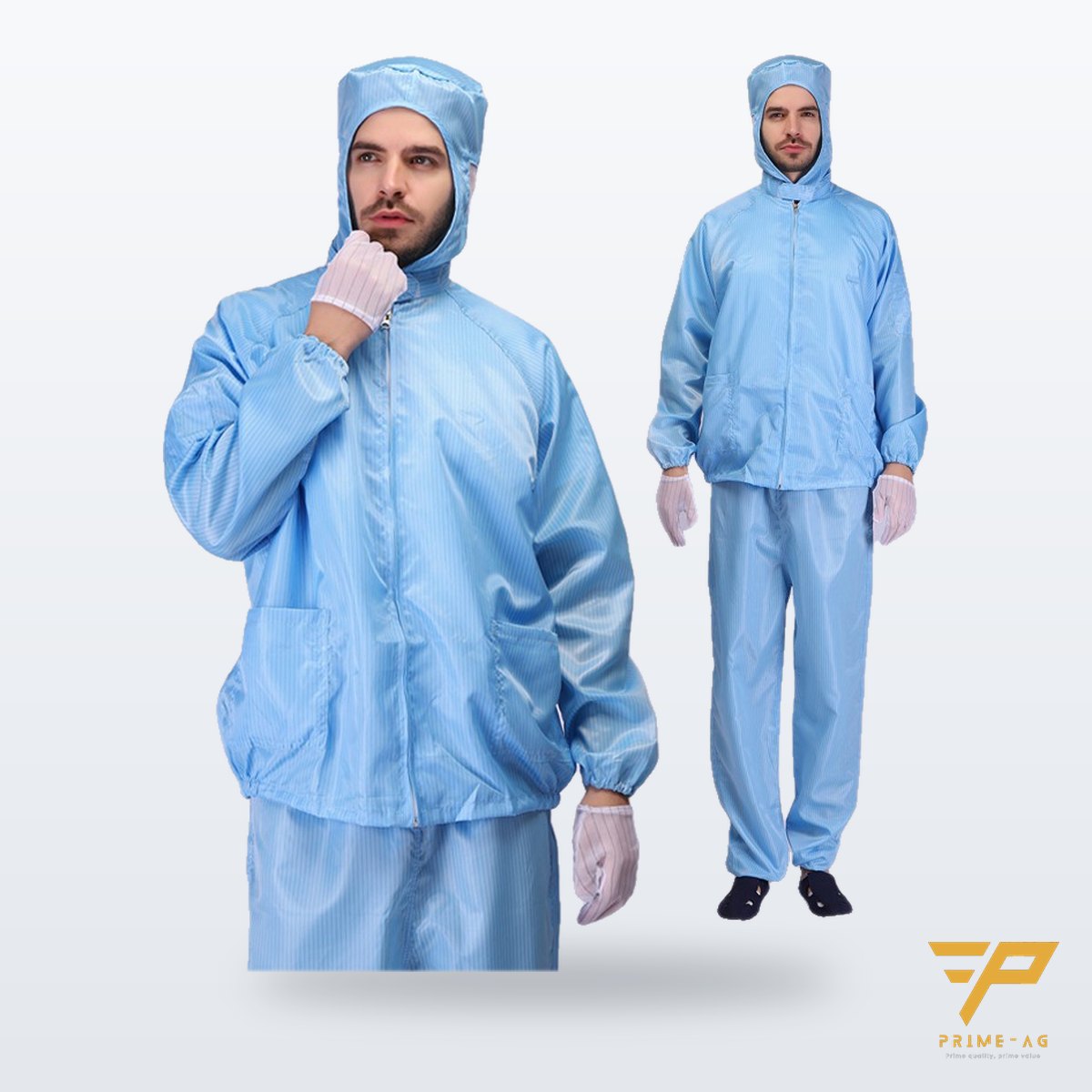
– More coverage needed → two-piece suit (CA-2P) or coverall (CA-1P).
Documents per batch: resistance report, RoHS; customers who need sleeve-to-sleeve results per ANSI/ESD STM2.1 should state this when ordering. Recurring orders: price held for 6 months.
Why must clothing be anti-static too?
Synthetic fabrics (polyester, nylon), wool and windbreakers charge very strongly when rubbed against chairs, sleeves and plastic bags. According to the ESD Association (ESDA), the problem is that ordinary clothing is insulated from the body: even when the operator wears a grounded wrist strap, charge on the fabric still does not drain through the skin to ground. The charged fabric creates an electric field; when a sleeve comes close to a PCB, this field can induce charge on components or discharge directly. The risk is greatest in cleanrooms and when the air is dry.
ESD shirts address this by replacing the outermost layer with fabric containing a conductive fibre grid, while covering the personal clothing underneath.
Material: carbon fibres in polyester fabric
- Filament polyester base: durable, quick-drying, low-linting — suitable for industrial laundering and clean areas.
- Carbon conductive fibres woven in as stripes or a check (grid) pattern. The carbon content is small (about 2 % per the specification table) but runs continuously throughout the body and sleeves, creating paths for charge to spread and drain. This is why ESD garments usually show a visible fine stripe or check pattern.
- Unlike “anti-static” fabrics treated with chemical coatings (whose effect fades after a few washes), carbon fibres woven into the fabric keep their properties long-term, with little dependence on humidity.

Three classes of ESD garment under ANSI/ESD S20.20
| Type | Characteristics | Notes |
|---|---|---|
| Static control garment | Not grounded | Charge can still accumulate on the conductive part of the fabric |
| Groundable static control garment | Has its own grounding point | When grounded, better suppresses electric fields from clothing underneath |
| Groundable static control garment system | Grounds the operator’s skin through the garment | Total resistance person – garment – cord < 35 MΩ |
Standard ESD uniform shirts belong to the first group. If the customer requires groundable garments (with a cord snap and a continuous carbon grid between the two sleeves), state this when ordering so the right model and corresponding testing are chosen. Groundable garments and groundable garment systems (< 35 MΩ) are separate models, not standard uniform shirts.
Which test standard applies?
- ANSI/ESD STM2.1 is the resistance test method for static control garments: point-to-point on the same panel, between panels and between the two sleeves (sleeve-to-sleeve).
- Sleeve-to-sleeve measurement is the most important test: it shows whether the carbon grid is continuous across the shoulder and armhole seams. A garment sewn from many panels whose seams do not connect the carbon grid will pass when measured on one panel but fail when measured across the whole garment.
- For internal assessment, periodically measure a sample of washed garments, recording by batch and number of washes — do not rely only on the test report for new garments.
Washing and storage
- Wash ESD garments separately, not with cotton towels or woollens — lint sticks to the garments.
- Avoid chlorine bleach and fabric softener: softener leaves a coating on the fibres that skews measurements and is unsuitable for clean areas.
- Do not iron at high temperature directly on the conductive fibres; line-dry or tumble-dry on low heat.
- Replace garments when torn, when sleeves are frayed, or when resistance no longer passes — the actual number of washes depends on each factory’s laundry regime.
Common mistakes
- Wearing sweaters or jackets over the ESD shirt in cold weather or air-conditioned rooms — the outermost layer is again a charging material, and all benefit is lost.
- Rolling long sleeves up to the elbow, exposing personal clothing underneath or letting insulating sleeves touch the bench.
- Treating the ESD garment as personnel grounding: the garment does not replace a wrist strap or ESD footwear. The operator must still be grounded by a wrist strap or the footwear–flooring system.
- Printing logos or names with plastic ink over large areas on the chest or back — this creates insulating patches. Prefer small embroidered areas.
- Not checking garments after many washes and relying only on documents at purchase.
FAQ
- Do shirts still need a smock over them? — No; the ESD shirt is the outer layer and only needs ESD trousers and ESD footwear with it.
- Does logo embroidery affect ESD performance? — No, only small areas are embroidered; PRIMEAG uses standard thread on areas ≤ 50 cm².
- Is size XS available? — Yes, in stock.
- Are matching separate trousers available? — Yes, see CA-2P.
Technical references
- ESDA – Fundamentals of ESD, Part 3: Basic ESD Control Procedures and Materials
- ESDA – Fundamentals of ESD, Part 6: ESD Standards
- Wikipedia – Antistatic device
- ESDA – Fundamentals of ESD, Part 4: Training and Auditing
Price: from 60,000 VND (excl. 8% VAT).
REQUEST A QUOTE: send number of shirts/sizes/colours and logo artwork — PRIMEAG quotes within 30 minutes.
Hotline/Zalo +84 906 108 292 · info@primeag.vn
Written by the PRIMEAG engineering team.
Related guides:Chemical storage and dispensing in the workshop: segregation, spill…ESD Cleanroom Garments in HCMC: Smock, Two-Piece or Coverall…
Related products:ESD SmocksDisposable Non-Woven Shoe CoversCleanroom Head Covers and Shoe CoversHooded ESD Cleanroom Coverall
Updated: 2026-10-24
Giao tận nhà máy TP.HCM, Bình Dương, Đồng Nai, Long An, Tây Ninh · Kèm biên bản đo điện trở ESD theo lô · Hotline 0906 108 292