
Chemical incidents in a workshop happen mainly in two places: storage (incompatible chemicals kept together, no spill tray) and dispensing (decanting into unlabeled bottles). PRIMEAG recommends starting with 3 things: segregate by hazard class, put each group on its own spill tray, and give every decanted bottle a GHS label.
- Segregation: flammables, acid corrosives, alkaline corrosives, oxidizers, toxics – never on the same tray.
- Spill trays: able to hold at least the volume of the largest container on the tray.
- Labels: decanted bottles must show the chemical name, GHS hazard pictograms and the decanting date.
- Dispensing: one shift’s worth only, dedicated decanting tools, the right PPE such as 3M 1621 goggles.
1. Common mistakes
- IPA, cleaning solvents, adhesives and acid cleaners kept on the same rack, with nothing to contain a spill.
- Cleaning fluid decanted into a drinking-water bottle with no label; the next shift has no idea what it is.
- No safety data sheet (SDS) at the point of use, so workers do not know what to do if it splashes into the eyes.
- Solvent-soaked rags thrown into the general waste bin.
2. Segregate and separate in storage
Read section 7 (handling and storage) and section 10 (stability and reactivity) of each chemical’s SDS. General rules:
| Group | Workshop examples | How to store |
|---|---|---|
| Flammable liquids | IPA, alcohol, paint thinners, solvent-based cleaners | Dedicated flammables cabinet, away from heat and sparks; keep only the quantity needed on the floor |
| Corrosive – acids | Rust removers, oxide removers | Separate tray, not on high shelves, never with alkalis |
| Corrosive – alkalis | Alkaline degreasers | Separate tray, away from acids |
| Oxidizers | Some cleaners and surface-treatment chemicals | Separate from flammables and organic materials |
| Adhesives, bonding agents | Loctite adhesives (Henkel, with CO per lot), two-part epoxy, silicone | Follow the storage temperature on the package; many adhesives must be kept cool and out of sunlight |
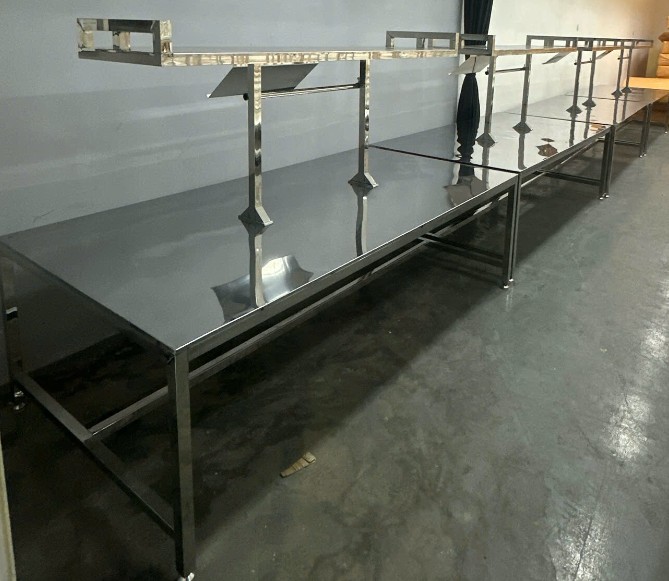
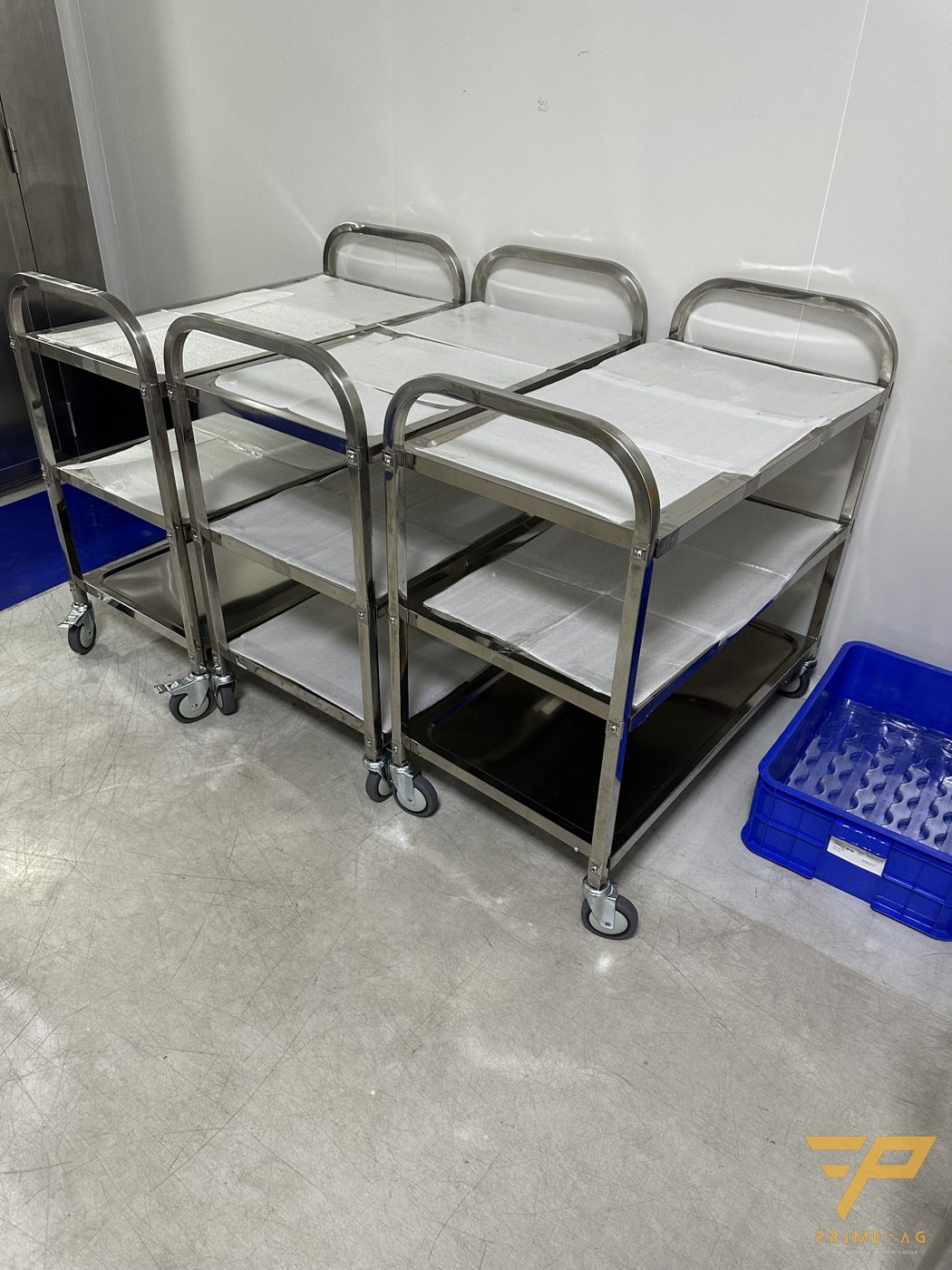
Chemical storage racks should be made of a material that the stored chemicals do not corrode. A stainless steel 304 rack/trolley withstands most common solvents and cleaners; strong acids need a PE/PP plastic tray. For the difference between stainless 201 and 304, see stainless 201 or 304 for benches, racks and trolleys.
3. Spill trays
Put each chemical group on its own spill tray so that if a container leaks or tips over, the liquid stays in the tray. The tray must hold at least the volume of the largest container on it; some regulations (for example the US Environmental Protection Agency rule for hazardous waste storage areas, 40 CFR 264.175) require no less than 10 % of the total volume or 100 % of the largest container, whichever is greater. Keep a spill kit (absorbents, disposal bags, gloves, goggles) next to the storage area.
4. Labels and SDS
In Vietnam, chemical labeling follows the GHS classification system (under the current chemical labeling regulations). In the workshop, apply it to decanted bottles too: chemical name, hazard pictograms (flame, corrosion, exclamation mark…), a short hazard statement and the decanting date. Keep a Vietnamese-language SDS in a plastic sleeve right at the cabinet or rack, together with the phone number of the person in charge.
5. Dispensing at the workstation
- Issue only what is needed for the shift; collect the bottles back to the storage area at the end of the shift.
- Use metered pump bottles or dispensing syringes and needles for small amounts instead of pouring straight from a large can.
- PPE per the SDS: sealed 3M 1621 goggles when pouring and decanting; a 3M 6200 respirator with 6001 cartridges for prolonged work with solvents in enclosed areas.
- Rags and industrial wipes soaked with solvent go into a lidded metal bin and are collected as hazardous waste.
- Move multiple bottles between areas on a trolley with raised shelf edges, not by hand.
15-minute self-check
- Are there any bottles in the workshop with no label or a faded handwritten one?
- Are acids and alkalis, or solvents and oxidizers, sharing a tray?
- Is any spill tray holding water or trash, or cracked?
- Is the SDS available at the point of use, and is there a Vietnamese version?
Frequently asked questions
What capacity does a chemical spill tray need? At least the volume of the largest container on the tray. Some regulations, such as US 40 CFR 264.175, require no less than 10 % of the total volume or 100 % of the largest container, whichever is greater.
Do decanted chemical bottles used at a station need a label? Yes. Show the chemical name, GHS hazard pictograms and the decanting date; never use beverage bottles for chemicals.
Can stainless steel racks be used to store chemicals? Stainless 304 withstands most common solvents and cleaners. Strong acids should sit in a PE/PP plastic tray; flammable liquids should be stored in a dedicated cabinet.
Updated: 2026-11-02 — PRIMEAG engineering team
Mon–Sat, 8:00–17:00 (GMT+7) · Phone/Zalo: +84 906 108 292 · Email: info@primeag.vn
Start where it suits you: Free technical advice · Send a drawing or layout · Get a quote within 30 minutes
Written by the PRIMEAG engineering team
Updated: 2026-10-23