
Stocked item: delivered in 1–2 working days in Ho Chi Minh City, Binh Duong and Dong Nai; free delivery for orders from VND 20,000,000; defective items exchanged within 7 days. Shipping & return policy
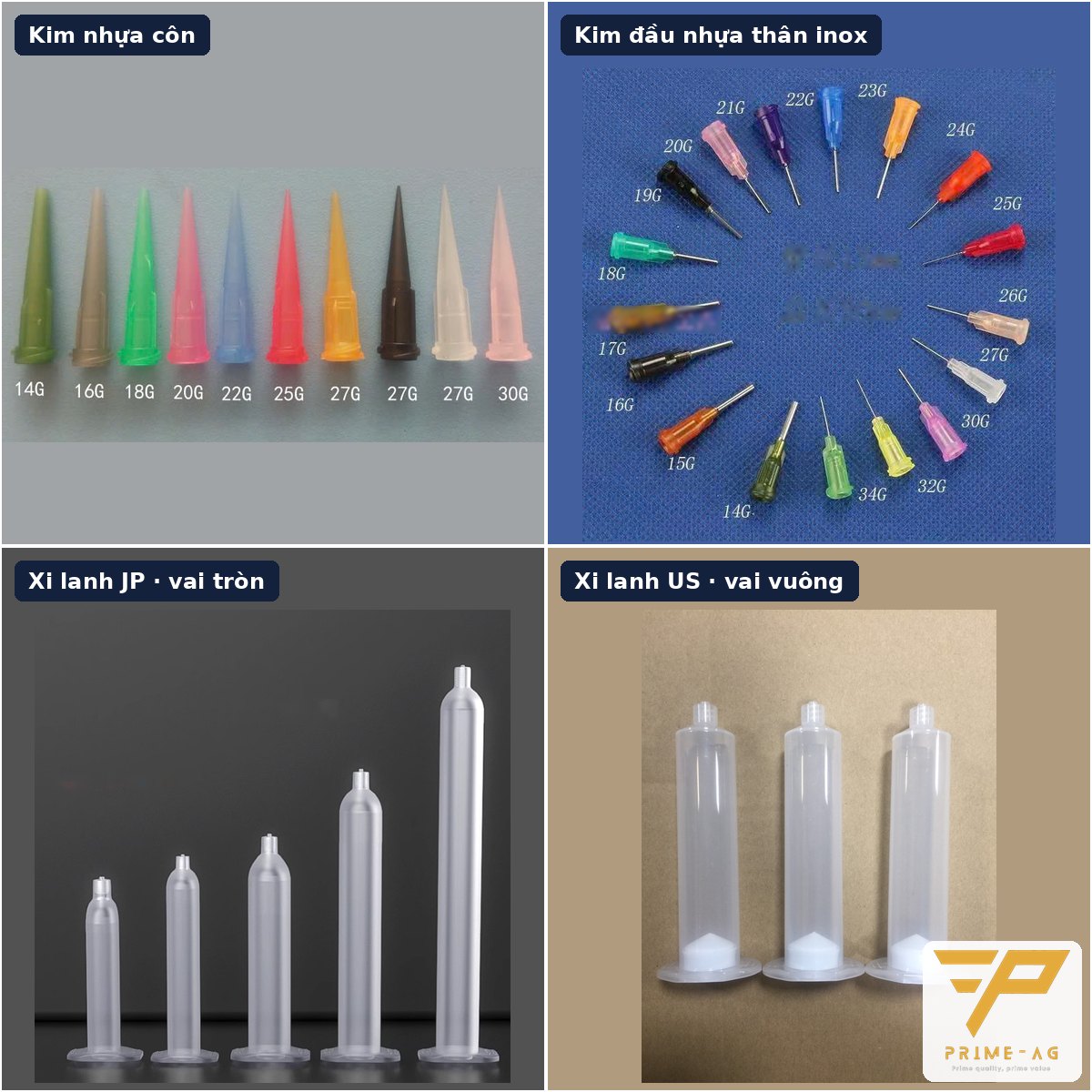
Code: DISP · Specification: dispensing syringes, needles, adapters & dispensers. Delivery: stocked items in 24–48 hours, made-to-order items 3–7 working days.
Also known as: “glue dispensing syringe”, “30cc syringe”, “18G dispensing needle”, “tapered plastic tip”, “MSS syringe”, “dispensing adapter hose”, “983A dispenser” — the difference: full JP, US and MSS systems (not interchangeable), 4 tip types: tapered plastic, plastic hub with stainless tube, long tube, all-metal; standard carton packing, tiered pricing.
Consumables for dispensing stations, dot dispensing, component bonding and solder paste application: PP syringes (3–500 cc) with pistons, tip caps and end caps; dispensing tips in tapered plastic, plastic hub with stainless tube (1-time use) or all-metal (reusable), sizes 8G (coarse) → 35G (fine); adapters connecting the syringe to the air dispenser; pneumatic dispensers 983A / SP982 with adjustable pressure and dispense time. Choose the system that matches your existing equipment: JP syringes have a rounded tapered shoulder, US syringes a blunt square shoulder — caps and pistons are not interchangeable.
| Item | Specification |
|---|---|
| Syringe | US system 3–55 cc, JP system 5–70 cc, coloured MSS system (amber/black/green) 5–70 cc, large syringes 100–500 cc; with pistons |
| Syringe caps | Piston + tip cap (PLUG) for JP / US / MSS systems |
| Tapered plastic tips (TT) | 14G–30G — 100 / 1,000 pcs/bag |
| Plastic hub, stainless tube tips | 14G–34G, 13 mm tube (30 mm overall length); long-tube type for deep gaps |
| All-metal tips | 8G–35G — reusable, 100 pcs/box |
| Adapter (air hose) | JP metal head / US plastic head, for 10cc and 30–70cc |
| Dispenser | 983A, SP982, SP983 — pneumatic, air supply 5.5–7.0 bar, output adjustable 0.1–7 bar, timer 0.01–99 s |
| Suitable fluids | Silicone, UV adhesives, epoxy, Loctite, solder paste, conformal coatings |
| Packing | 30cc syringes: 1,000 pcs/carton; tips: 1,000/bag |
| MOQ | 1 carton of syringes / 1 bag of tips |
Choose by fluid
– Thin fluids (UV, Loctite 401) → 21–25G stainless tips, 10–30 cc syringes, black syringes for UV.
– Medium fluids (silicone, epoxy) → 16–18G tips, 30–50 cc syringes.
– Thick fluids, solder paste → 14–15G tips, 50–70 cc syringes.
– High volume → 983A dispenser + adapter for the right system; for manual dispensing only syringe + tip are needed.
Documents: RoHS; samples of 10 syringes + 10 tips for trials with the customer’s fluid.
Recurring orders: price held for 6 months, minimum stock of 1 carton of syringes and 5 bags of the most-used tip sizes.
4 types of dispensing tip – choose by the job, not just the gauge
At the same 18G size, tapered plastic tips, plastic-hub stainless tips and all-stainless tips give very different results. Choosing the wrong type commonly causes stringing, clogged tips or fluid curing inside the tip.
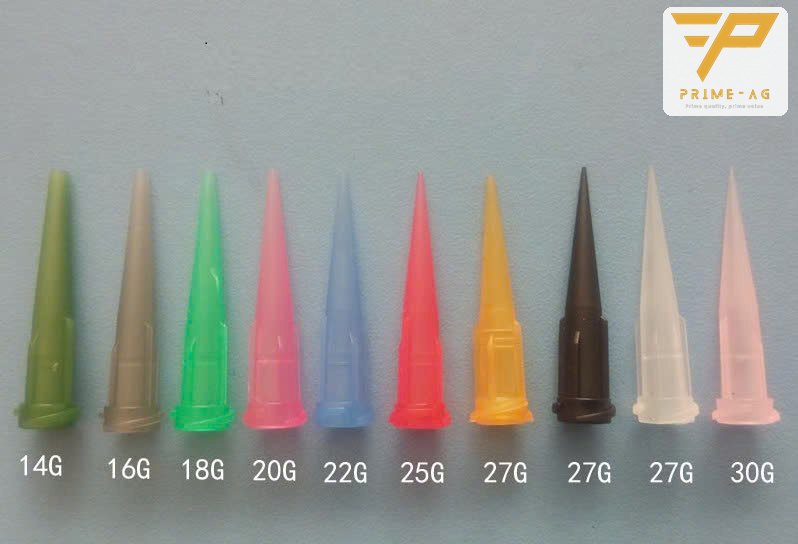
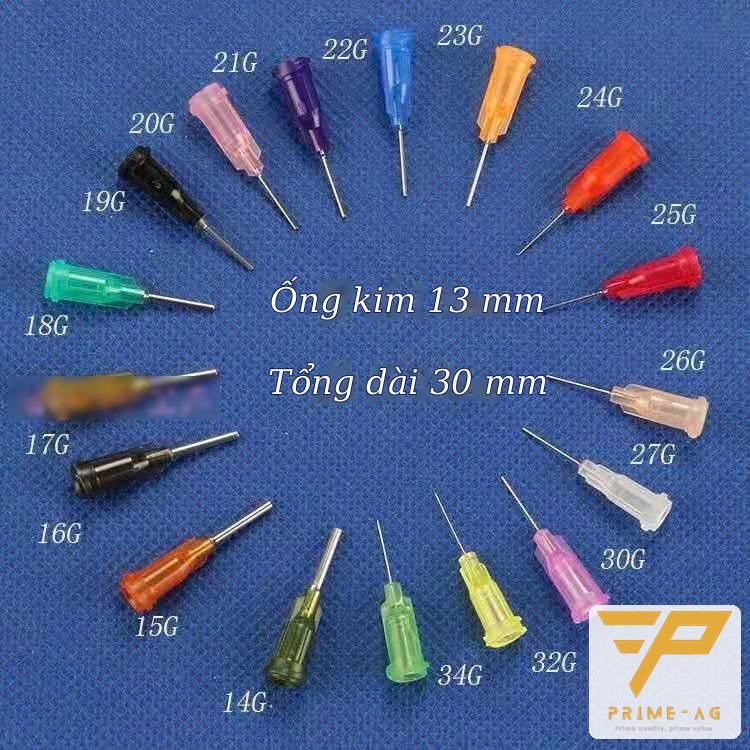
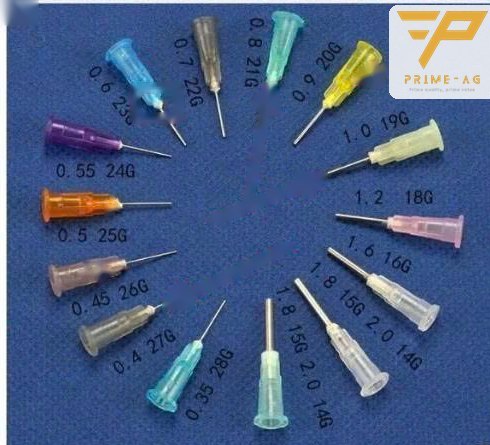
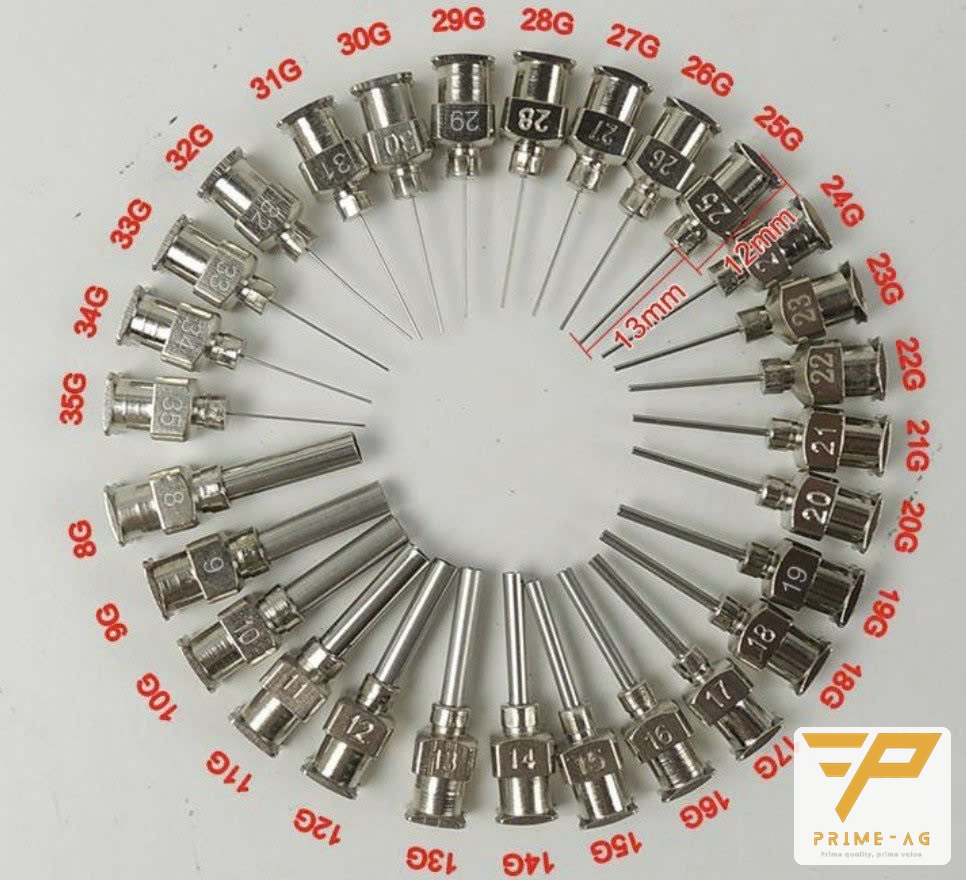
| Tip type | Construction | Best for | Avoid |
|---|---|---|---|
| ① Tapered plastic (TT) | All PP, bore narrows gradually; 1-time use | Thick fluids, filled fluids (epoxy, RTV silicone, solder paste), anaerobic threadlockers; low pressure, little stringing. Black/amber versions block light for UV adhesives | Very small dots that must be placed close to components; plastic tips wear easily on contact |
| ② Plastic hub, stainless tube, 13 mm | Colour-coded plastic Luer hub + blunt stainless tube; 30 mm overall length; 1-time use | General purpose: dots and beads of thin–medium fluids (UV, instant adhesives, thin silicone, oils and greases) | Anaerobic adhesives (cure inside metal tips); very thick fluids at small sizes |
| ③ Plastic hub, long tube | As type ②, with a longer stainless tube | Dispensing into deep gaps, holes, and spots hidden behind tall components | Thick fluids (a long tube increases resistance and needs high pressure) |
| ④ All-metal | Metal Luer hub + stainless tube; sizes 8G–35G; reusable | Robots and automatic machines needing firm positioning; can be solvent-cleaned and heated; 8G–13G for greases and sealants in large volumes | Anaerobic adhesives; applications needing frequent tip changes (higher cost) |
Quick size tip: the higher the gauge number, the smaller the bore; hub colours are only each manufacturer’s convention (photos ② and ③ show the same size in different colours), so always read the gauge number on the packaging.
Telling JP, US and Musashi (MSS) syringes apart
The three syringe systems do not share adapter caps or pistons. A quick visual check: JP syringes have a rounded, tapered shoulder (the transition from barrel to tip), US syringes a blunt, nearly square shoulder. Capacity also hints at the system: 3 cc and 55 cc are US; 50 cc and 70 cc are JP or MSS.
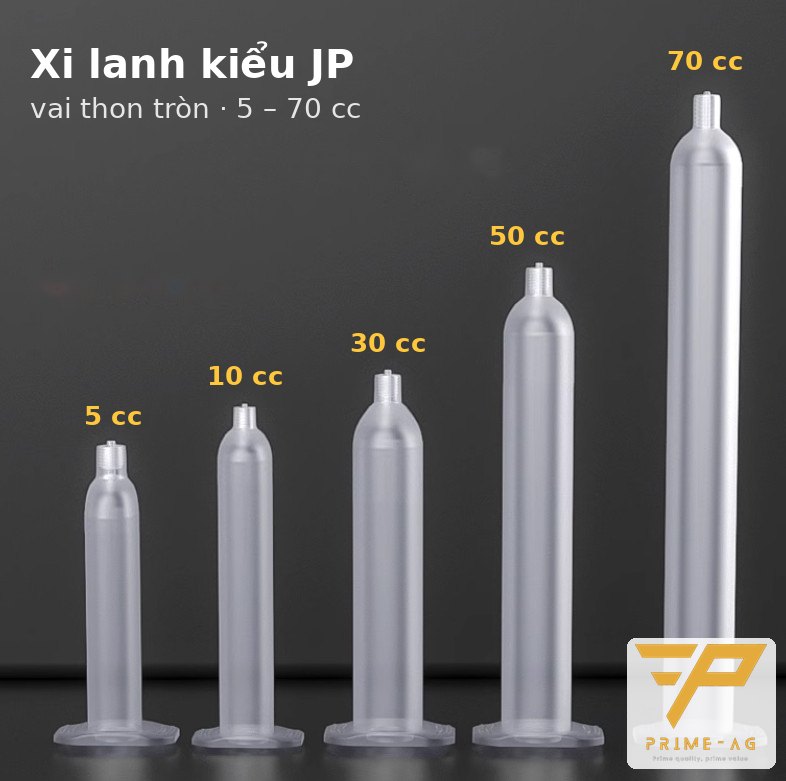
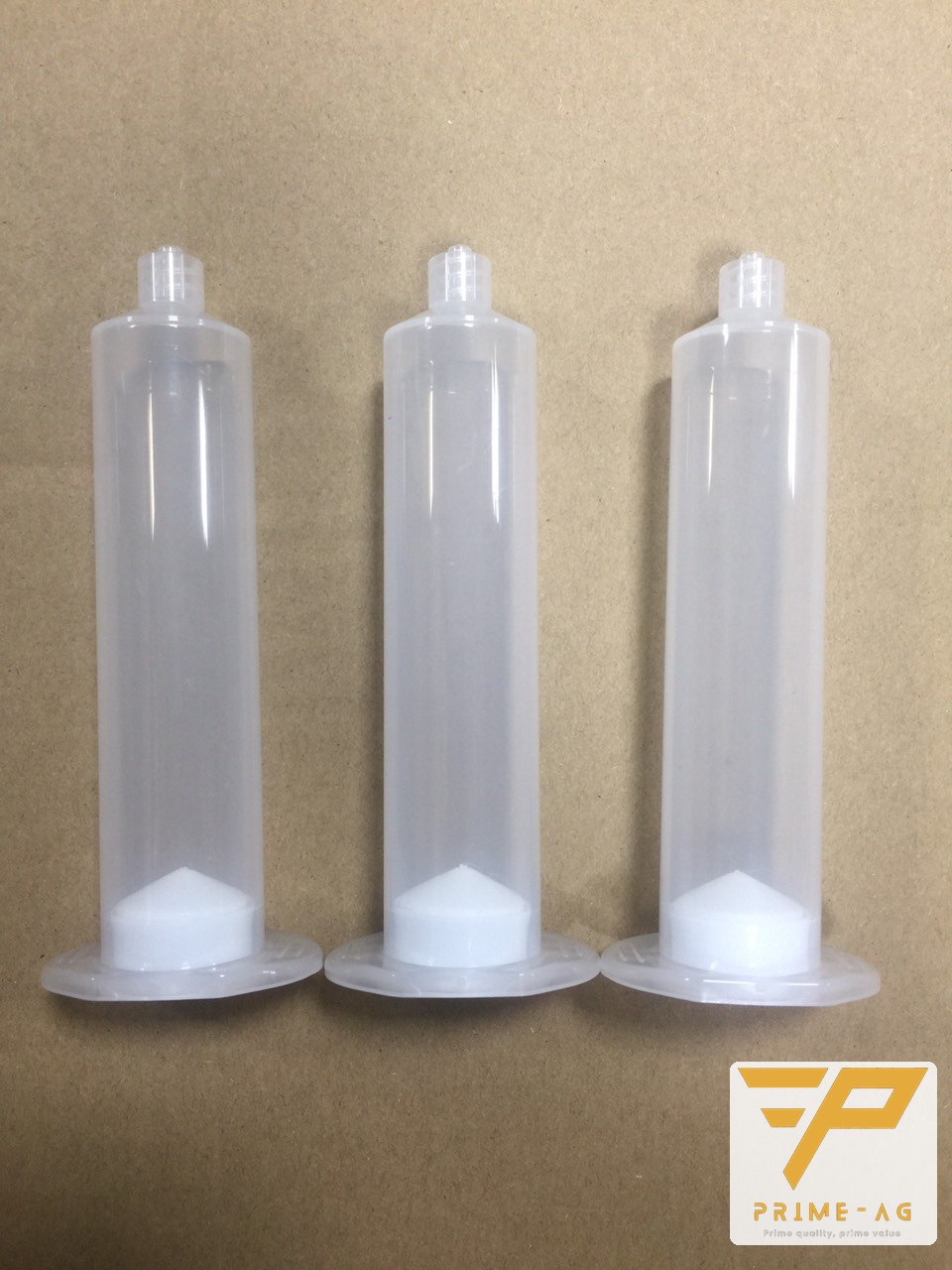
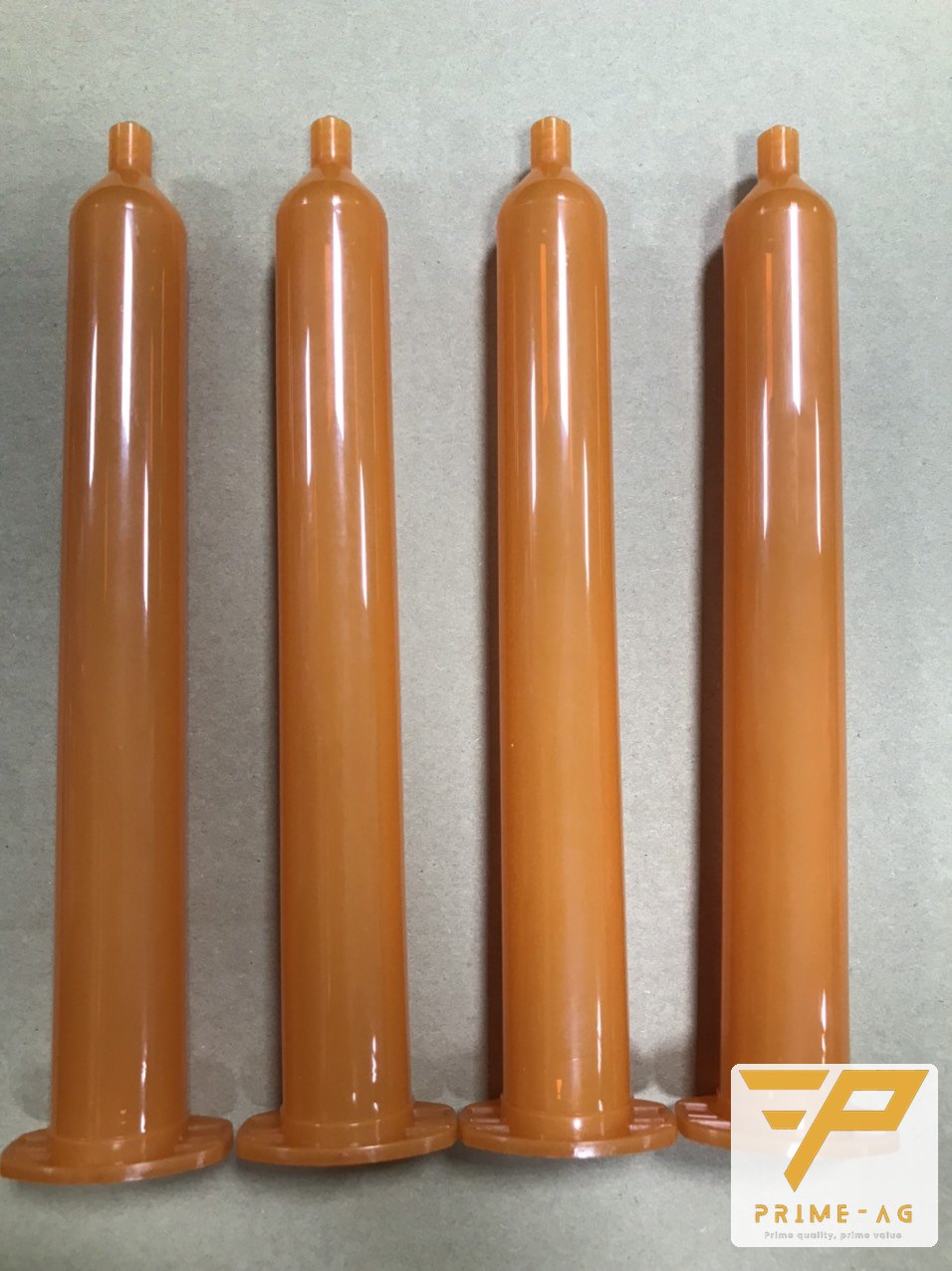
| Feature | US system | JP system | MSS system |
|---|---|---|---|
| Syringe shoulder | Blunt, nearly square | Rounded, tapered | Rounded, tapered, ribbed base |
| Colour | Translucent (translucent PP) | Frosted white (frosted) | Coloured: amber / black / green |
| Capacity | 3 · 5 · 10 · 30 · 55 cc | 5 · 10 · 30 · 50 · 70 cc | 5 · 10 · 30 · 50 · 70 cc |
| OD of 30 cc | 25.7 mm | 26 mm | 26.2 mm |
| Caps & pistons | Must match the system – not interchangeable; when changing dispenser system, change the adapter too | ||
Dimensions by size (mm)
| Capacity | US: OD / ID / overall length | JP: OD / ID / overall length | MSS: OD / ID / overall length |
|---|---|---|---|
| 3 cc | 11.55 / 9.55 / 73.7 | — | — |
| 5 cc | 14.6 / 12.6 / 70 | 15.2 / 13.2 / 77 | 14.9 / 12.9 / 80 |
| 10 cc | 18.55 / 15.7 / 90 | 17.2 / 15.2 / 105 | 18.3 / 16.3 / 105 |
| 30 cc | 25.7 / 22.5 / 118.15 | 26 / 23 / 130 | 26.2 / 23.2 / 129.7 |
| 50 cc | — | 26 / 23 / 161.3 | 26.2 / 23.2 / 160.7 |
| 55 cc | 25.7 / 22.5 / 175 | — | — |
| 70 cc | — | 26 / 23 / 224 | 26.2 / 23.2 / 223.7 |
Tolerance: ±0.1 mm · Material: virgin PP, chemical-resistant, does not deform when filled with UV adhesives, silicone or industrial inks. Compatible with standard US / JP / MSS caps and pistons of the matching system. Coloured MSS syringes: amber blocks UV, black blocks light completely, green for colour-coding fluids.
Large syringes 100–500 cc (US style)
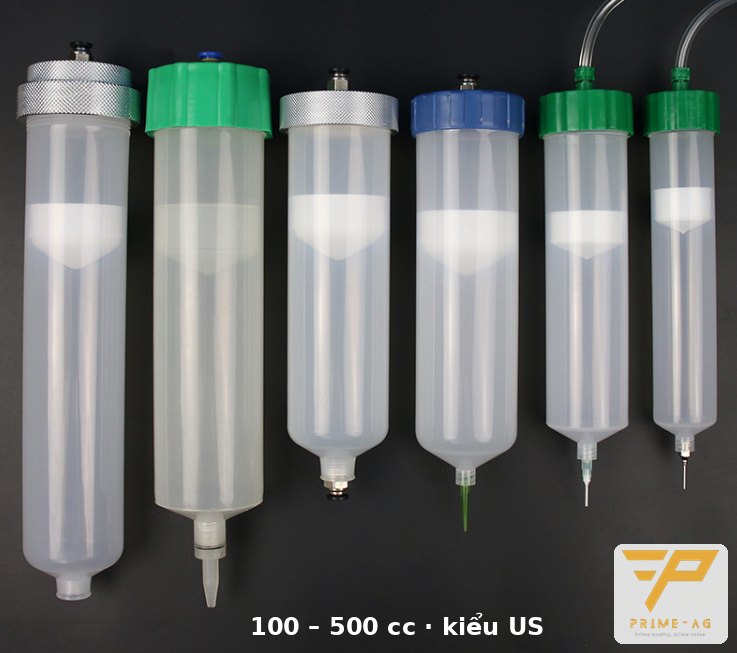
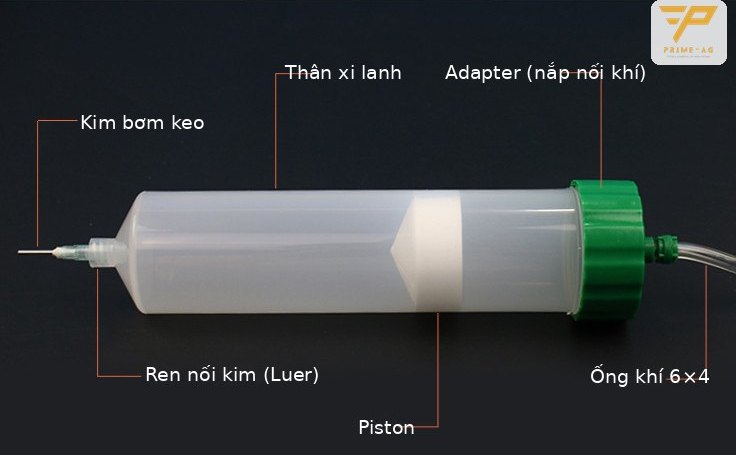
| Size | OD | ID | Barrel length | Overall length |
|---|---|---|---|---|
| 100 cc | 35 | 32 | 191 | 215 |
| 200 cc | 44.65 | 39.5 | 191 | 215 |
| 300 cc | 55 | 50 | 200 | 223 |
| 500 cc | 58.6 | 54 | 240 | 268 |
| 500 cc slim barrel | 54.75 | 50 | 268 | 286 |
Dimensions in mm, per manufacturer data. Large syringes are for high-volume dispensing stations, reducing syringe changes per shift.
Further reading, in-depth article: how to choose JP, US and Musashi syringes and the 4 dispensing tip types for each fluid.
How time–pressure dispensers work
Pneumatic dispensers (983A, SP982…) work on the time–pressure principle: each press of the foot pedal sends a pulse of compressed air into the syringe for the set time, pushing the piston and forcing fluid through the tip. The deposit size per shot depends on four factors: pressure, time, tip size and fluid viscosity. The vacuum function creates slight negative pressure in the syringe between shots so thin fluids do not drip from the tip.
- Supply air to the dispenser is usually 5.5–7.0 bar (80–100 psi) per the Nordson EFD dispenser operating procedure; the air must be dry and clean.
- Nordson EFD plastic syringes withstand a maximum of 100 psi (about 7 bar) — do not set pressure above this level.
Tip gauge and inner diameter
The higher the gauge number, the smaller the bore. Tips are colour-coded so operators can identify them quickly. The table below follows the Nordson EFD catalogue; other manufacturers’ colours may differ, so always check the gauge number printed on the packaging.
| Tip gauge | Colour (Nordson EFD) | Inner diameter | Outer diameter* |
|---|---|---|---|
| 14G | Olive | 1.54 mm | 2.0 mm |
| 15G | Amber | 1.36 mm | 1.8 mm |
| 16G | Grey | 1.19 mm | 1.6 mm |
| 18G | Green | 0.84 mm | 1.2 mm |
| 20G | Pink | 0.61 mm | 0.9 mm |
| 21G | Purple | 0.51 mm | 0.8 mm |
| 22G | Blue | 0.41 mm | 0.7 mm |
| 25G | Red | 0.25 mm | 0.5 mm |
| 27G | Clear | 0.20 mm | 0.4 mm |
* Outer diameter of the tip tube per the manufacturer’s label (see photo ③); used to choose tips that fit into gaps and holes.
Tapered plastic or stainless tips?
- Tapered plastic tips: the bore narrows gradually so fluid flows smoothly, needing less pressure for thick and filled fluids (epoxy, RTV silicone, solder paste) and reducing stringing at the tip.
- Stainless tips (plastic hub with stainless tube, or all-metal): suit thin fluids and small dots; the rigid tube gives precise placement. Bent 45° and 90° versions are available to reach difficult spots.
- Fluids that react with metal: Nordson EFD does not recommend stainless tips for these. For example, anaerobic adhesives (Loctite threadlockers) cure on contact with metal ions in the absence of air — they easily cure inside metal tips; use plastic tips.
Syringes, pistons and filling
- Clear syringes: for most fluids. Amber syringes (transmitting less than 12 % of visible light at wavelengths ≤ 550 nm) or opaque black syringes for UV and light-sensitive adhesives.
- Pistons: the standard type is for thick and filled fluids; barrier pistons are for cyanoacrylates and thin anaerobics — the piston sits on top and works with vacuum to prevent dripping.
- Fill level: UV adhesives, epoxies, sealants, pastes: fill about 2/3 of the syringe and push the piston down to the fluid surface to expel air. Thin cyanoacrylates: fill about 1/2.
- Do not heat syringes above 38 °C; do not clean with strong solvents (MEK, acetone, THF). Syringes and pistons are single-use consumables — washing them for reuse reduces accuracy.
Keeping deposits consistent between shots
- As the syringe empties, the deposits get smaller (the air cushion volume increases) — use smaller syringes or do not overfill, and readjust the time when little fluid is left.
- Changes in fluid temperature change viscosity — a common cause of variation. Two-part epoxies thicken over their pot life.
- Fluctuating air pressure: fit a precision regulator and an air filter.
- When setting parameters, start with the smallest tip, low pressure and short time, then increase gradually. Avoid high pressure with very short times (below 0.01 s); longer dispense times usually give better repeatability.
Safety and common mistakes
- Wear safety glasses during operation; a high-pressure jet of fluid can cause injury. Release all pressure before removing the syringe from the adapter.
- Mixing JP and US adapters — air leaks and fluid backs up into the hose.
- Using clear syringes for UV adhesives — the adhesive cures right in the syringe under workshop lighting.
- Not checking the air hose after each shift: fluid gets sucked back into the hose when the vacuum is set too high.
FAQ
- What is the difference between JP and US? — Look at the syringe shoulder: JP is rounded and tapered, US is blunt and square; barrel and piston diameters differ, so adapters and caps are not interchangeable. Check the dispenser you use to choose.
- The higher the gauge number, the bore is…? — Smaller: inner diameter 14G ≈ 1.54 mm, 21G ≈ 0.51 mm.
- When are black syringes used? — For UV and light-sensitive adhesives — they prevent curing inside the syringe.
- Does the dispenser need compressed air? — Yes, a 5.5–7.0 bar air supply; PRIMEAG supplies the hose and filter with it.
Technical references
- Nordson EFD – Precision dispense tips catalog (tip gauge chart)
- Nordson EFD – Optimum syringe barrels & pistons brochure
- UCSB – SOP Nordson EFD fluid dispenser
- Adhesives & Sealants Industry – Better from the benchtop (time–pressure dispensing)
Price: from 800 VND (excl. 8% VAT).
REQUEST A QUOTE: send fluid type, capacity, tip size and dispenser system — carton quotes within 30 minutes.
Hotline/Zalo +84 906 108 292 · info@primeag.vn
Written by the PRIMEAG engineering team.
Related guides:Chemical storage and dispensing in the workshop: segregation, spill…Dispensing Needle Clogging, Dripping or Uneven Dots: Checks and…Choosing Dispensing Syringe Barrels and Needles: JP, US, Musashi…
Updated: 2026-10-24
Giao tận nhà máy TP.HCM, Bình Dương, Đồng Nai, Long An, Tây Ninh · Kèm biên bản đo điện trở ESD theo lô · Hotline 0906 108 292