
Stocked item: delivered in 1–2 working days in Ho Chi Minh City, Binh Duong and Dong Nai; free delivery for orders from VND 20,000,000; defective items exchanged within 7 days. Shipping & return policy
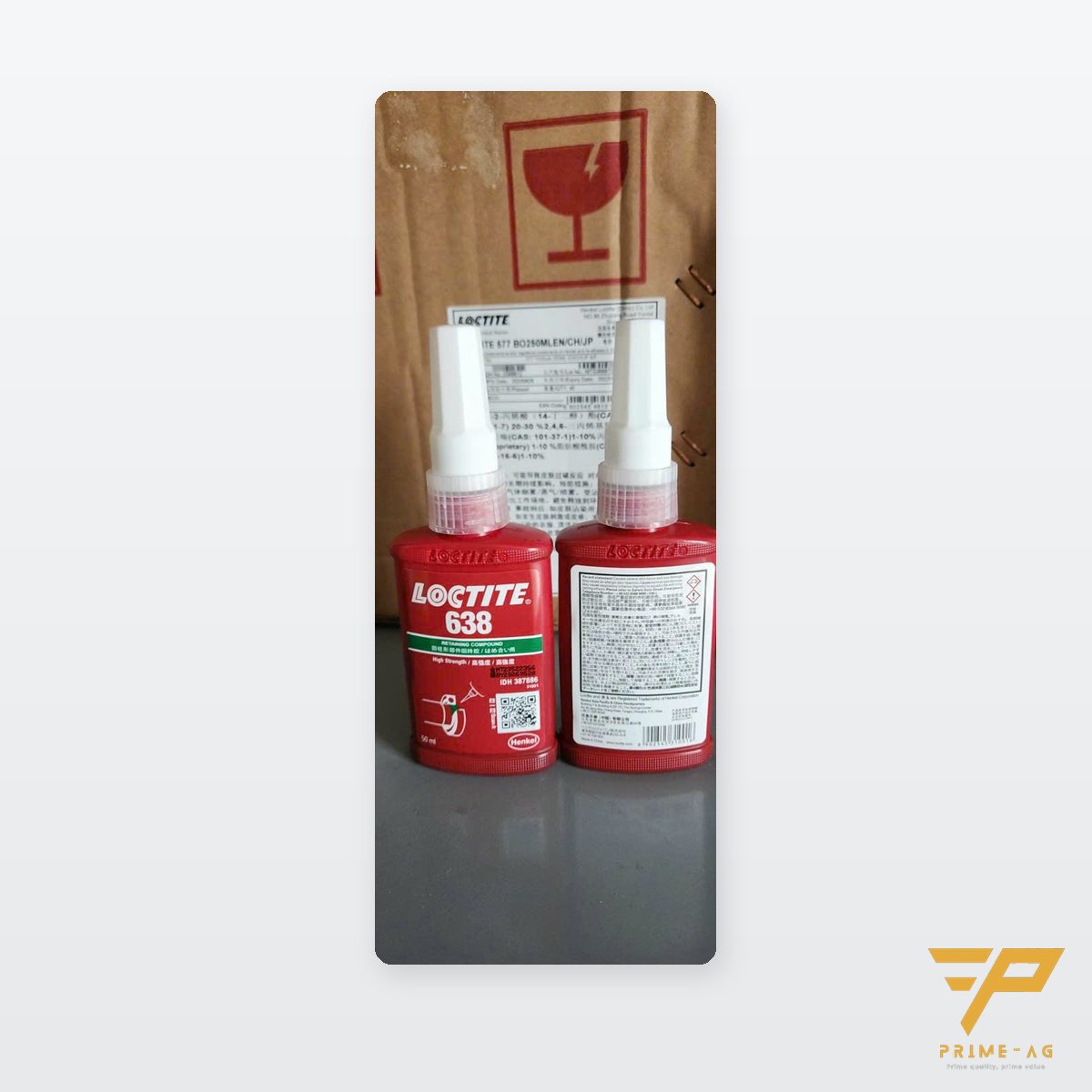
Product code: LT-6XX · Specification: Loctite retaining compounds for shafts and bearings (603, 638, 648, 680…)
Loctite Retaining Compounds
Delivery: stocked items are delivered in 24–48 hours (Ho Chi Minh City, Binh Duong, Dong Nai); made-to-order items 3–7 working days.
Retaining compounds for cylindrical assemblies fill the gap between shaft and bore, giving 2–3 times the shear strength of a press fit and preventing fretting and corrosion — used to fix bearings in housings, bushes, gears, pulleys and pins. Select by gap and strength: small gap ≤0.1 mm, oil-tolerant → 603; general purpose → 609; large gap 0.25 mm → 638 (highest strength); heat resistant to 230 °C → 620; removable → 641; high strength, 175 °C → 648; repairing worn shafts, 0.5 mm gap → 660; high strength, large gap → 680.
| Grade | Colour | Max. gap | Shear strength (N/mm², indicative) | Temperature | Features | Pack size |
|---|---|---|---|---|---|---|
| 603 | Green | 0.13 mm | 22 N/mm² | 150 °C | Oil-tolerant, for surfaces not fully clean | 10 / 50 / 250 ml |
| 609 | Green | 0.1 mm | 17 | 150 °C | General purpose | 50 / 250 ml |
| 620 | Green | 0.2 mm | 17 (24 h) | 230 °C | Heat resistant | 50 / 250 ml |
| 638 | Green | 0.25 mm | 29 (72 h) | 180 °C | High strength, large gap | 10 / 50 / 250 ml |
| 641 | Yellow | 0.2 mm | ≥ 6.5 | 150 °C | Removable, bearings | 50 ml |
| 648 | Green | 0.15 mm | ≥ 25 | 180 °C | High strength, fast cure | 10 / 50 / 250 ml |
| 660 | Silver | 0.5 mm | 17 | 150 °C | Worn shaft repair, gel | 50 ml |
| 680 | Green | 0.25 mm | ≥ 19.3 | 200 °C | High strength, large gap | 50 / 250 ml |
Shear strength and temperature in the table are indicative values; for figures from the Henkel TDS (ISO 10123) see the table “Selecting by gap and strength” below. Orders from 1 bottle/tube (MOQ 1).
FAQ
– Which grade for bearings that will be replaced later? — 641 (removable), or 603 if heating to 250 °C at replacement is acceptable.
– Does a press fit need adhesive? — Yes, with 603/648 to prevent fretting and increase strength 2–3 times.
– How long does it take to cure? — Handling strength in 10–30 minutes, full cure up to 24 h; on stainless steel/plated parts use primer 7649.
How retaining compounds work
A retaining compound is an anaerobic adhesive: it stays liquid in the bottle and cures only when confined between two closely fitting cylindrical metal surfaces — shaft and bore, bearing and housing, bush and casing. The adhesive fills the micro-voids that a purely mechanical press fit cannot reach, so the load is transmitted across the entire contact area, while also sealing the joint against loosening and leakage caused by vibration and shock (as described by Henkel).
Factors affecting cure speed according to the TDS: gap (the larger the gap, the slower the cure), material (steel cures fast; stainless steel and plated surfaces cure slowly), temperature (cold slows curing). Where the gap is large or curing is too slow, use activator SF 7471 or SF 7649.
Selecting by gap and strength
| Grade | Features according to Henkel TDS | Compressive shear strength, steel pin and collar (ISO 10123) |
|---|---|---|
| 603 | Low viscosity (100–150 mPa·s); for surfaces that cannot always be fully cleaned; retains bearings and oil-impregnated bushes | ≥ 22.5 N/mm² after 24 h |
| 609 | Low viscosity; rotors on small motor shafts, reinforcing press fits | ≥ 15.8 N/mm² after 24 h |
| 620 | High viscosity; gaps up to 0.2 mm; higher heat resistance — radiator locating pins, gearbox bearings | 17 N/mm² after 24 h; 24 N/mm² with additional heat cure at 177 °C |
| 638 | High viscosity (~2,500 mPa·s); gaps up to 0.25 mm; cures even on stainless steel and plated surfaces; oil-tolerant | 29 N/mm² after 72 h |
| 641 | Medium strength; for parts that must be dismantled for maintenance — retains bearings on shafts and in housings | ≥ 6.5 N/mm² |
| 648 | Gaps up to 0.15 mm; high strength at room temperature | 31 N/mm² after 72 h |
| 660 | Metallic grey paste; gaps up to 0.5 mm — restores fits on worn shafts, spun bearings, damaged keyways | ≥ 17.2 N/mm² after 24 h |
| 680 | Medium viscosity, high strength; cures even on passive metals | ≥ 19.3 N/mm² after 24 h |
The figures above are typical/minimum values from the TDS, measured on standard test specimens; actual strength depends on material, surface roughness, gap and joint length. Critical joints should be tested on real parts.
Application by type of fit
- Clean the inner and outer surfaces with a degreasing solvent and allow to dry. For stainless steel, aluminium, plated surfaces or large gaps: spray activator onto the surface and allow to dry.
- Slip fit: apply adhesive around the leading edge of the shaft and the inside of the bore, push and rotate during assembly so the adhesive spreads evenly.
- Press fit: coat both surfaces thoroughly and press quickly at a high press-in speed so the adhesive is not scraped off.
- Shrink fit (heating/cooling): if the bore part is heated, apply adhesive to the shaft; if the shaft is cooled, apply it to the bore; avoid condensation on the cold part.
- Do not load the joint until the adhesive has reached handling strength.
Disassembly and cleaning
- Disassemble with standard tools; if this fails, apply localised heat to approx. 250 °C and disassemble while hot (per TDS for 638, 648). If the part cannot be heated to this level, heat as high as possible and use a puller.
- Cured adhesive on parts: soak in Loctite solvent combined with scrubbing with a wire brush.
- For designs that need periodic disassembly (bearings replaced by running hours): choose medium-strength 641 instead of 638/648.
Storage, safety and common mistakes
- According to the TDS, optimal storage is 8–21 °C in unopened bottles in a dry place; do not return excess adhesive to the bottle.
- Henkel does not recommend anaerobic adhesives for plastic parts (especially thermoplastics, which are prone to stress cracking), for pure oxygen systems, or for chlorine sealing.
- Washing parts with water-based solutions before applying adhesive: Henkel notes that compatibility must be checked, as some solutions affect curing.
- Using a small-gap adhesive (603, 609, 648) on a large-gap joint — the adhesive does not fill the gap and cures poorly.
- Using threadlockers (243, 263) instead of retaining compounds on bearings: they differ in viscosity and design purpose.
- Running under load immediately after assembly before the adhesive has reached its strength.
Technical references
- Henkel – LOCTITE 603 Technical Data Sheet
- Henkel – LOCTITE 638 Technical Data Sheet
- Henkel – LOCTITE 641 Technical Data Sheet
- Henkel – LOCTITE 648 Technical Data Sheet
- Henkel – LOCTITE 660 Technical Data Sheet
- Henkel – LOCTITE 620 Technical Data Sheet
Data from the LOCTITE 2025 catalogue
| Grade | Viscosity (mPa·s) | Diametral gap | Shear strength (N/mm², ISO 10123) | Fixture time | Operating temperature |
|---|---|---|---|---|---|
| 603 | 100–150 | ≤ 0.13 mm | ≥ 22.5 | 10 min | −55 to 150 °C |
| 620 | 5,000–12,000 | — | ≥ 17.2 | — | −55 to 230 °C |
| 638 | 2,000–3,000 | ≤ 0.25 mm | ≥ 25 | 10 min | −55 to 180 °C |
| 641 | 400–800, thixotropic | ≤ 0.2 mm | ≥ 6.5 | 40 min | −55 to 150 °C |
| 648 | 400–600 | ≤ 0.15 mm | ≥ 25 | 10 min | −55 to 180 °C |
| 660 | 150,000–350,000, thixotropic | ≤ 0.5 mm | ≥ 17.2 | 20 min | −55 to 150 °C |
| 680 | 750–1,750 | — | ≥ 19.3 | — | −55 to 200 °C |
Shear strength measured on steel pins and collars per ISO 10123. 638, 648 and 680 are upgraded grades with higher temperature resistance and better adhesion to oily surfaces. Grade 609 is not in the 2025 catalogue; its data follows Henkel TDS.
LOCTITE product catalogue 2025 (Henkel, Japanese edition, 52 pages, code C56-2502S): data tables for threadlocking, thread sealing, retaining, flange sealing, activators, instant adhesives and anti-seize. The data on this page has been cross-checked against the 2025 catalogue. The Vietnamese 2008 edition is still useful for the application-based selection charts, but some of its figures are out of date.
Download LOCTITE catalogue 2025 (PDF, 4.7 MB) · Vietnamese 2008 edition: maintenance selection charts
Price: from 180,000 VND (excl. 8% VAT).
REQUEST A QUOTE: send the quantity and specifications you need — PRIMEAG quotes within 30 minutes.
Hotline/Zalo +84 906 108 292 · info@primeag.vn
Written by the PRIMEAG engineering team.
Related guides:Industrial Adhesives for Factories: Choosing by JobBolts Loosening Under Vibration: How to Choose and Apply…Leaking Pipe Threads and Flanges: Loctite Sealants Instead of…
Related products:Loctite Instant AdhesivesLoctite Threadlocker AdhesivesLoctite Thread and Flange SealantsLoctite Anti-Seize Lubricants
Updated: 2026-10-21
Giao tận nhà máy TP.HCM, Bình Dương, Đồng Nai, Long An, Tây Ninh · Kèm biên bản đo điện trở ESD theo lô · Hotline 0906 108 292