
Stocked item: delivered in 1–2 working days in Ho Chi Minh City, Binh Duong and Dong Nai; free delivery for orders from VND 20,000,000; defective items exchanged within 7 days. Shipping & return policy
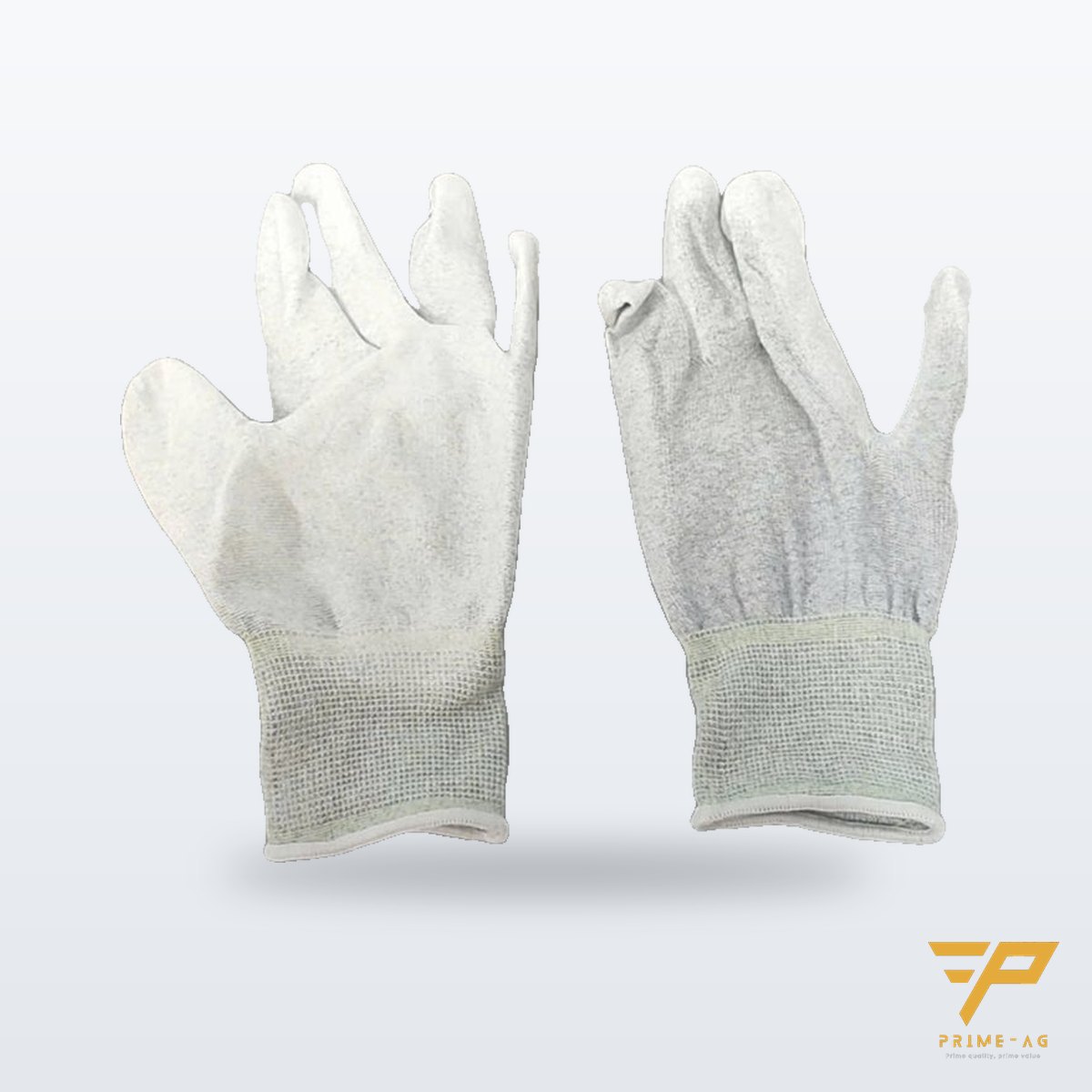
Product code: GC-P · Specification: Carbon Palm ESD gloves, PU palm-coated
Carbon Palm ESD Glove, PU palm-coated, Overlock seam
Equivalent to: “Carbon Palm”, “carbon palm-coated gloves”, “ESD palm-coated gloves” — what is different: carbon yarn knitted through the whole glove (not printed stripes), resistance measured for every lot with a report, Overlock seams.
Common specification: size M.
Delivery: stocked items delivered within 24–48 hours (Ho Chi Minh City, Binh Duong, Dong Nai); availability confirmed at quotation.
ESD gloves for factories in Vietnam where hands do a lot of gripping and handling in the EPA: packing boards into shielding bags, loading trays into ESD bins, sub-assembly, component stores. The polyester liner is blended with conductive carbon yarn running through the glove, and PU covers the whole palm for grip and durability; charge on the hand drains through the carbon yarn to the wrist strap or ESD floor. The EC (economy) version has the same construction with a thinner liner, about 10 % cheaper.
| Item | Value |
|---|---|
| Liner | Polyester + carbon yarn, 13G, seamless knit, Overlock |
| Coating | PU on palm + inner side of fingers |
| Resistance | 10⁵ – 10⁸ Ω (per the lot test report) |
| Sizes | S / M / L |
| Color | Carbon grey with black stripes |
| Standards | Suitable for EPA use under ANSI/ESD S20.20 (worn with a wrist strap), EN 388 3131, RoHS |
| Packing | 10 pairs/bag · 100 pairs/carton |
| MOQ | 1 carton |
Choose by process
– Heavy gripping and handling in the EPA → Carbon Palm (this item).
– Picking small components in the EPA → Carbon Top, fingertip-coated (GC-O).
– No ESD requirement → grey PU palm-coated gloves (GP-GP), about 30 % cheaper.
– Finger cots instead of gloves → ESD finger cots (FC-TF).
Inspection: resistance measured per lot, report included; a reminder to customers: gloves do not replace wrist straps — gloves only conduct the charge, it is the wrist strap + 1 MΩ cord that takes it to ground.
FAQ
– Carbon Palm or Carbon Top – which should I choose? — Palm gives more grip and durability; Top gives more sensitivity for small components.
– Do ESD gloves lose their ESD properties after washing? — The carbon yarn does not wash out; after 3–5 washes at 40 °C resistance rises slightly but stays within the 10⁸ range.
– What is different about the EC version? — Thinner liner, same carbon, lower price; suits low-abrasion areas.
– Do you provide a resistance test report for audits? — Yes, per lot, stating the test method (ESD gloves are usually measured to ANSI/ESD STM15.1).
Construction of the Carbon Palm glove
- 13G knit liner: gauge = needles per inch of fabric. 13G is a mid gauge, balancing dexterity, durability and grip (Ergodyne). 15G and 18G gloves are thinner and more sensitive; 7–10G are thicker and more abrasion-resistant.
- Knitted-in carbon yarn: polyester yarn containing conductive carbon runs throughout the glove, forming a continuous conductive network from the fingertips to the cuff — where the skin and the wrist strap make contact.
- PU palm coating: a thin polyurethane coat with good grip on dry, smooth surfaces; the back of the hand is left uncoated so sweat can escape.
- Overlock seams: lock the fabric edges and limit fraying.
How do ESD gloves work?
ESDA advises that a grounded person handling static-sensitive components should not wear insulating gloves or finger cots; if gloves are worn, they must be dissipative or conductive. Ordinary polyester gloves are insulating: charge generated by friction between the glove and trays, bags or components cannot drain to the person’s hand.
A carbon glove connects the hand to the component through a “moderate” resistance. According to Desco, even a grounded person can cause a charged device model (CDM) discharge when touching a charged component; raising the contact resistance with a dissipative glove slows the discharge current and reduces the risk of damage. That is why ESD gloves sit in the dissipative range rather than being highly conductive.
Reading the EN 388 code on the glove
The first four digits of EN 388 are the performance levels for abrasion – cut (blade) – tear – puncture. For code 3131:
| Digit | Property | Level | Minimum threshold (EN 388:2016) |
|---|---|---|---|
| 3 | Abrasion | 3 | 2,000 cycles |
| 1 | Cut (Coup test) | 1 | index 1.2 |
| 3 | Tear | 3 | 50 N |
| 1 | Puncture | 1 | 20 N |
In other words, the glove has fair abrasion resistance but practically no cut resistance. Do not use it to handle sharp sheet metal, blades or broken glass.
Checking resistance while the glove is worn
- ANSI/ESD STM15.1 describes how to measure the resistance of the glove and of the person–glove system; the ESD TR53 guideline is used for periodic verification.
- A simple method on the line: wearing the glove, plug in the wrist strap and touch the wrist strap tester electrode with a gloved finger. If it still passes, the hand – glove – strap – ground path is continuous (Desco uses this method for its own ESD gloves).
- Re-test after washing; discard gloves that fail.
PU coating: a note on DMF
Conventional PU-coated gloves are dipped in a PU solution made with dimethylformamide (DMF) and then washed to remove the solvent. DMF can be absorbed through the skin. The general standard for protective gloves, EN ISO 21420:2020 (replacing EN 420), sets a DMF limit of 1,000 mg/kg for gloves containing PU. For large orders, ask the supplier for a DMF test report or OEKO-TEX certification for the lot.
Washing, replacement and common mistakes
- Wash in cool or warm water on a gentle cycle with liquid soap; no bleach; line dry or tumble dry on low heat (Desco’s recommendation for ESD gloves).
- Replace when the PU peels, the palm is worn through to the yarn, or the resistance test fails.
- Do not use carbon gloves in place of wrist straps for seated operators.
- Do not wear the gloves outside the EPA for dirty work and then come back — oil and dust raise the resistance.
- Do not handle oil or grease with PU gloves: PU grips well when dry but poorly on oil.
Technical references
- ESDA – Fundamentals of ESD, Part 3 (personnel grounding, footwear – flooring, gloves)
- Desco – ESD Inspection Glove 68120 (resistance, washing, CDM)
- ESDA – ANSI/ESD STM15.1-2019: resistance of gloves and finger cots
- SATRA – EN 388:2016+A1:2018: mechanical protection levels
- CTC – EN ISO 21420:2020 replaces EN 420 (DMF, pH limits…)
- Ergodyne – How glove gauge affects performance
Price: from 2,500 VND (excl. 8% VAT).
Request a quote: send pairs per month, sizes, and standard or EC version — PRIMEAG replies with a quote within 30 minutes.
Hotline/Zalo +84 906 108 292 · info@primeag.vn
Written by the PRIMEAG engineering team.
Related guides:ESD gloves: fingertip-coated or palm-coated – which to choose…PU Fingertip Gloves Peeling or Holed After One Shift:…Choosing Gloves by Process Step in Electronics Manufacturing: 12…
Related products:Carbon Top ESD Gloves, PU Fingertip CoatedGrey Top PU Fingertip Coated GlovesPVC Dotted Work GlovesWhite Palm PU Palm-Coated Gloves
Updated: 2026-10-25
Giao tận nhà máy TP.HCM, Bình Dương, Đồng Nai, Long An, Tây Ninh · Kèm biên bản đo điện trở ESD theo lô · Hotline 0906 108 292