
Which Vetus ESD tweezers should you buy for each task on an electronics line in Vietnam? Choose Vetus tweezers by tip shape: for 0402/0201 chips use the curved ESD-15 or the ESD-11; for ICs and lead straightening use ESD-12 or ESD-13; for pulling wires and removing labels use ESD-14 or ESD-17; for glass surfaces use plastic tweezers 93302/93303. PRIMEAG points out that ESD-coated tweezers only drain charge when the person holding them is grounded.
A rework line leader asks: “They’re both Vetus, so why does the curved one pick chips cleanly while the straight one keeps flicking parts away?” Neither is worse; each model is ground for a particular kind of task.
- The models differ mainly in tip shape: ultra-fine, curved, plastic and other forms.
- Small chips: curved tip. Label removal, tight gaps: ultra-fine. Glass surfaces: plastic.
- Replace when tips are misaligned, gapping or the coating is peeling, typically every 6–12 months in an EPA.
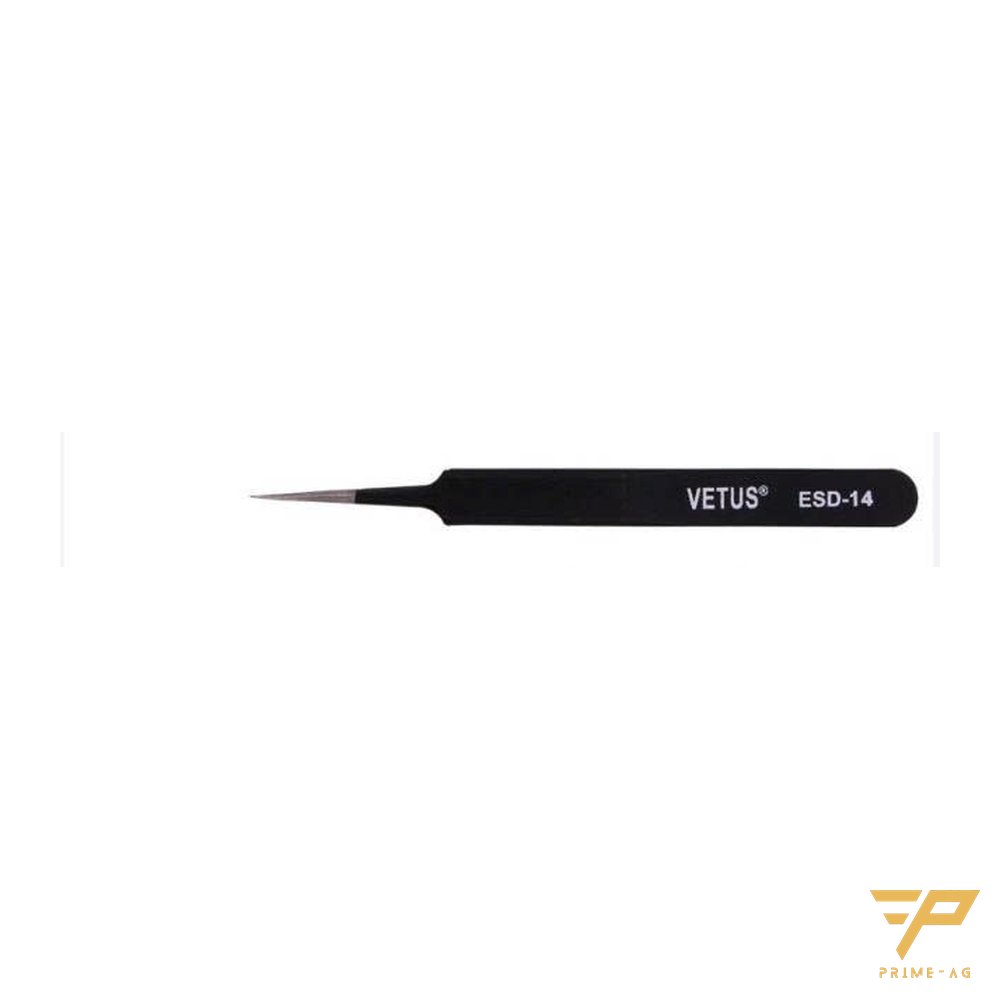
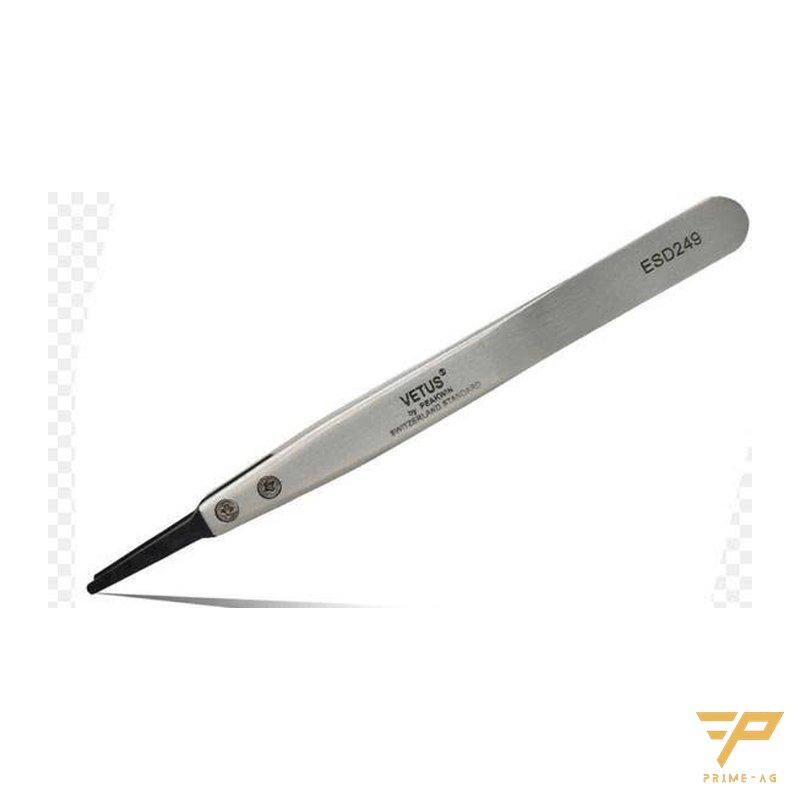
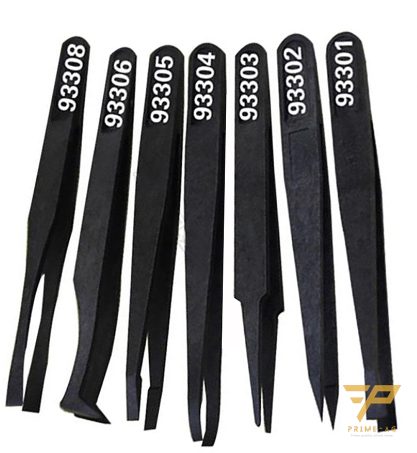
Vetus ESD series tweezers: how the models differ
The Vetus ESD anti-static tweezers range covers models 10–17, 249, 250, 259 and 7A: non-magnetic stainless steel with a black dissipative epoxy coating, 120–140 mm long. Chips with steel caps are not attracted to the tips.
What differs between models is the tip shape. Curved tips give a clear view of the pick point. The Vetus ST series uses the same model numbers but is bare stainless steel, better suited to mechanical work and labs than to EPAs.
Model selection table by task
| Model | Tip shape | Suitable task | Note |
|---|---|---|---|
| ESD-15 (or ESD-11) | ESD-15 curved | Picking 0402, 0201 chips | Fine tips, bend easily if dropped |
| ESD-12, ESD-13 | Test a sample first | Picking ICs, straightening leads | Samples: 1 piece per model |
| ESD-14 | Ultra-fine | Pulling fine wires, removing labels, tight gaps | Do not use for prying or levering |
| ESD-17 | See the sample photo, test 1 piece | Pulling wires, removing labels | Keep separate from chip-picking tweezers |
| ESD-10 | See the sample photo, test 1 piece | No assigned process yet; test a sample before ordering in quantity | Do not choose by feel |
| ESD-249, ESD-259 | Replaceable plastic tips | Easily scratched parts | Replace the tips when worn, keep the body |
| ESD plastic 93301–93308 | Carbon-filled plastic | Glass, displays (93302/93303) | Less precise tips |
| Ceramic tip NHIP_S | Ceramic rated to 1,000 °C | Holding parts while soldering | Insulating |
Rework soldering and work next to hot joints
While soldering, hold the part with ceramic-tip tweezers: solder does not stick to them and they are non-magnetic. Ceramic is insulating, so switch back to ESD-coated tweezers after soldering.
Do not dip stainless tips into molten solder unnecessarily; solder build-up thickens the tips and makes chips hard to pick. The soldering station must also be grounded; choose from the soldering tips, soldering irons and solder range.
Signs that tweezers need replacing
- Under a magnifier, the two tips do not meet at the same time or misalign when squeezed lightly.
- Tips gapping, splayed or bent: 0402 chips easily fly off.
- Coating on the grip area peeling or cracked: remove from the EPA and use outside it.
- Plastic tips worn round and slipping: replace the tips.
Storage and where to put tweezers on the bench
Keep tweezers in a stand with tip covers, not mixed with heavy items. Clean with IPA; do not soak for long in strong solvents. Do not use chip-picking tweezers to remove adhesive.
Per ESD TR20.20, hand tools are grounded through the ESD work surface and the operator. The place to put tweezers down is a 2-layer ESD rubber mat: top surface 10⁶–10⁹ Ω, 10 mm snap wired to the common ground point. An ungrounded mat is just a rubber sheet.
Getting started at each station
- Assign one tweezer model to each task and put the model label on the stand.
- At the start of each shift, check wrist straps and the mat ground cord.
- Order by model: 12 pieces per box, MOQ 12, with Vetus CO, RoHS; regular customers get prices held for 6 months.
While reviewing hand tools, you can ask PRIMEAG to visit your plant in Ho Chi Minh City, Binh Duong or Dong Nai and also check the station’s work surfaces, mats and trays, including items bought elsewhere, then receive a PDF with photos of each point (free on-site ESD measurement); this report is for internal tracking, not for submitting to auditors.
Why bare metal tweezers can cause discharge when touching a charged component: choosing ESD tweezers and brushes for the EPA. Soldering tips and solder: choosing soldering tips, temperature and solder paste storage.
Frequently asked questions
- What is the difference between Vetus ESD and Vetus ST tweezers? — ESD has a black dissipative coating that drains charge in a controlled way. ST is bare stainless steel, cheaper, and should be limited for sensitive components in an EPA.
- Can ESD plastic tweezers pick up 0402 chips? — With difficulty. Plastic tweezers suit large components, glass and displays; for 0402 chips use fine-tip ESD-coated stainless tweezers.
- How often should ESD-coated tweezers be replaced? — In an EPA typically every 6–12 months, sooner if the coating peels or the tips are misaligned.
Email: info@primeag.vn · Phone/Zalo: +84 906 108 292
Written by the PRIMEAG engineering team
Updated: 2026-10-26