
Stocked item: delivered in 1–2 working days in Ho Chi Minh City, Binh Duong and Dong Nai; free delivery for orders from VND 20,000,000; defective items exchanged within 7 days. Shipping & return policy
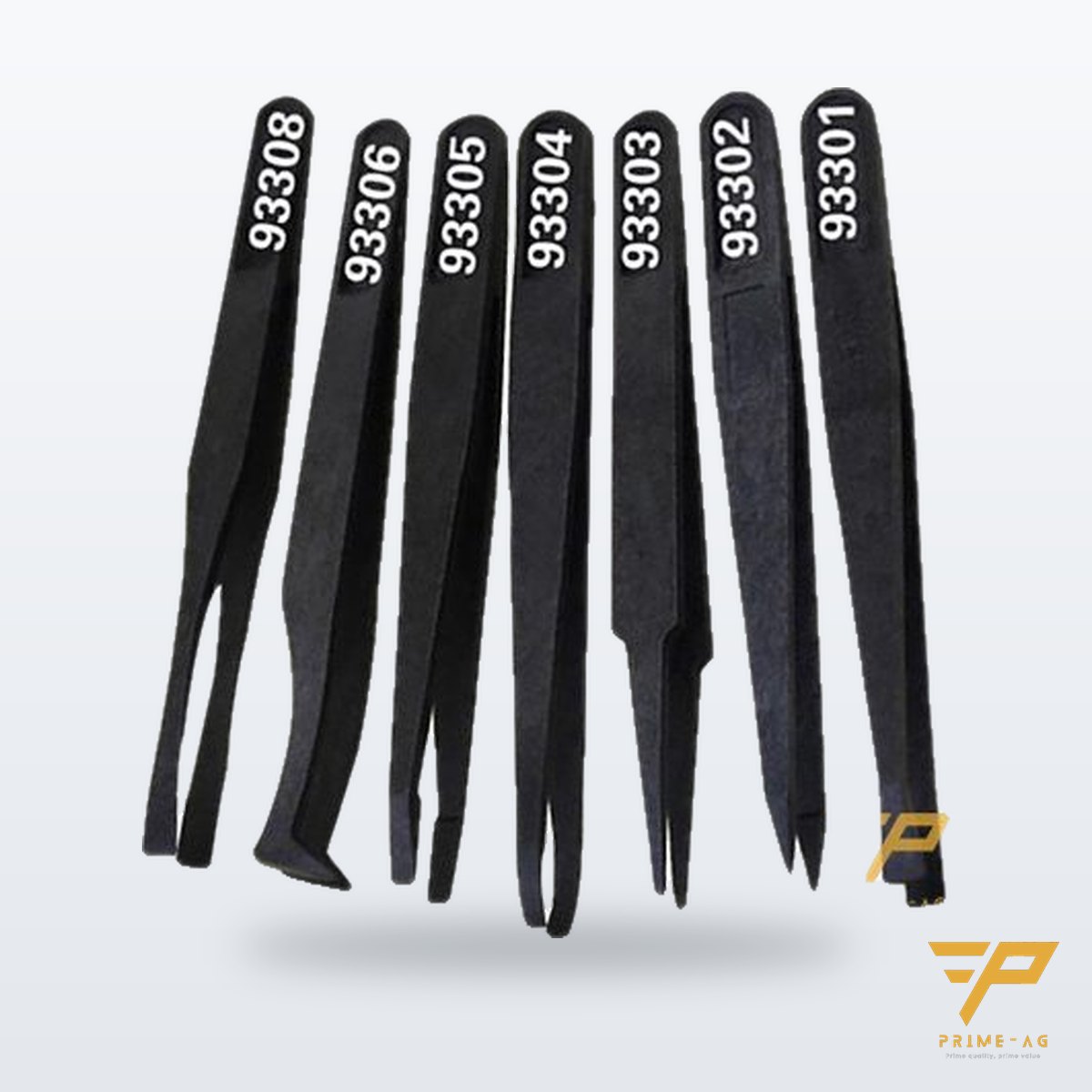
Product code: TW-ESD · Specification: Vetus ESD tweezers & plastic ESD tweezers
Vetus ESD-coated Tweezers, Stainless & Plastic ESD Tweezers
Equivalent names: “Vetus ESD-11 tweezers”, “component pick-up tweezers”, “antistatic tweezers”, “93302 plastic tweezers” — difference: Vetus products carry the genuine-product label (ESD-12 has its own “genuine” version), all 4 lines available, with replacement tips and heat-resistant ceramic-tip tweezers.
Most common models: ESD-10, 11, 12, 13, 14, 15, 259 and ST-11/12.
Delivery: stocked items delivered in 24–48 hours (Ho Chi Minh City, Binh Duong, Dong Nai); other models 5 days; stock confirmed at quotation.
Tweezers are the second-largest consumable after gloves in an SMT factory. Vetus ESD-xx: stainless steel body with black antistatic epoxy coating, precision pointed tips, non-magnetic — for picking 0402/0201 components, solder wire, labels. Vetus ST-xx: bare uncoated stainless steel, to be used sparingly on sensitive components in the EPA; suitable where cleaning with strong solvents is needed. Plastic ESD tweezers 9330x: carbon-filled engineering plastic, does not scratch surfaces, does not conduct heat — for glass, displays and sensitive components. Ceramic-tip tweezers: heat resistant for holding components during soldering. The model number indicates the tip shape: 10 (long pointed), 11 (fine pointed), 12 (standard pointed), 13 (flat tip), 14 (curved), 15 (fine curved), 16 (wide flat), 17 (curved pointed), 249/250/259 (long straight pointed), 7A (curved pointed tip).
| Line | Models | Features | Used for |
|---|---|---|---|
| Vetus ESD | 10, 11, 12, 13, 14, 15, 16, 17, 249, 250, 259, 7A | ESD-coated stainless steel, non-magnetic | SMT, board repair |
| Vetus ST | 10, 11, 12, 13, 14, 15, 16, 17, SS-SA, 2A-SA | Bare stainless steel | Mechanical work, labs |
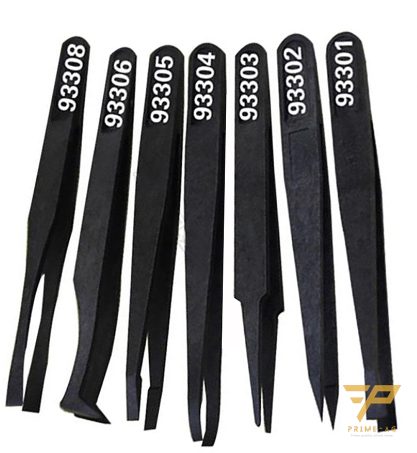
| Plastic ESD | 93301 → 93308 | Carbon-filled plastic, replaceable tips | Glass, displays, sensitive components |
| Ceramic tip | NHIP_S | Ceramic tips rated to 1,000 °C | Holding during soldering |
| Replacement tips | ESD-259, plastic | Replace the tip, keep the body | — |
General: coating resistance as stated by the manufacturer; length 120–140 mm; 1 pc/bag, 12/box; MOQ 12 pcs.
Selection by process
– Picking 0402/0201 → ESD-11 or ESD-15.
– Picking ICs, straightening leads → ESD-12, ESD-13.
– Pulling wires, removing labels → ESD-14, ESD-17.
– Glass, displays → plastic ESD 93302/93303.
– Holding components during soldering → ceramic tip.
Documents: Vetus CO, RoHS; 1 sample per model.
Recurring orders: price held for 6 months; tiered discount for monthly orders >200 pcs.
FAQ
– What is the difference between Vetus ESD and ST? — ESD has a black static-dissipative coating that discharges in a controlled way; ST is bare stainless steel and cheaper; in the EPA, limit its use on sensitive components (CDM risk when metal touches a charged component).
– What if the coating peels? — It can still be used outside the EPA; inside the EPA it should be replaced — usually after 6–12 months.
– How to tell genuine Vetus? — Sharp laser engraving, tips meet tightly when squeezed, box label; PRIMEAG provides CO.
– Can plastic tweezers pick 0402? — Hardly; plastic is for larger components and scratch-sensitive surfaces.
Tweezer body material
- Anti-magnetic, acid-resistant stainless steel: quality electronics tweezers use stainless steel with little or no magnetism. Small components with steel leads or lids do not stick to the tips; the tweezers do not rust when wiped with alcohol or exposed to flux.
- Tips: precision ground, usually polished; the body may be sand-blasted for a non-slip grip. Fine-point tweezers for 0402/0201 components have tips only a few tenths of a millimetre thick, so they bend very easily if dropped.
What does the ESD coating do?
ESD tweezers have a dissipative epoxy coating on the body. As described by manufacturers such as Knipex, the coating equalises the potential between the user and the part in a controlled way, instead of an instantaneous discharge.
ESDA’s ESD TR20.20 handbook (quoted by Desco) states that non-powered hand tools such as pliers, cutters and tweezers are usually grounded through the ESD worksurface and the grounded operator. Plastic-handled metal tools are usually not an ESD concern because they are hard to charge.
Desco adds a note on the charged device model (CDM): if the main contact surface of the tool is conductive metal, touching a charged component will cause a discharge. A dissipative contact surface controls this discharge.
Comparison of tweezer lines
| Line | Electrical property | Advantages | Limitations |
|---|---|---|---|
| ESD-coated stainless (Vetus ESD-xx) | Dissipative body, grounded through the operator | General use in the EPA, comfortable grip | Coating wears and peels over time |
| Bare stainless (Vetus ST-xx) | Fully conductive | Resistant to strong solvents and heat | Direct metal contact with charged components |
| Carbon-filled plastic (9330x) | Dissipative | Does not scratch glass or displays; does not conduct heat | Less precise tips, wears quickly |
| Zirconia ceramic tip | Insulative | Very high heat resistance, non-magnetic, solder does not stick | Brittle, chips easily if dropped |
On ceramic tips: Aven states its zirconia tips withstand up to 1,500 °C, with low thermal conductivity and no magnetism. Another manufacturer states a working temperature above 2,000 °F and explicitly lists the surface as insulative. Ceramic tweezers are therefore for holding parts during soldering and cannot replace ESD tweezers for routine handling.
Inspecting the tips
- Inspect the tips under a magnifier: both tips must meet at the same time, aligned, with no gap when squeezed lightly.
- Bent, splayed or misaligned tips easily flick away small components such as 0402 and 0201.
- ESD-coated tweezers: check the grip area; remove from the EPA if the coating is heavily peeled or cracked.
Storage and long service life
- Keep tweezers in a stand or pouch with tip covers. Do not leave them loose in a toolbox with heavy objects.
- Do not use tweezers to pry, lever, open lids or as a screwdriver — this is the fastest way to ruin the tips.
- Clean with IPA. For ESD-coated tweezers, avoid prolonged soaking in strong solvents.
- Do not put bare stainless tips into molten solder unless necessary — solder build-up thickens the tips and makes small components hard to pick.
Common mistakes
- Assuming any black plastic tweezers are ESD tweezers.
- Using ceramic (insulative) tweezers for routine handling of static-sensitive components.
- Operators not wearing wrist straps — the ESD tweezers then have no path to discharge.
- Using the same tweezers for picking components and removing adhesive or tape — the tips get sticky and carry dust onto the board.
Technical references
- Desco – Hand tools & fixtures per ESD TR20.20 (Q&A)
- Desco – ESD-safe hand tools and CDM (Q&A)
- ESDA – Fundamentals of ESD, Part 3 (hand tools)
- Aven – Ceramic tip tweezers datasheet (zirconia)
- ideal-tek – ESD epoxy coated anti-magnetic tweezers (specifications)
Price: from 16,000 VND (excl. 8% VAT).
REQUEST A QUOTE: send the models and quantity per month — PRIMEAG quotes within 30 minutes.
Hotline/Zalo +84 906 108 292 · info@primeag.vn
Written by the PRIMEAG engineering team.
Related guides:Vetus ESD Tweezers: Straight, Ultra-Fine, Curved or Plastic Tip…Ordinary Tweezers and Brushes Charging Up in the EPA:…Food Ingredient Warehouse Racking in Vietnam: Clearance, Hygiene, FIFO
Related products:ESD Cleaning Brushes
Updated: 2026-10-24
Giao tận nhà máy TP.HCM, Bình Dương, Đồng Nai, Long An, Tây Ninh · Kèm biên bản đo điện trở ESD theo lô · Hotline 0906 108 292