
Stocked item: delivered in 1–2 working days in Ho Chi Minh City, Binh Duong and Dong Nai; free delivery for orders from VND 20,000,000; defective items exchanged within 7 days. Shipping & return policy
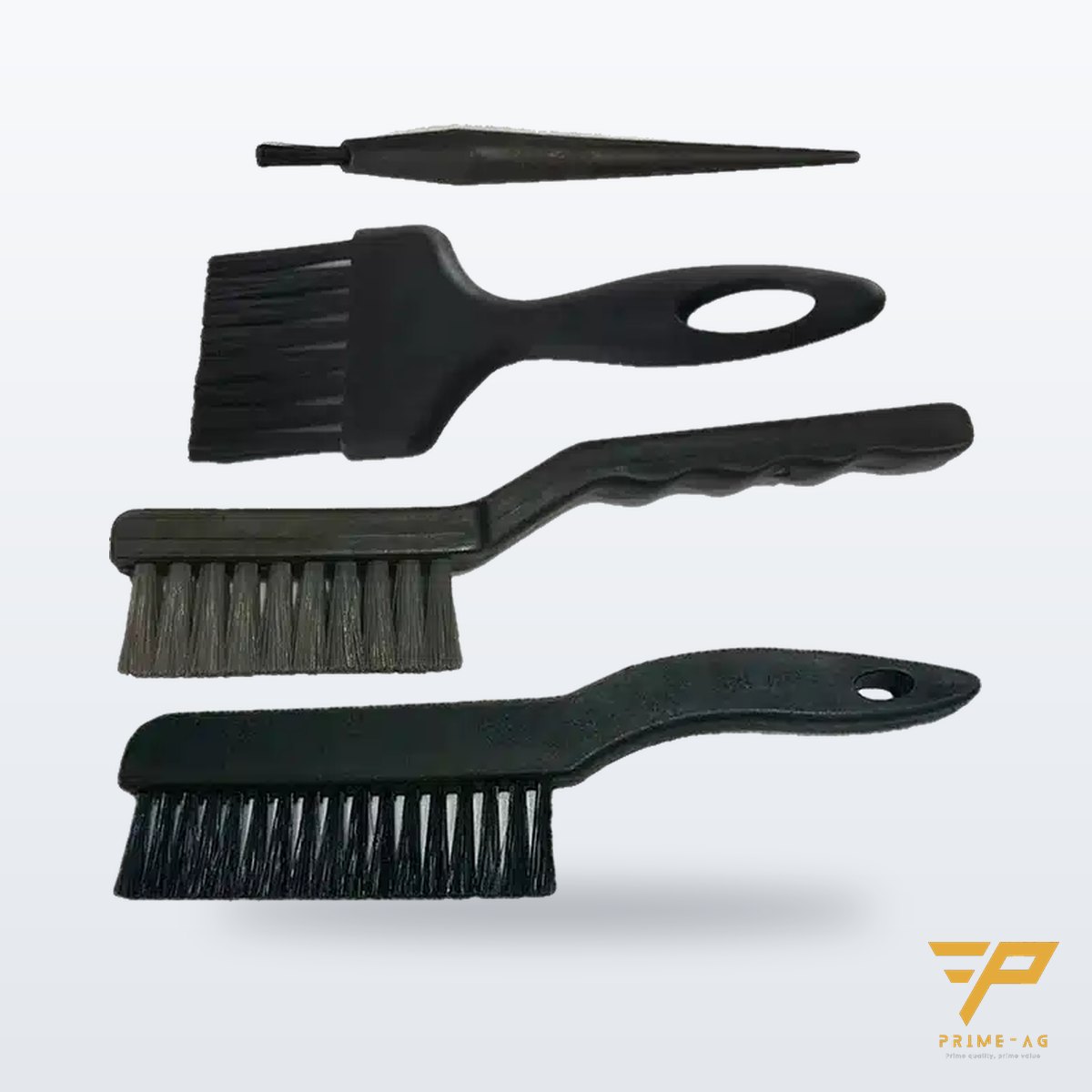
Product code: BR-ESD · Specification: Antistatic brushes (ESD brushes)
ESD-safe Cleaning Brushes
Also known as: “ESD brush”, “black antistatic brush A4”, “PCB cleaning brush”, “brush ESD” — the difference: the full catalogue groups A, B, C, D and F, carbon-loaded plastic (not ordinary plastic painted black), and handles with measurable resistance.
Common specifications: A1, A2, A4, B2, F2.
Delivery: stocked items delivered in 24–48 hours (Ho Chi Minh City, Binh Duong, Dong Nai); other codes 5 days; stock is confirmed with the quotation.
Brushes with carbon-loaded PP handles and conductive nylon bristles — for sweeping dust, solder debris and dry flux from PCBs, connector slots, trays and stencils without charging the components. Codes by shape: A1–A4 toothbrush style with long curved handle, bristle heads from small to large (A4 is the largest and best-selling — for cleaning benches and trays); B1–B3 flat brushes with hanging-hole handle, progressively wider heads; C1–C2 long-handled bench sweeping brushes; D1–D3 block brushes with grip handle; F1–F4 pen brushes with narrow heads for connector slots; A2 copper wire / A3 soft variants. Copper-wire brushes with wooden handles for cleaning moulds and soldering tips.
| Code | Shape | Bristle head size (relative) | Used for |
|---|---|---|---|
| A1 | Long curved handle, small head | Smallest in group A | Connectors, ICs |
| A2 / A2-copper | Long curved handle, medium head | Larger than A1 | PCBs, copper wire for moulds |
| A3 / A3-soft | Long curved handle, large head | Larger than A2 | Large boards, soft version for displays |
| A4 | Long curved handle, largest head in group A | Largest in group A | Benches, trays, ESD bins |
| B1–B3 | Flat, handle with hanging hole | Wider from B1 → B3 | PCBs, flat surfaces |
| C1–C2 | Long-handled bench brush | C1 medium, C2 largest in the range | Sweeping benches, large trays |
| D1–D3 | Block with grip handle (scrubbing type) | Larger from D1 → D3 | Scrubbing trays, bins, bench tops |
| F1–F4 | Pen type, narrow bristle head (F4 narrowest) | Very narrow | Connector slots, small parts |
| Copper wire, wooden handle | Metal | — | Moulds, soldering tips, solder residue |
General: handle resistance 10⁶–10⁹ Ω; IPA-resistant nylon bristles; RoHS; 10–20 pcs/bag; MOQ 10 pcs/code.
Selection by process
– Cleaning ESD benches, trays, bins → A4, C1–C2, D1–D3.
– PCBs after soldering → A2, A3 soft.
– Connector slots, under ICs → group F (F4 has the narrowest head).
– Stencils, soldering tips → copper wire (not for use on PCBs).
Documents: resistance test report, RoHS; sample of 1 pc/code.
Recurring orders: price held for 6 months.
FAQ
– Are ordinary black plastic brushes antistatic? — No; they must be carbon-loaded plastic with measurable resistance. PRIMEAG measures and records it on a test report.
– Do nylon bristles scratch PCBs? — The bristles are soft and light brushing does not scratch; for hard solder residue use copper wire on moulds, not on PCBs.
– Can they be used with IPA? — Yes; dip in IPA, scrub the flux, then let dry.
– Are there ESD brushes for vacuum cleaners? — ESD vacuum nozzles are available, ask PRIMEAG.
Why does brushing a PCB generate static?
Brushing is a continuous sequence of contact, friction and separation between the bristles and the surface of the board and components. This is exactly the mechanism of triboelectric charging. With ordinary plastic brushes and nylon bristles, the charge generated stays on the bristles and handle because insulating materials cannot discharge to ground. ESD brushes address this in two ways:
- Low-charging materials when rubbed against PCBs and solvents.
- A path to ground: conductive or dissipative handle and bristles, so the charge flows through the hand of a grounded operator. Makers such as Menda state clearly that the brush only “drains charge to ground when held by a grounded person”.
Bristle and handle types on the market
| Type | Electrical properties | Notes |
|---|---|---|
| Carbon-loaded nylon bristles (black), metal or conductive plastic handle | Conductive; e.g. Menda specifies 1×10³ to < 1×10⁵ Ω (point-to-point resistance, per a method modified from ANSI/ESD S4.1) | Stiff bristles, for scrubbing solder debris and dry flux |
| Carbon-loaded PP handle, standard nylon 6.12 bristles | E.g. one Menda line: 1×10⁹ to < 1×10¹¹ Ω | Conductive handle, low-charging bristles; the handle’s ESD performance does not depend on humidity like a wooden handle |
| Natural bristles (horsehair, hog hair), wooden handle | “Static neutral” according to Techspray, especially when the bristles are wet with solvent | Techspray notes this line is not a resistance-controlled ESD brush |
| Metal wire (stainless steel, brass) | Conductive, grounded through the operator | Only for moulds, soldering tips and metal parts |
PRIMEAG BR-ESD brushes have carbon-loaded PP handles with handle resistance 10⁶–10⁹ Ω — within the dissipative range of the ANSI/ESD classification.

Correct use in the EPA
- The operator must wear a grounded wrist strap and hold the handle directly. Any gloves or finger cots must be ESD types; insulating gloves cut off the brush’s discharge path.
- Place the board on a grounded ESD bench surface and brush in one direction, moving debris away from components.
- Scrubbing flux with IPA: wet the bristles with a little solvent, brush, then blot the dissolved flux with a cleanroom wiper; let the board dry completely.
- Boards with many insulating parts (plastic connector housings, labels) should also use an ionizing blower. According to ESDA, insulators can only be neutralised by ionization, not discharged through grounding.
Testing and records
- A black colour does not prove a brush is ESD. A resistance test report per lot is required; at incoming inspection, point-to-point or point-to-ground resistance can be measured with a surface resistance meter and small electrodes.
- Add brushes to the hand-tool list of the ESD control program; ANSI/ESD S20.20 requires grounding of all conductors at the workstation, and conductive brushes are grounded through the operator.
- Re-test when the bristles are heavily coated with flux, the handle is cracked, or after changing the cleaning solvent.
Cleaning, storage and service life
- After each shift, shake off debris, rinse the bristles in clean IPA and let them dry with the bristles pointing down or lying flat.
- Assign brushes by process (post-solder, clean area, moulds) and do not mix them. Brushes used on flux and solder must not go back to wiping clean surfaces.
- Replace when the bristles splay, break or fall out, or harden from undissolved flux.
Common mistakes
- Buying ordinary black plastic brushes (toothbrushes, paint brushes) for use in the EPA.
- Brushing boards when the operator is not wearing a wrist strap — the conductive brush then has no discharge path.
- Using metal-wire brushes on populated boards: they easily scratch traces, and broken wires can cause short circuits.
- Brushing hard with stiff bristles over small 0402/0201 components, shifting or dislodging components that have not yet been inspected.
Technical references
- Techspray – Are Techspray technical brushes ESD-safe?
- Menda – ESD brush 35699 datasheet (conductive carbon nylon bristles)
- Menda – ESD brush datasheet (carbon PP handle, nylon 6.12 bristles)
- ESDA – Fundamentals of ESD, Part 3 (hand tools, insulators)
- Desco – ESD-safe hand tools and CDM (Q&A)
Price: from 10,000 VND (excl. 8% VAT).
REQUEST A QUOTE: send the codes and monthly quantity — PRIMEAG quotes within 30 minutes.
Hotline/Zalo +84 906 108 292 · info@primeag.vn
Written by the PRIMEAG engineering team.
Related guides:Ordinary Tweezers and Brushes Charging Up in the EPA:…ESD rubber bench mat curling or bulging: 6 causes…
Related products:ESD Tweezers (Vetus & Plastic ESD)
Updated: 2026-10-24
Giao tận nhà máy TP.HCM, Bình Dương, Đồng Nai, Long An, Tây Ninh · Kèm biên bản đo điện trở ESD theo lô · Hotline 0906 108 292