
Anti-fatigue mats at CNC and injection-molding stations in Vietnam factories that curl at the edges, turn slippery or go hard and brittle within a few months are usually affected by coolant, oil trapped underneath, plasticizer migrating out of the PVC, heat near the mold above roughly 60 °C, or carts running over them. PRIMEAG recommends drying the mat underside, choosing the 14 mm grade with beveled edges, and nitrile rubber for hot, oily areas.
At a machine station the mat faces oil, coolant, plastic pellets and heat all at once; the cause of failure can usually be found right on the spot.
- Slippery: oil film, plastic pellets.
- Curling edges: water trapped under the mat, heat.
- Hard and brittle: plasticizer migrating out of the PVC; standard PVC deforms at about 60 °C.
- Re-specify: 11 / 14 / 20 mm thickness by location, beveled edges, no forklift traffic.
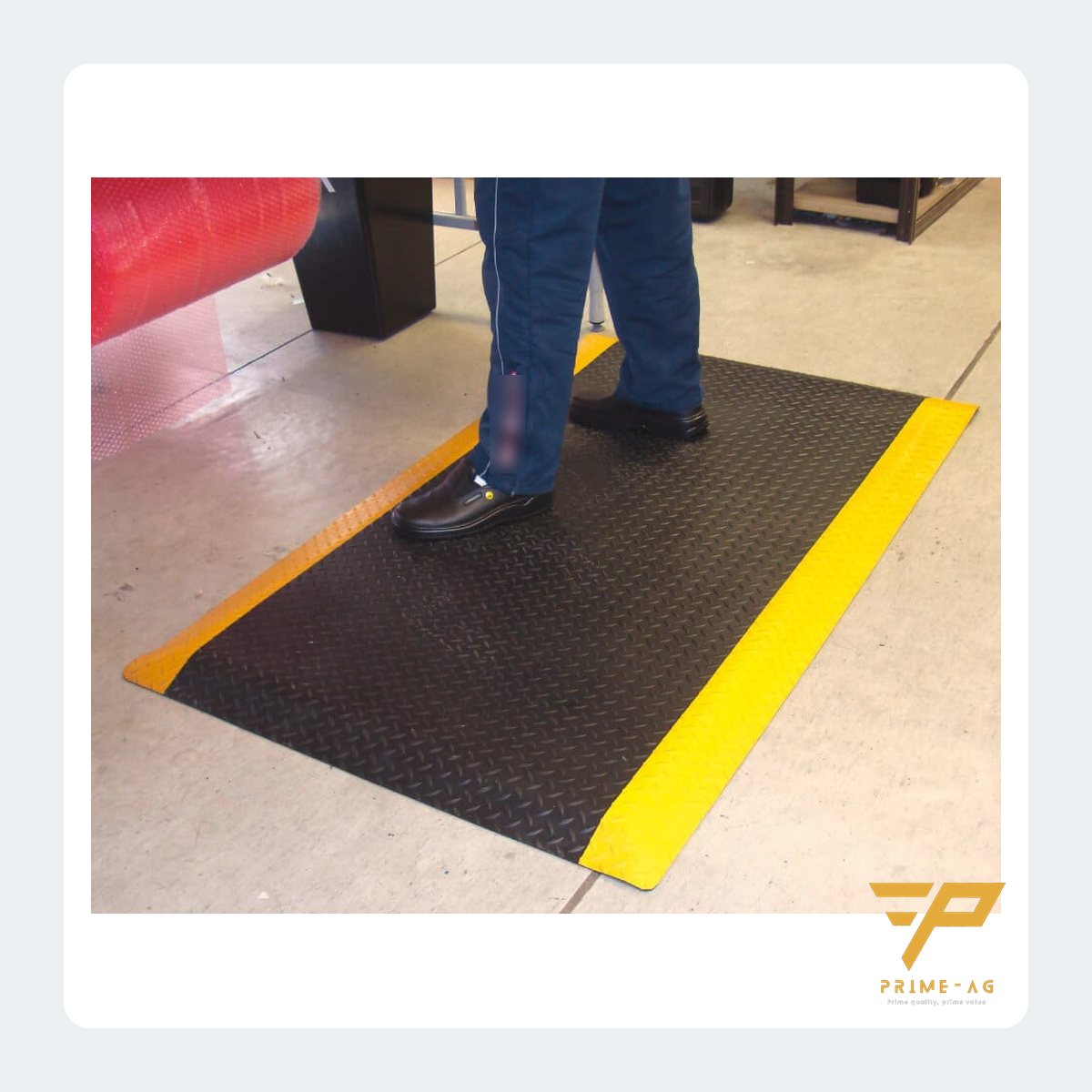
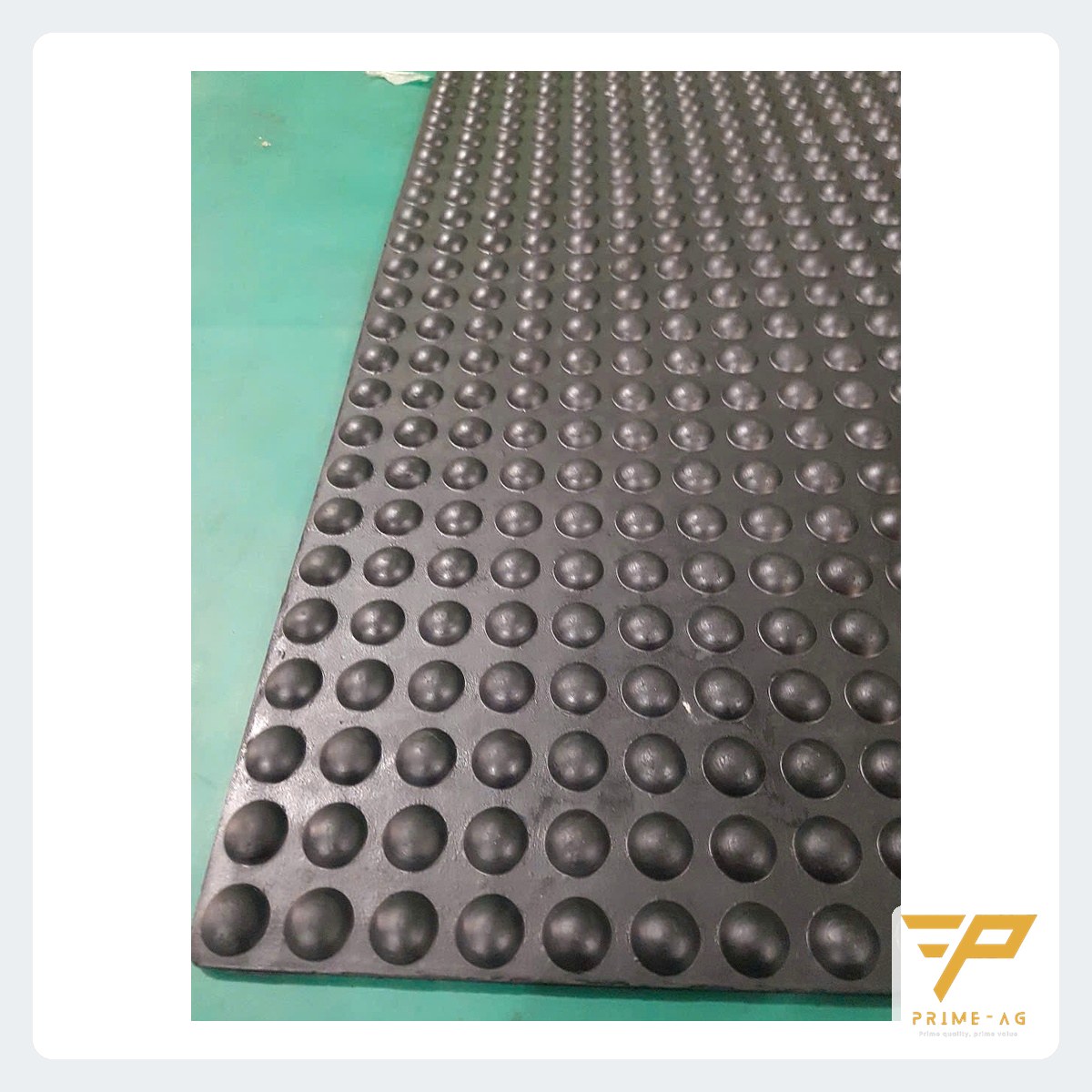
Anti-fatigue mat edges curling up: water and heat under the mat
CNC coolant and floor-washing water run under the mat and pool there. A damp underside lets the mat creep slightly every time the operator shifts weight; the edges get pushed together and curl up.
Lift the mat: a wet floor underneath with oil residue or mold confirms the diagnosis. Fix the leak, dry the mat underside and the floor, then lay it back down.
Injection-molding machines add heat. Standard PVC starts to heat-deform at about 60 °C; a mat lying next to the mold or the hot-part drop zone will ripple and bulge locally.
Slippery surface: oil, coolant, plastic pellets
A PU top layer resists oil fairly well, but an oil film left for long still causes slips; plastic pellets roll under shoe soles like ball bearings. The stud grooves grip when wet but also trap pellets: sweep daily, clean with a neutral detergent and avoid wax-containing products.
For oily areas, press machines, CNC and hot chips, consider nitrile rubber (NBR) mats: better resistance than natural rubber to mineral oil and dilute acids and alkalis, with a working range of about −40 to 108 °C.
Hard and brittle after a few months: plasticizer migration
Foamed PVC stays soft thanks to plasticizer. It is not chemically bound to the polymer, so it gradually migrates out; the mat loses resilience, the surface cracks, the edges become brittle and do not recover. Replace the mat when there is permanent compression where people stand, surface cracking, delamination, or edges curling into a trip hazard.
Compression and tears from vehicles running over the mat
Anti-fatigue mats are designed for foot traffic and hand carts, not forklifts. Forklifts and heavily loaded pallet jacks tear the foam layer and lift the edges after only a few passes. Loose tiles that do not fit together leave gaps that trip people; use a continuous cut roll or tiles joined with beveled edges.
Re-specifying thickness, border and surface
According to CCOHS, prolonged standing can cause foot pain, varicose veins and lower back pain, and standing directly on concrete should be avoided. But foam that is too thick lets the feet sink, reduces stability and can actually increase fatigue.
PRIMEAG anti-fatigue rubber mats are made from foamed PVC with a PU surface and a yellow-black beveled border; thickness 11 / 14 / 20 mm; sheets of 600×900, 900×1200, 900×1500, 900×1800 mm or rolls of 900 × 20 m. The 14 mm grade suits most full-shift standing positions, 20 mm suits cold concrete floors. Let operators trial a mat for half a shift before equipping the whole line.
Symptoms and fixes
| Symptom | Common cause | Fix |
|---|---|---|
| Slippery | Oil film, plastic pellets | Sweep daily; use NBR in oily areas |
| Bulging, curling edges | Water pooled under the mat, heat near the mold | Dry the underside and floor; move away from heat sources |
| Hard, cracked | Plasticizer migration, hot chips | Replace the mat; use NBR in hot-chip areas |
| Compressed, torn edges | Mat too soft, forklifts running over it | Trial the 14 mm grade, reroute vehicle traffic |
Self-check at the machine station
Five questions: is the mat underside wet; is it near a hot mold; is there oil or plastic pellets on the surface; does it still spring back when pressed by hand; do forklifts cross it? Two or more “yes” answers: fix the source of damage first, then replace the mat.
Stock items in the rubber mat range are carried in all sizes and delivered within 24–48 hours in Ho Chi Minh City, Binh Duong and Dong Nai. For chairs and workbench height see reducing fatigue for operators who stand a full shift; for stations after the molding machine see laying out deflashing and visual inspection benches for injection-molded parts.
Frequently asked questions
- Can an anti-fatigue mat be placed right next to an injection molding machine? — Yes, as long as it stays out of the hot zone; standard PVC deforms at around 60 °C.
- Will carts running over an anti-fatigue mat damage it? — Hand carts are fine; forklifts and heavily loaded pallet jacks are not.
- Does a 20 mm anti-fatigue mat reduce fatigue more than a 14 mm one? — Not necessarily. A mat that is too soft lets the feet sink; the middle grade suits most shift workers, while the thickest grade suits cold concrete floors.
Email: info@primeag.vn · Phone/Zalo: +84 906 108 292
Written by the PRIMEAG engineering team
Updated: 2026-10-23