
Industrial plastic crates in Vietnam factories that crack at the handle, split at the base corners or sag when stacked usually suffer from overloading, offset stacking, dragging, recycled resin, sun exposure or PP homopolymer used below 0 °C. PRIMEAG recommends re-specifying: solid virgin-PP crates with lids for high stacking, open-mesh crates for washing lines, and moving loads on 200 kg trolleys.
Where the crack sits tells you whether the crate failed from carrying, dropping or poor stacking.
- Read the crack location to tell carrying, dropping or offset stacking apart.
- Cold storage: avoid PP homopolymer below 0 °C; HDPE stays tougher.
- High stacking: solid crates with lids; keep open-mesh crates for washing.
- Stop hand-carrying and dragging: move crates on a 500 × 700 mm plastic-deck trolley.
Why industrial plastic crates crack: read the crack location
Handle cracking from the edge of the hand hole: the crate was carried too heavy. Cracked base corner: the crate was thrown or dropped, or took a concentrated load from an offset crate above. Bulging walls or a distorted rim: the contents are too heavy or the stack is too tall.
Crates already cracked at the base corner, handle or rim must be pulled from the stack, not taped up and kept in use.
Overloading, offset stacking and dragging
Rounded hand holes suit a person carrying roughly 15–30 kg; carry anything heavier by the handles and the force concentrates at the hole edge, where the crack starts.
The crate base has a rim that locks into the mouth of the crate below. Stack it offset and the rim does not engage, so the load bears on one base corner. Dragging across concrete floors wears down the base rim, making later stacks even more likely to slip.
Open-mesh (perforated) crates carry less stacking load than solid crates of the same size.
Temperature: cold rooms, sunlight and hot wash water
PP homopolymer turns brittle below 0 °C; rubber-modified copolymer grades largely overcome this.
Conversely, HDPE handles hot washing worse than PP, so keep PP in hot-water washer areas. PP also degrades gradually under prolonged exposure above 100 °C, so do not park crates right next to drying ovens.
Under long sun exposure, UV radiation cracks and chalks the surface of PP without UV stabilizer.
Recycled resin: cheap to buy, expensive to replace
Recycled crates are dark, streaky in color, prone to brittleness and crack early at the handles and base corners. Virgin-resin crates have uniform color and a glossy surface, with batch-to-batch consistent mechanical properties, suited to high stacking.
Re-specifying the crate and how loads are moved
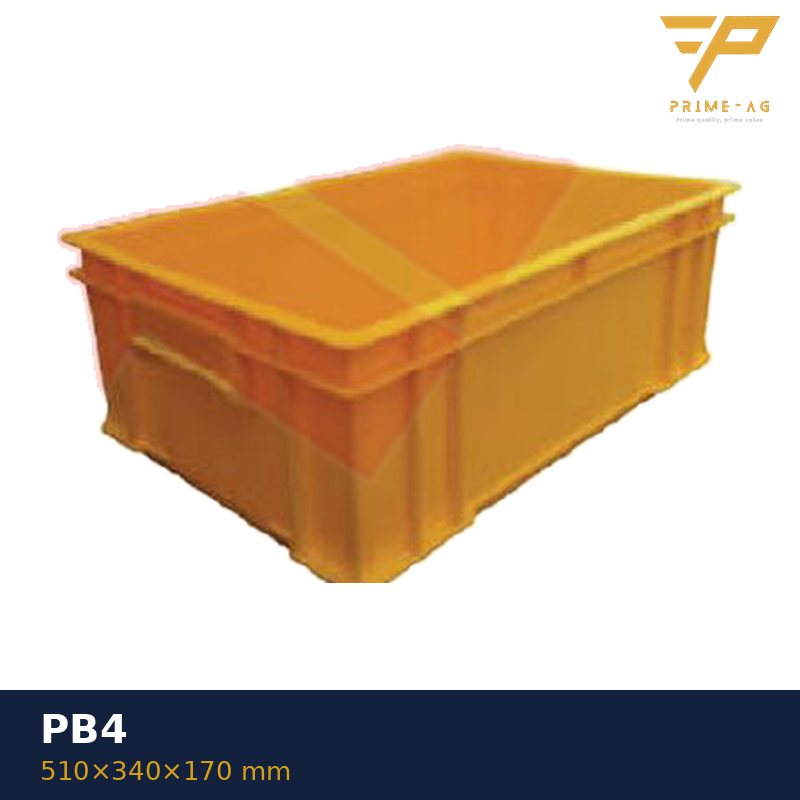
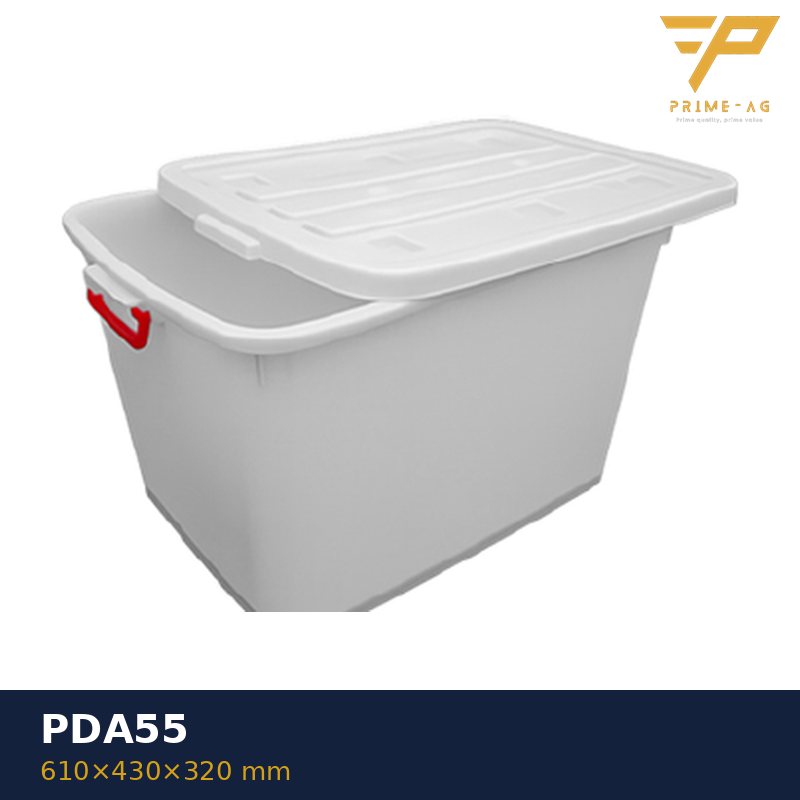
PRIMEAG virgin-PP industrial plastic crates come in 46 solid sizes and 20 open-mesh sizes, with an outside-dimension tolerance of ±3 %. For high-stack storage choose a solid crate with lid such as the PDA55, 610 × 430 × 320 mm; for small parts use the PB2–PB8 series. MOQ 10 crates; logo printing and dividers available.
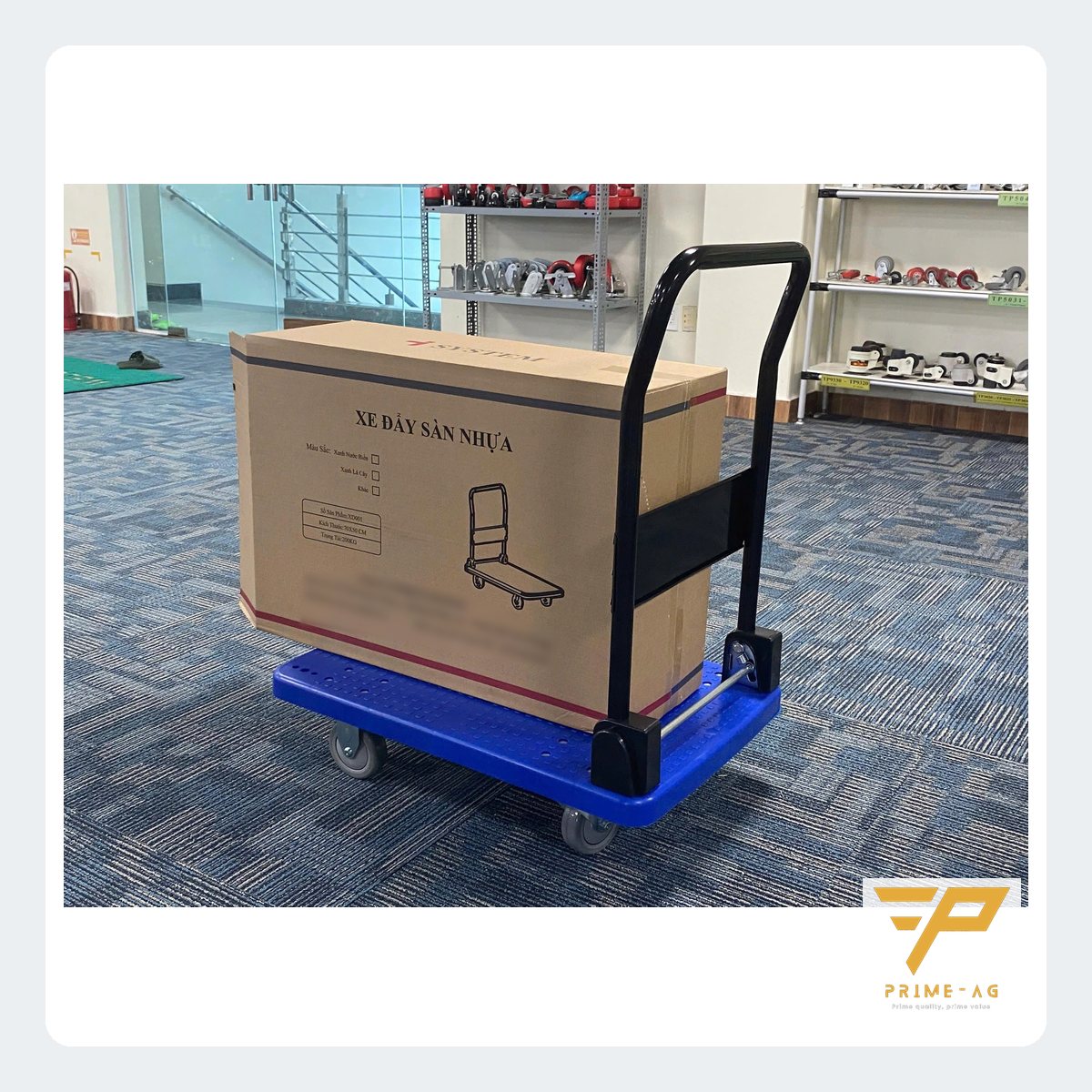
Replace hand-carrying and dragging with a 500 × 700 mm plastic-deck hand trolley: 200 kg evenly distributed load, folding handle, 12-month warranty. To move several tiers of 600 × 400 crates, use a multi-tier lean pipe (plastic-coated steel pipe, Φ28) trolley rated 100 kg per tier, with a 3-year frame warranty. How to size trolley load capacity is covered in warehouse trolleys with broken casters or tipping over, and how to choose load capacity.
PP or HDPE by storage condition
| Property | PP | HDPE |
|---|---|---|
| Melting point | Approx. 160–166 °C | Approx. 132 °C |
| Hot washing, steam sterilization | Good | Poorer than PP |
| Below 0 °C | Homopolymer brittle; rubber-modified copolymer better | Tougher |
| Chemicals | Oils and greases, non-oxidizing acids and alkalis | Wide range of solvents, fuels |
| Best for | Multi-tier stacking crates, hot-wash areas | Cold storage, solvent environments |
Check a crate stack yourself in 5 minutes
Look from the side: is the stack straight? Turn one crate over: is the base worn flat, with the rim gone? Inspect the handles: any white stress marks or crazing?
Send us your findings with photos and PRIMEAG will quote within 30 minutes. If the crates sit on racks with location codes, rework the material flow following the warehouse solution for wrong-location picks and slow picking.
Frequently asked questions
- Can a plastic crate with a cracked handle be taped or welded and kept in use? — Not recommended; handles, base corners and rims are where crates fail suddenly under heavy carrying or stacking, so crates cracked there should be scrapped.
- Which plastic crate should we use in a cold room below 0 °C? — Avoid PP homopolymer, which turns brittle at sub-zero temperatures; choose HDPE or rubber-modified PP copolymer and confirm the resin type when ordering.
- Can open-mesh crates be stacked as high as solid crates? — No; at the same size, open-mesh crates carry less stacking load. Use open-mesh crates for washing and draining, and solid crates with lids for high-stack storage.
Email: info@primeag.vn · Phone/Zalo: +84 906 108 292
Written by the PRIMEAG engineering team
Updated: 2026-10-23