
Stocked item: delivered in 1–2 working days in Ho Chi Minh City, Binh Duong and Dong Nai; free delivery for orders from VND 20,000,000; defective items exchanged within 7 days. Shipping & return policy
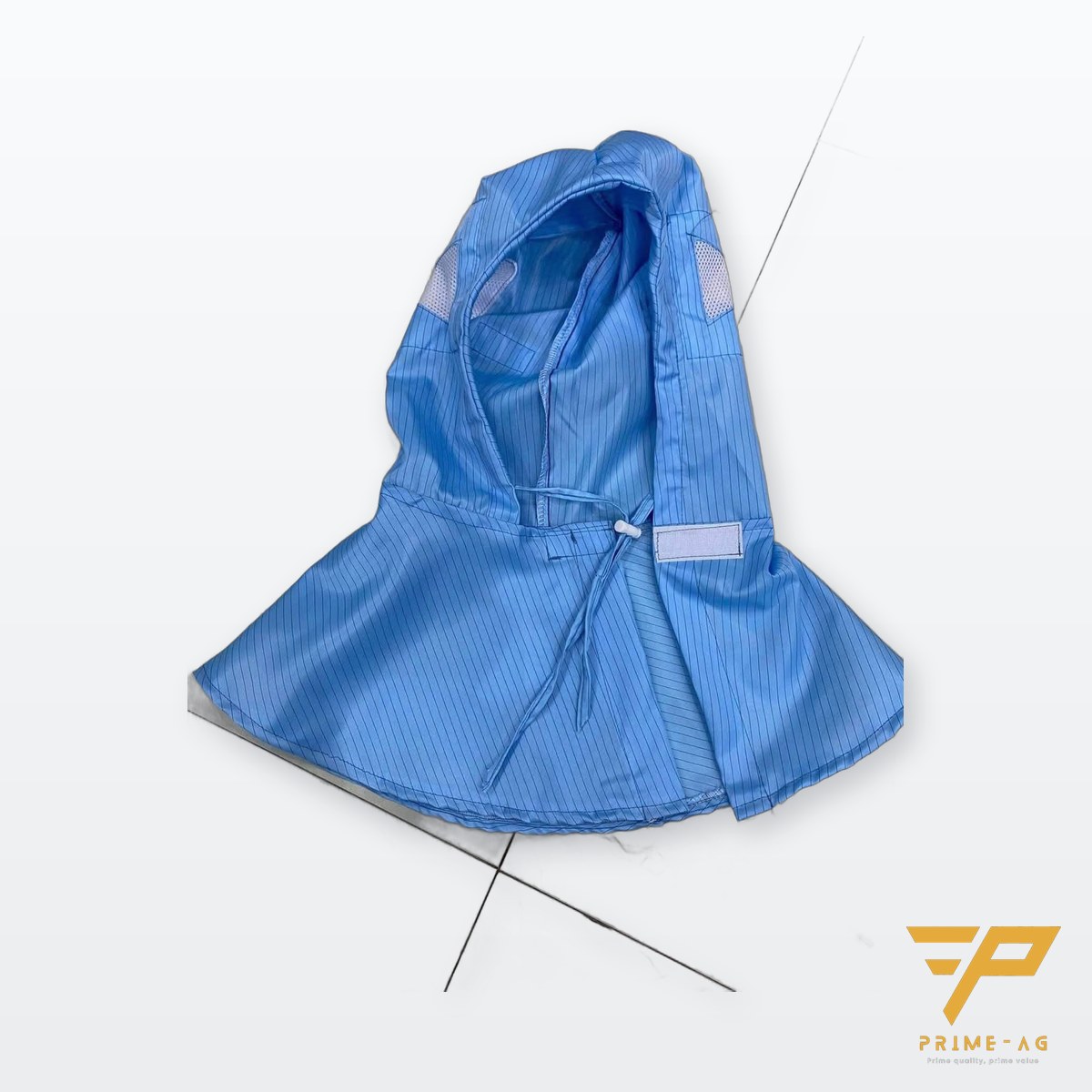
Code: CH-HOOD · Specification: cleanroom shoulder-length hoods, fabric caps & hair nets. Delivery: in stock, delivered within 24–48 hours (Ho Chi Minh City, Binh Duong, Dong Nai); lead time for bulk orders is confirmed with the quotation.
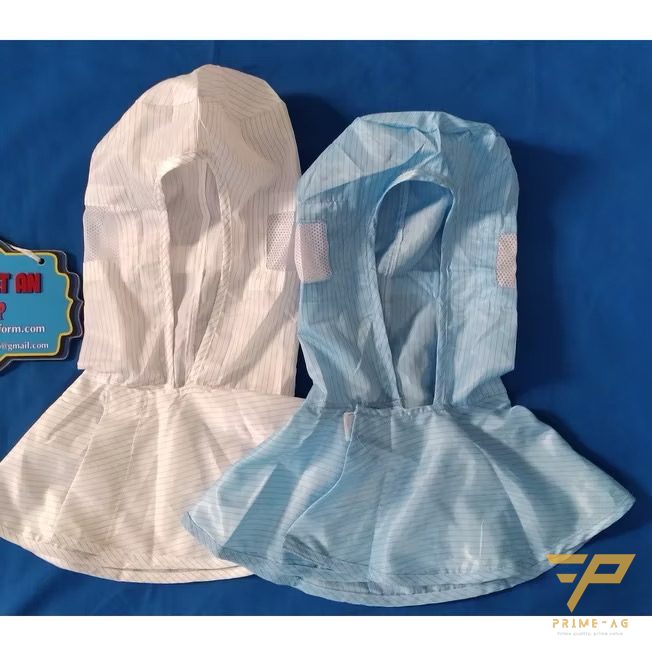
Also known as: “hood with shoulder cape”, “cleanroom hood”, “ESD hood”, “white hair net” — the difference: long cape covering the shoulders, tucked inside the garment, elasticated face opening, 5 colours matching the garment.
Common specification: white hood with cape, blue cap.
The hood with shoulder cape fully covers hair, neck and shoulders; the cape is tucked inside the coverall/smock, leaving only the face exposed — mandatory in ISO 5–6 and in SMT areas sensitive to hair particles. The round drawstring ESD fabric cap is for standard EPAs. The white non-woven hair net is single-use for visitors/maintenance.
Company logo printing available on request.
| Type | Fabric | Class | Colour | Packing |
|---|---|---|---|---|
| Hood with shoulder cape | Carbon-stripe polyester, 10⁶–10⁹ Ω | ISO 5–7 | White, sky blue, pink, yellow, purple | 10/bag |
| Fabric cap | Carbon polyester | EPA, ISO 7–8 | White, blue | 10/bag |
| Hair net | Non-woven PP | Visitors, short-term | White | 100/bag |
Selection: ISO 5–6 → hood with cape; EPA → fabric cap or peaked cap (CH-CAP); visitors → hair net or non-woven cap (CH-01).
Why do high-grade cleanrooms require hoods with shoulder capes?
The head and neck shed a lot of particles: hair, dandruff, skin flakes, breath. EU GMP Annex 1 (2022) requires, at the highest cleanliness grade, that headgear covers all hair, including facial hair, and that a separate hood is tucked into the neck of the coverall, while the mask and goggles cover the facial skin. FDA guidance likewise requires garments that cover skin and hair, with the parts overlapping to form a continuous barrier.
A hood with shoulder cape meets exactly this requirement: the long cape covers the neck and shoulders and sits inside the garment, so particles from the hair and neck skin have no way out; only the eye–nose area is exposed, and that is covered by the mask and goggles.
Comparing the three types
| Criterion | Hood with shoulder cape | Round fabric cap | Non-woven hair net |
|---|---|---|---|
| Coverage | Hair, ears, neck, shoulders | Hair, upper ears | Hair |
| ESD | Yes (carbon fabric) | Yes (carbon fabric) | No |
| Reuse | Washable | Washable | Single-use |
| Area | ISO 5–7 | EPA, ISO 7–8 | Visitors, short maintenance; liner inside the hood |
How to put on the hood correctly
- Tie the hair up neatly; wearing a non-woven hair net underneath to hold the hair is recommended.
- Put on the cleanroom mask (PPE-MASK) before the hood.
- Pull on the hood and adjust the face opening to fit snugly; the hood edge overlaps the mask edge, leaving no exposed cheeks or forehead.
- Put on the coverall, tuck the whole cape inside the collar, and zip up fully to the neck.
- Check in the mirror: no visible hair, no cape showing outside, snaps/ties fastened.
Static at the head
In the triboelectric series published by ESDA, human hair sits on the positive side, near the top of the series, so it charges easily when rubbed against synthetic fabrics. A carbon-fibre fabric hood reduces charging in the area directly above the product when the operator leans over. However, headgear is a non-grounded garment; the person must still be grounded by a wrist strap or ESD footwear. Non-woven PP hair nets have no ESD properties — in an EPA they should only be used as a liner inside a fabric hood.
Washing, replacement and service life
- Hoods and fabric caps are washed together with cleanroom garments: in a separate laundry, without fabric softener; inspect after every wash.
- Annex 1 requires a defined maximum number of wash cycles for reusable garments and replacement when damage is found — check especially the face-opening elastic, cape seams and snaps.
- Torn hoods or stretched elastic must be replaced immediately; do not mend and reuse them in ISO 5–6 areas.
Common mistakes
- Leaving the cape outside the garment — it no longer covers the neck and shoulders.
- Putting on the mask after the hood, which shifts the hood out of place.
- Using an oversized hood with a wide-open face opening.
- Removing the hood inside the cleanroom to wipe sweat or adjust hair.
FAQ
- Is the cape tucked inside or outside the garment? — Inside, so hair particles do not fall out.
- Are goggles/mask integrated? — No; use a separate cleanroom mask (PPE-MASK).
Technical references
- European Commission – EU GMP Annex 1 (2022), section 7: cleanroom garments
- U.S. FDA – Guidance: Sterile Drug Products Produced by Aseptic Processing
- ESDA – Fundamentals of ESD, Part 1: An Introduction to ESD
- ESDA – Fundamentals of ESD, Part 3: Basic ESD Control Procedures and Materials
- IEST – IEST-RP-CC003: Garment System Considerations for Cleanrooms
Price: from 35,000 VND (excl. 8% VAT).
REQUEST A QUOTE: send codes, specifications and quantities — PRIMEAG quotes within 30 minutes.
Hotline/Zalo +84 906 108 292 · info@primeag.vn
Written by the PRIMEAG engineering team.
Related guides:Vinyl vs Nitrile Gloves for Food PackingHair Contamination in Food Packaging: Bouffant Caps, Hairnets and…
Related products:ESD SmocksESD Shirts and Shirt-Cap SetsDisposable Non-Woven Shoe CoversCleanroom Head Covers and Shoe Covers
Updated: 2026-10-24
Giao tận nhà máy TP.HCM, Bình Dương, Đồng Nai, Long An, Tây Ninh · Kèm biên bản đo điện trở ESD theo lô · Hotline 0906 108 292