
Stocked item: delivered in 1–2 working days in Ho Chi Minh City, Binh Duong and Dong Nai; free delivery for orders from VND 20,000,000; defective items exchanged within 7 days. Shipping & return policy
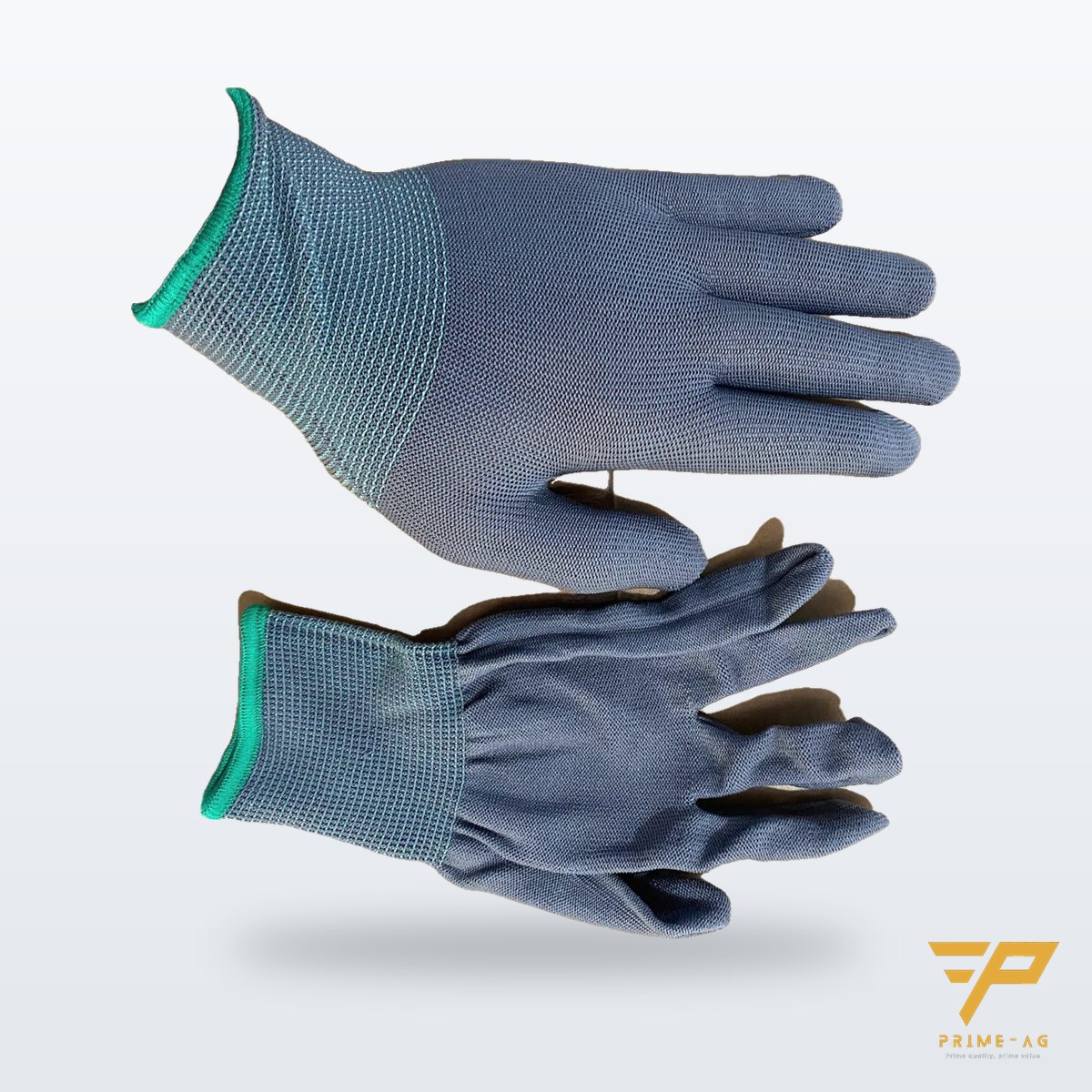
Product code: GS-THO · Specification: Uncoated polyester knitted gloves, white / grey
Uncoated 13G Polyester Liner Glove
Equivalent to: “knitted work gloves”, “white liner gloves”, “uncoated polyester gloves”, “grey gloves” — what is different: evenly knitted 13G liner (no loose fingers), packed 100 pairs per carton, 2 colours and 3 sizes, the most stable consumption in the knitted glove group.
Delivery: in stock, delivered within 24–48 hours (Ho Chi Minh City, Binh Duong, Dong Nai); lead time for bulk orders is confirmed with the quotation.
The knitted work glove is the plain 13G polyester liner without PU coating — light, breathable and the cheapest of the knitted gloves. Use it where hands only need protection from dirt and light scratches: moving dry goods, packing, as a liner inside nitrile/latex gloves to absorb sweat, and handling film-wrapped finished goods. White for areas where dirt must show, grey for workshops. This is the highest-consumption item in the knitted glove group at electronics plants in southern Vietnam.
| Item | Value |
|---|---|
| Material | 100 % polyester, seamless 13G knit, elastic knit cuff |
| Coating | None |
| Colour | White / grey |
| Sizes | S / M / L |
| Weight | ≈ 12 g/pair |
| Standards | EN ISO 21420:2020 (replaces EN 420; checked against the supplier’s certificates), RoHS |
| Packing | 10 pairs/bag (ML version) or 12 pairs/bag · 100 pairs/carton |
| MOQ | 1 carton |
Selection by process step
– Handling dry goods, transport, liner inside rubber gloves → knitted work gloves (this item).
– Grip and anti-slip needed → PU palm-coated gloves (GP-GP / GP-P).
– Smooth finish that will not scratch surfaces → ultra-fine gloves (GS-SM).
– Cut or heat resistance needed → specialised glove range.
Documents per lot: RoHS, CO/CQ; 5-pair sample.
Scheduled orders: price held for 6 months, minimum stock of 5 cartons of size M.
FAQ
– What is the difference between polyester knitted gloves and cotton gloves? — Polyester sheds less lint, dries faster and is cheaper; cotton absorbs sweat better but sheds much more lint.
– Can they be used in a cleanroom? — No; knitted polyester still sheds lint, and cleanrooms use nitrile.
– Can they be washed and reused? — Yes, 5–10 times; many factories wash them and reissue them to the logistics area.
– What does 13G mean? — A knit density of 13 needles/inch — finer than 10G, thicker than 15G.
Polyester yarn: why is it the most common liner material?
According to ISHN, polyester is a low-cost, widely available synthetic fibre with medium tensile strength and low cut resistance; textured polyester yarn has good abrasion resistance for its price; and it has broad chemical resistance. Drawbacks: moderate heat resistance, with a risk of melting and dripping when exposed to high heat or flame. These properties explain why the polyester knitted glove is the “base glove”: cheap, light, durable enough — and it is also the liner that is dipped in PU to make Grey Top and White Palm gloves.
Polyester knitted gloves can be made from filament yarn or spun yarn — the yarn type affects lint shedding, so ask PRIMEAG when using them near sensitive products. According to SHOWA, continuous filament yarn sheds almost no lint, unlike short-staple cotton — which is why polyester knitted gloves are cleaner than cotton gloves when used near enclosed electronic products.
What does 13G mean in practice?
Gauge is the number of needles per inch on the knitting machine; the higher the gauge, the thinner and more flexible the glove. SHOWA calls 13G the “balance” point between durability and dexterity. According to ISHN, a 13G glove knitted from fine yarn (for example 210 denier) has about 30–40 % open area — which is why knitted gloves are breathable and cool, but it also means fine dust and liquids pass through easily.
| Gauge | Characteristics | Used for |
|---|---|---|
| 7G | Very heavy, thick yarn, cushions the hand | Heavy materials handling |
| 13G | Balance of durability and dexterity | General tasks (this item) |
| 18–21G | Very thin, sensitive | Precision assembly, surface inspection |
Use as a liner inside rubber gloves
- Wearing knitted gloves inside thick nitrile/latex gloves reduces sweat build-up and chafing when rubber gloves must be worn for long periods (cleaning, chemical mixing).
- Liners must be dry and clean; sweat-soaked liners must be changed, otherwise the skin stays damp for the whole shift.
- Do not use knitted gloves as liners for cleanroom gloves: knitted yarn still sheds lint, and cleanrooms specify their own gloves.
General requirements and size selection
EN 420 has been replaced by EN ISO 21420:2020, which applies to all protective gloves: material pH 3.5–9.5, size table, and dexterity in 5 levels (level 5 can pick up a pin of 5 mm diameter). Size table by hand circumference:
| Size | Hand circumference (mm) | Hand length (mm) |
|---|---|---|
| S (7) | 178 | 171 |
| M (8) | 203 | 182 |
| L (9) | 229 | 192 |
Uncoated knitted gloves are generally only for minimal risks (dirt, light scratches). Under Circular 25/2022/TT-BLDTBXH, personal protective equipment must match the hazards of the job — process steps with sharp edges, heat or chemicals must not be issued knitted gloves in place of specialised gloves.
Washing and reuse
- Wash at a moderate temperature (glove makers such as Ansell state 40 °C for PU-coated knitted gloves); do not tumble-dry hot — polyester shrinks and pills at high temperatures.
- Sort by colour and size before washing; wash white gloves separately to keep their dirt-revealing function.
- Discard gloves with holes at the fingertips, stretched cuffs or pilling: stretched gloves slip off the hand when carrying goods.
Common mistakes
- Using knitted gloves for slippery or oily parts — with no coating they slip; switch to PU-coated or nitrile gloves.
- Wearing knitted gloves at machines with rotating shafts or drill bits: the fabric can be caught and pulled in.
- Using polyester gloves near soldering irons, ovens or heat presses — risk of melting onto the skin.
- Assuming knitted gloves are antistatic: standard polyester yarn builds up charge through friction; EPA areas use carbon-fibre gloves and still require a grounded wrist strap.
Technical references
- ISHN – Anatomy of a glove: knit, dip and fibers
- SHOWA – Fiber foundations: staple, filament and gauge
- MSC Industrial – Choosing work glove gauge for safety & dexterity
- Wenaas – EN ISO 21420:2020 (replacing EN 420): general requirements, size table
- Ansell – HyFlex 11-600 (PU-coated glove, EN 388 data)
- Circular 25/2022/TT-BLDTBXH – provision of personal protective equipment
Price: from 2,900 VND (excl. 8% VAT).
REQUEST A QUOTE: send the number of pairs per month by colour and size — PRIMEAG quotes within 30 minutes.
Hotline/Zalo +84 906 108 292 · info@primeag.vn
Written by the PRIMEAG engineering team.
Related guides:Choosing Gloves by Process Step in Electronics Manufacturing: 12…
Related products:Cotton, String Knit and Heavy Knit Work GlovesSuper-Fine Inspection Gloves
Updated: 2026-10-24
Giao tận nhà máy TP.HCM, Bình Dương, Đồng Nai, Long An, Tây Ninh · Kèm biên bản đo điện trở ESD theo lô · Hotline 0906 108 292