
Stocked item: delivered in 1–2 working days in Ho Chi Minh City, Binh Duong and Dong Nai; free delivery for orders from VND 20,000,000; defective items exchanged within 7 days. Shipping & return policy
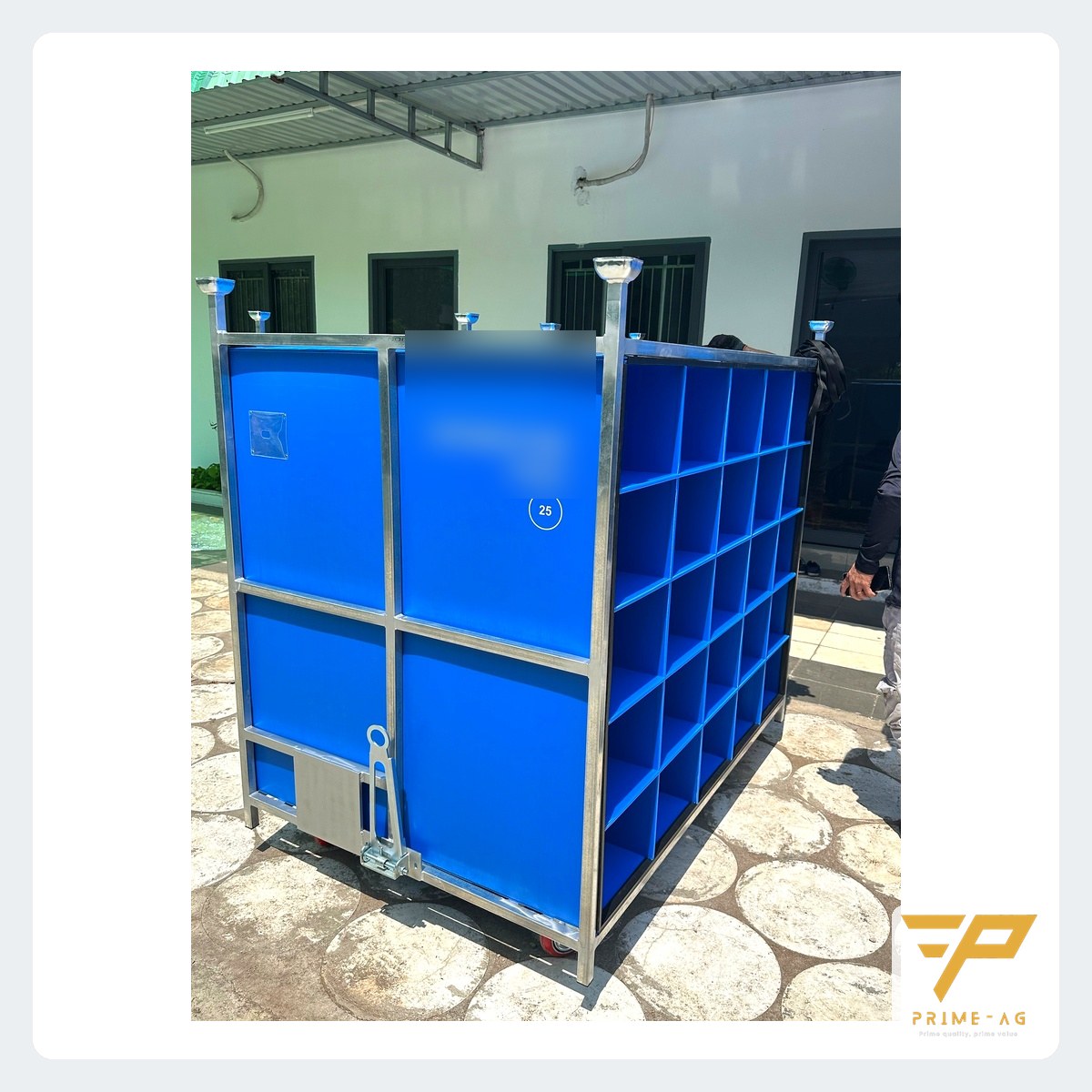
Product code: EB-STD · Specification: Industrial plastic bins in 46 sizes (PA, PB, PSB, PDA) & lids
Industrial Plastic Crates & Lids
Also known as: “B8 plastic bin”, “B3 plastic crate”, “A5 parts tray”, “610×420×390 blue bin”, “anti-static bin lid” — the difference: a ready-to-use size chart of 46 sizes, both solid and perforated versions, and an ESD lid that fits the ESD bin (EB-6142).
Delivery: stocked items are delivered in 24–48 hours; made-to-order items 3–7 working days.
Standard (non-ESD) plastic bins for raw material stores, boxed finished goods and assembly lines that are not static-sensitive — at half the price of ESD bins. From 109×95×52 parts trays up to 610×420×390 bins and bins on castors, stackable, with perforated-bottom versions for drainage (washing, food). The black ESD bin lid fits 610×420 bins (both ESD and standard). Accessory groups also available: bag frames (F8), chemical trays, large bins on castors. See the plastic tray and bin size chart.
Some commonly used sizes (external dimensions, mm, tolerance ±3 %; all 46 solid bin sizes and 20 open (perforated) crate sizes are in the plastic tray and bin size chart):
| Code | External (L×W×H) mm |
|---|---|
| PB2 | 455 × 270 × 120 |
| PB3 | 460 × 330 × 182 |
| PB4 | 510 × 340 × 170 |
| PB8 | 520 × 424 × 220 |
| PSB025 | 610 × 420 × 100 |
| PSB017 | 610 × 420 × 250 |
| PSB026 | 610 × 420 × 390 |
| PDA55 (with lid) | 610 × 430 × 320 |
| ESD lid 610×420 | 605 × 420 × 28 — for the 610×420 range (on a standard bin it only keeps out dust and does not turn it into an ESD bin) |
Virgin PP; logo printing, text printing, label card holders, dividers and lids available; MOQ 10 bins; embossed logo from 500. For food use: request test results to the Ministry of Health technical regulation for plastic food-contact packaging when ordering.
Selection: ESD needed → EB-6142; washing, food → perforated; high stacking in the warehouse → solid, with lid.
FAQ
– Are the blue bins anti-static? — No; ESD bins must be black, carbon-loaded and measurable.
– Do the lids lock? — Drop-on lids, with optional cable-tie locking.
Material: why do industrial bins use PP or HDPE?
Industrial plastic bins (crates) are injection-moulded in one piece from polypropylene (PP) or high-density polyethylene (HDPE). Both plastics are lightweight, impact resistant, rust-free, non-absorbent and resistant to most common chemicals.
| Property | PP | HDPE |
|---|---|---|
| Density | 0.895–0.93 g/cm³ (the lightest of the common plastics) | 0.93–0.97 g/cm³ |
| Melting point | about 160–166 °C (commercial grades) | about 132 °C |
| Resistance to hot washing, steaming | Good, withstands steam sterilisation | Poorer than PP |
| Low temperatures | Brittle below 0 °C for PP homopolymer; rubber-modified copolymer grades perform better | More flexible at low temperatures |
| Chemicals | Resistant to oils and greases, non-oxidising acids and alkalis | Broad solvent resistance, good fuel resistance |
PP is chosen for most stacking bins in factories because it is stiffer, withstands hot washing better and holds its shape well when stacked many levels high.
Virgin and recycled plastic
- Virgin: even colour, glossy surface, odourless; consistent mechanical properties from lot to lot. Suitable for high stacking and food contact (a certificate of conformity from the manufacturer is required).
- Recycled: dark, uneven colour, may contain impurities; prone to brittleness and early cracking, especially at the handles and bottom corners.
- Bins in direct contact with food must meet the Ministry of Health technical regulation on hygiene and safety of plastic packaging; ask the supplier to provide test results per lot.
Construction and choosing a bin type
- Solid (closed) bins: hold small components and screws; better dust protection when fitted with a lid. Used for component stores and finished goods.
- Perforated (open) crates: drain water and allow airflow; used for washing parts, vegetables and fruit, and parts that need to dry quickly.
- Ribs and rim: vertical ribs carry the load when stacked; a thick rim keeps the bin from bulging when full. The base has a lip that locates in the rim of the bin below so the stack does not slide.
- Hand-hole handles: rounded edges so hands are not pinched when lifting bins of 15–30 kg.
The B7/B8 size (610 × 420 mm) is the common size in Asian markets. Europe uses the Euro container system to VDA 4500 with sizes 600 × 400 and 400 × 300 mm, which fit exactly on a 1,200 × 800 mm pallet. If the factory uses trolleys or racks built to the Euro standard, measure beforehand.
Standard bins in electronics factories: where to use them, where to avoid them
Blue and yellow PP bins are insulative materials. When rubbed or slid across a bench, the bin becomes charged and cannot discharge through ground. According to ESDA, all containers used in an EPA must be low-charging and either dissipative or conductive.
- Suitable: stores for non-static-sensitive materials (plastic housings, packaging, mechanical accessories), finished goods in sealed boxes, packing areas, maintenance spare parts stores.
- Not suitable: holding bare PCBs, ICs or modules in the EPA. Use carbon-loaded ESD bins (EB-6142).
- ESD lid on a standard bin: serves only as a dust cover. The bin body remains insulative and does not become an ESD bin.
Storage, cleaning and service life
- Wash with water and a neutral detergent; PP withstands hot water and crate washing machines.
- Avoid prolonged outdoor storage: UV rays crack PP and cause surface chalking unless UV stabilisers are added. Black bins containing carbon black withstand sunlight better than light-coloured bins.
- PP gradually degrades with prolonged exposure to high temperatures (above 100 °C). Do not place bins next to drying ovens or hot presses.
- Discard bins with cracks at the bottom corners, handles or rim — these points fail suddenly when stacked or lifted heavy.
Common mistakes
- Stacking perforated crates full of heavy goods too high — perforated crates have lower stacking strength than solid bins of the same size.
- Dragging bins across concrete floors: the base wears and loses its stacking lip.
- Using recycled bins for food or pharmaceuticals.
- Bringing standard plastic bins onto EPA workbenches “for convenience” — a charge source right next to the components.
Technical references
- Wikipedia – Polypropylene (temperature, chemicals, UV stabilisers)
- Wikipedia – High-density polyethylene
- Wikipedia – Euro container (VDA 4500, 600×400 module)
- Wikipedia – Carbon black (conductive filler, UV absorption)
- ESDA – Fundamentals of ESD, Part 3 (packaging, ANSI/ESD S541, garments, carts)
Price: from 100,000 VND (excl. 8% VAT).
REQUEST A QUOTE: send the quantity and specifications you need — PRIMEAG quotes within 30 minutes.
Hotline/Zalo +84 906 108 292 · info@primeag.vn
Written by the PRIMEAG engineering team.
Related guides:Missing Screws in Flat-Pack Furniture Cartons: Bagging Bench, Divided…Molded Plastic Parts Warping After Stacking Hot: Cooling Racks,…Food Ingredient Warehouse Racking in Vietnam: Clearance, Hygiene, FIFO
Updated: 2026-10-23
Giao tận nhà máy TP.HCM, Bình Dương, Đồng Nai, Long An, Tây Ninh · Kèm biên bản đo điện trở ESD theo lô · Hotline 0906 108 292