
Made to order: delivered and installed as quoted, covered by warranty, no returns. Shipping & return policy
Product code: FS-INSTALL · Specification: Floor adhesive, floor finish chemicals & ESD floor installation service
ESD Floor Adhesive, Conductive Floor Finish & Installation Service
Common specifications: adhesive, JD-37, EAR-11 according to project m².
Delivery: stocked items are delivered in 24–48 hours (Ho Chi Minh City, Binh Duong, Dong Nai); made-to-order items 3–7 working days; availability is confirmed with the quotation.
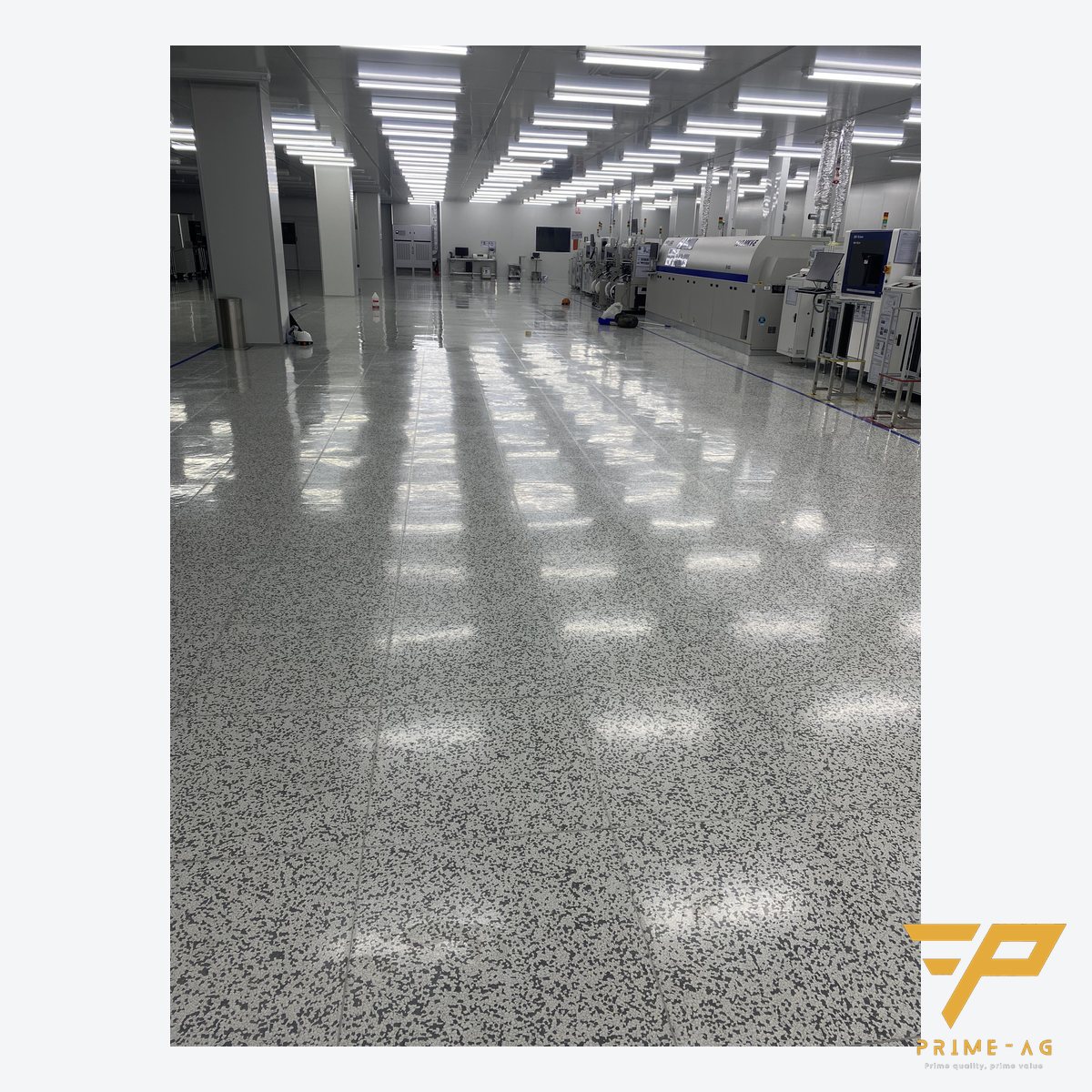
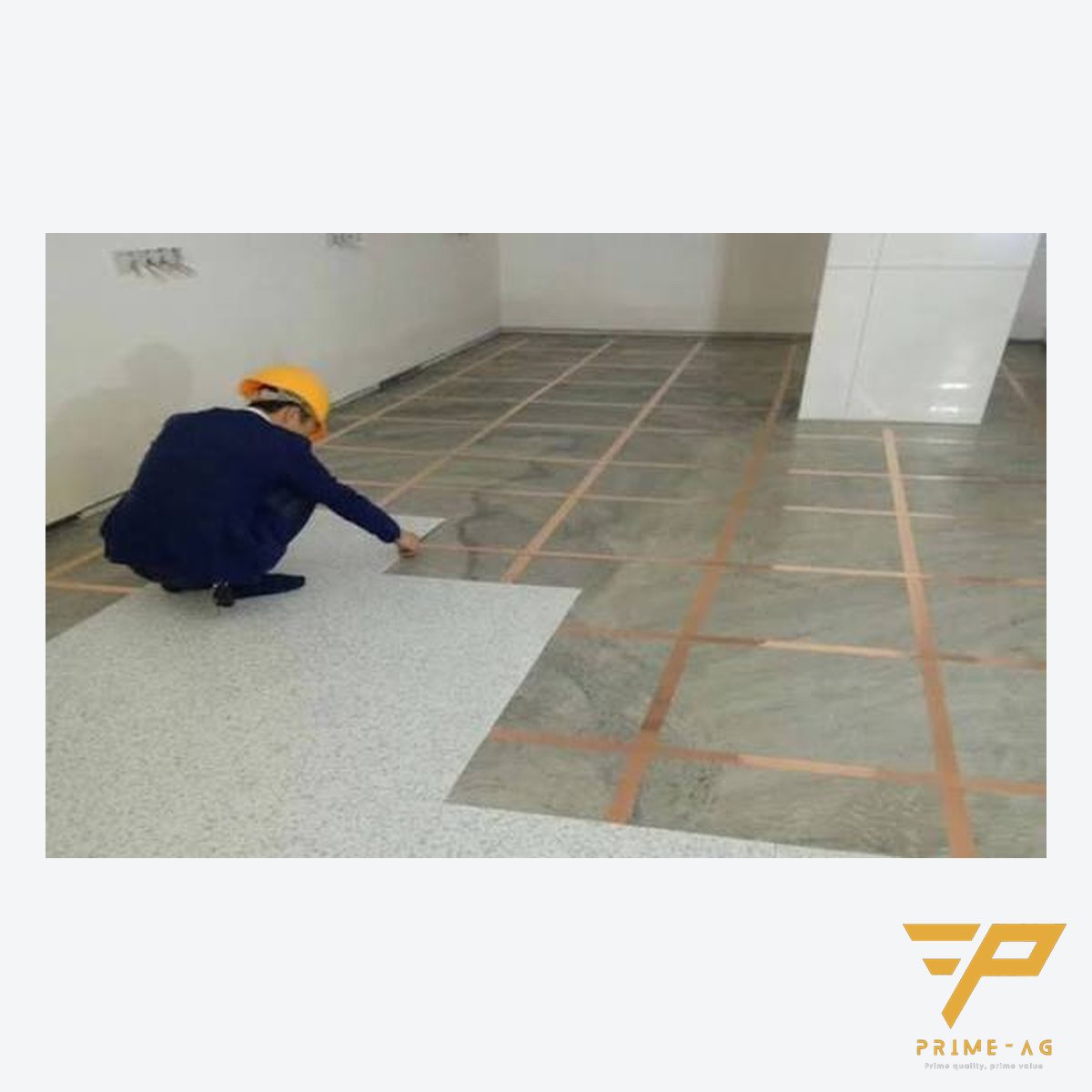
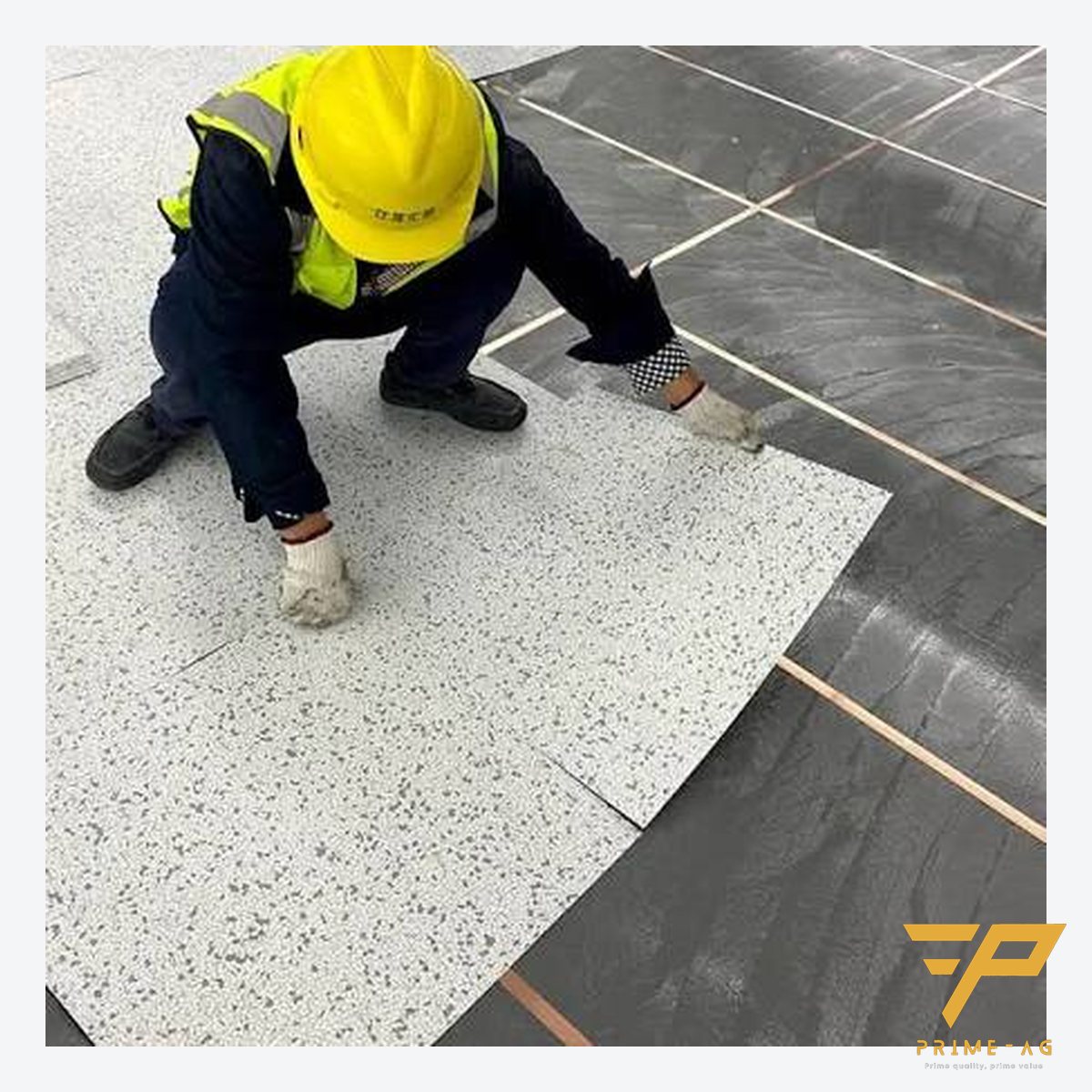
An ESD floor only performs when all 4 layers are right: a flat, dry subfloor → copper tape grounding grid (TE-CU) → 2-component conductive adhesive (never standard adhesive!) → floor tiles (FT-6620) → JD-37 conductive floor finish (never standard wax — insulating wax destroys the ESD performance). Maintenance: EAR-11 to strip the old finish every 6–12 months, maintenance cleaner for daily mopping. PRIMEAG provides turnkey installation: survey, subfloor preparation, laying, finishing, acceptance resistance testing to ANSI/ESD STM7.1 (resistance-to-ground limit per ANSI/ESD S20.20: < 1×10⁹ Ω) and a handover report.
| Item | Specification | Consumption / rate |
|---|---|---|
| 2-component conductive adhesive | 25 kg/set (A+B), 10³–10⁶ Ω | 0.3–0.4 kg/m² |
| Conductive copper tape | 500 m roll | 3 m grid + perimeter |
| JD-37 floor finish | 18.9 L, dissipative 10⁶–10⁹ Ω | 2 coats, 50 m²/L |
| Conductive WAX | 18.9 L | Replaces JD-37 where high gloss is needed |
| EAR-11 stripper | 18.9 L | 1 L / 20 m² |
| Maintenance cleaner | 5 L | Daily mopping, diluted 1:50 |
| Installation | Labour + machinery | About 300 m²/day |
FAQ
– ESD floor laid 2 years ago now fails testing? — The most common cause is a standard wax finish; strip it with EAR-11, recoat with JD-37 and re-test.
– Can ESD flooring be laid over ceramic tiles? — Yes, provided the tiles are not loose, the joints are filled and copper tape is installed.
– How is acceptance testing done? — Point-to-point and point-to-ground resistance with a 100 V/10 V meter (ET-WT), measured on a 3×3 m grid.
An ESD floor works like an electrical circuit
A complete anti-static floor is a series chain: person → ESD footwear → floor surface → conductive adhesive → copper tape → grounding point → building earth. A single open link (standard adhesive, unconnected copper tape, an insulating wax layer, ordinary shoes) and the whole system stops working, even if every individual material “meets the standard”. That is why acceptance must be measured on the installed floor, not based solely on the tile test certificate.
The role of each material layer
- Copper tape: thin copper strips laid under the floor as a grid, collecting charge from the adhesive to the grounding point. According to Forbo’s description for Colorex tiles, the tiles are connected to each other by conductive adhesive, and the whole floor area is grounded via copper tape to the earth point.
- Conductive adhesive: both bonds and acts as the “conductor” connecting the underside of the tiles to the copper tape. With standard (insulating) adhesive each tile is isolated — the point-to-point reading may pass, but resistance to ground fails.
- Sheet flooring with a conductive backing (e.g. Forbo Sphera EC): conductive adhesive is only needed at the copper tape, not across the whole area — the material construction determines the installation method.
- Conductive/dissipative finish: used where the floor needs gloss or surface protection. A good-quality homogeneous ESD PVC floor does not have to be coated; once coated, an ESD finish must be used and maintained on the correct cycle.
Finishes and waxes: the source of most failures
- ESDA notes that floor finishes are less durable than vinyl flooring, so they need more frequent checking and must be re-measured after every maintenance.
- Some ESD waxes perform well at high humidity but poorly at low humidity; hygroscopic agents in the finish can lose effect or be washed off, causing resistance to rise gradually.
- Polyurethane or ceramic coatings on ESD vinyl floors can cause footwear to charge when walking, however conductive the footwear is.
- Cleaning agents and polishes left on the floor surface change the contact resistance between footwear and floor.
The maintenance procedure must therefore be written down for the cleaning team: use only the specified chemicals, and never buy floor cleaners containing wax or silicone on your own.
Acceptance to the standards
| Measurement | Limit | Document |
|---|---|---|
| Floor resistance to ground (RTG) and point-to-point (RTT) | RTG < 1×10⁹ Ω | ANSI/ESD STM7.1 |
| Person – footwear – floor to ground | < 3.5×10⁷ Ω; or < 1×10⁹ Ω together with walking voltage < 100 V | ANSI/ESD STM97.1 |
| Body voltage when walking | < 100 V | ANSI/ESD STM97.2 |
| Periodic verification of floor and footwear | each < 1×10⁹ Ω | ESD TR53 |
Walking voltage must be tested with the exact footwear the workers wear, including heel straps if the factory allows them: according to In Compliance, heel straps usually give the highest voltage because the insulating sole still becomes charged.
Notes on conductive epoxy floors
ESD epoxy floors usually consist of several layers: an insulating primer, a middle layer heavily loaded with conductive carbon, and a semi-dissipative top coat. Some systems have an insulating top coat — point-to-point measurements may still give a reading, but footwear charges when walking. When refurbishing an existing floor, know exactly which floor system is in place before deciding whether to lay over it or remove it.
Common mistakes
- Using standard floor adhesive across the whole area and conductive adhesive only at the copper tape (for tiles without a conductive backing).
- Copper tape not brought out beyond the floor edge for grounding, or connected to water pipes or metal frames instead of the earthing system.
- Carrying out acceptance testing before the adhesive has cured — unstable results.
- The cleaning team using wax or silicone-containing cleaners after handover.
- Not testing walking voltage, only measuring resistance.
Technical references
- ESDA – Fundamentals of ESD, Part 3: Basic ESD Control Procedures and Materials
- ESDA – Fundamentals of ESD, Part 4: Training and Auditing
- In Compliance – Qualifying ESD flooring
- Forbo – Colorex EC conductive tiles
- Forbo – Sphera EC conductive sheet
- Desco – Footwear/flooring system limits in ANSI/ESD S20.20 (Q&A)
Price: from 300,000 VND (excl. 8% VAT).
REQUEST A QUOTE: send the quantity and specifications you need — PRIMEAG quotes within 30 minutes.
Hotline/Zalo +84 906 108 292 · info@primeag.vn
Written by the PRIMEAG engineering team.
Related guides:ESD Floor Finish and Sealer: When to Coat, Maintenance…ESD Floor Fails Resistance Test After Cleaning or Polishing:…ESD PVC Flooring Installation in Vietnam: Cost per m²,…
Related products:ESD PVC Floor Tiles 600×600 (Conductive / Dissipative)ESD PVC Flooring Installation Materials: Copper Tape, Conductive Adhesive,…
Updated: 2026-10-24
Giao tận nhà máy TP.HCM, Bình Dương, Đồng Nai, Long An, Tây Ninh · Kèm biên bản đo điện trở ESD theo lô · Hotline 0906 108 292