
What does an ESD PVC floor installation in Vietnam cost per m², and what is included? The price per m² is not just the tiles. Each finished square metre includes 2.78 tiles of 600×600, 0.3–0.4 kg of conductive adhesive, copper tape, grounding points, floor preparation and labour. PRIMEAG quotes the m² price within 30 minutes, itemising each line so the factory can compare contractors.
- The m² price covers tiles, conductive materials, floor preparation, labour and acceptance testing.
- The subfloor must be dry (moisture ≤ 4 %) and flat before laying.
- Output is about 300 m²/day; wait 72 hours for the adhesive before measuring.
- Acceptance: point-to-ground measurement on a grid, recording %RH and temperature.
What the m² price of ESD PVC flooring installation includes
There is no standard unit price for every project: with the same tile, an old ceramic-tile floor and a new concrete slab give different total costs. A complete quote needs the following lines.
| Item | Quantity rate | Notes |
|---|---|---|
| ESD PVC floor tiles 600×600×2.0 mm | 2.78 tiles/m² | Also available in 2.5/3.0 mm |
| Two-component conductive adhesive | 0.3–0.4 kg/m² | Ordinary adhesive isolates each tile |
| Copper tape | 3 m grid + perimeter | Collects charge |
| Grounding point | 1 point/100 m² | Connected to earth <1 Ω |
| Floor preparation | Moisture ≤ 4 %; deviation ≤ 3 mm/2 m | Grinding, patching, self-levelling |
| JD-37 polish coat | 2 coats, 50 m²/L | Optional |
| Seam welding | Optional | Seamless floor, easy to clean |
| Labour + equipment | ~300 m²/day | After-hours work possible |
Factors that raise or lower the price
- A floor that is delaminating, damp or uneven must be ground or self-levelled.
- Type D (10⁶–10⁹ Ω) is about 15 % cheaper than type C (10⁴–10⁶ Ω, the low end of the dissipative range); thicker tiles cost more.
- Small rooms, many columns and many corner cuts reduce output.
- Options: seam welding, polish coat, after-hours work.
If you have not yet decided between PVC, epoxy or mats, read choosing an ESD floor for the factory.
Installation procedure
- Survey: measure moisture, check flatness with a 2 m straightedge, tap to find loose tiles.
- Floor preparation: sand, fill joints, vacuum.
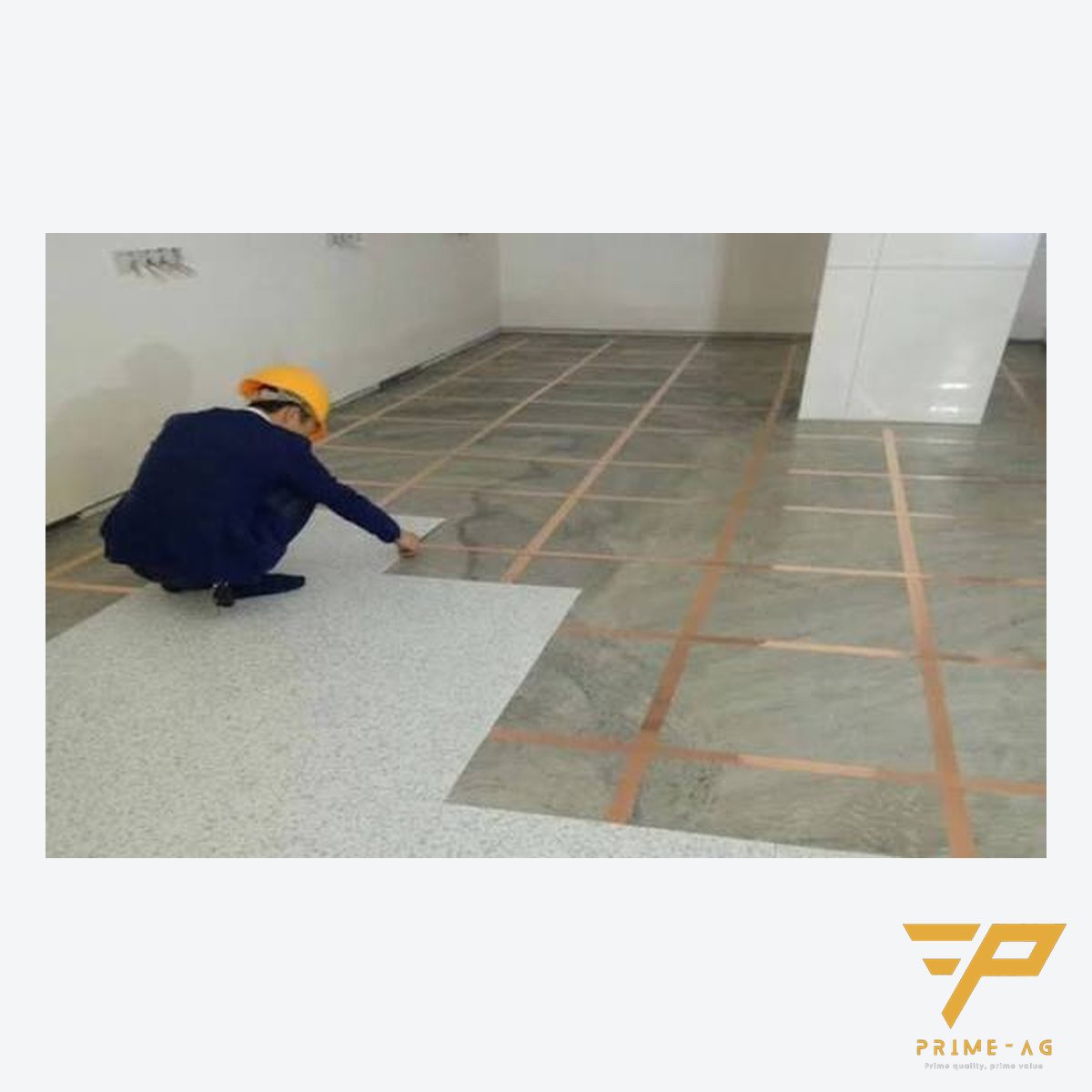
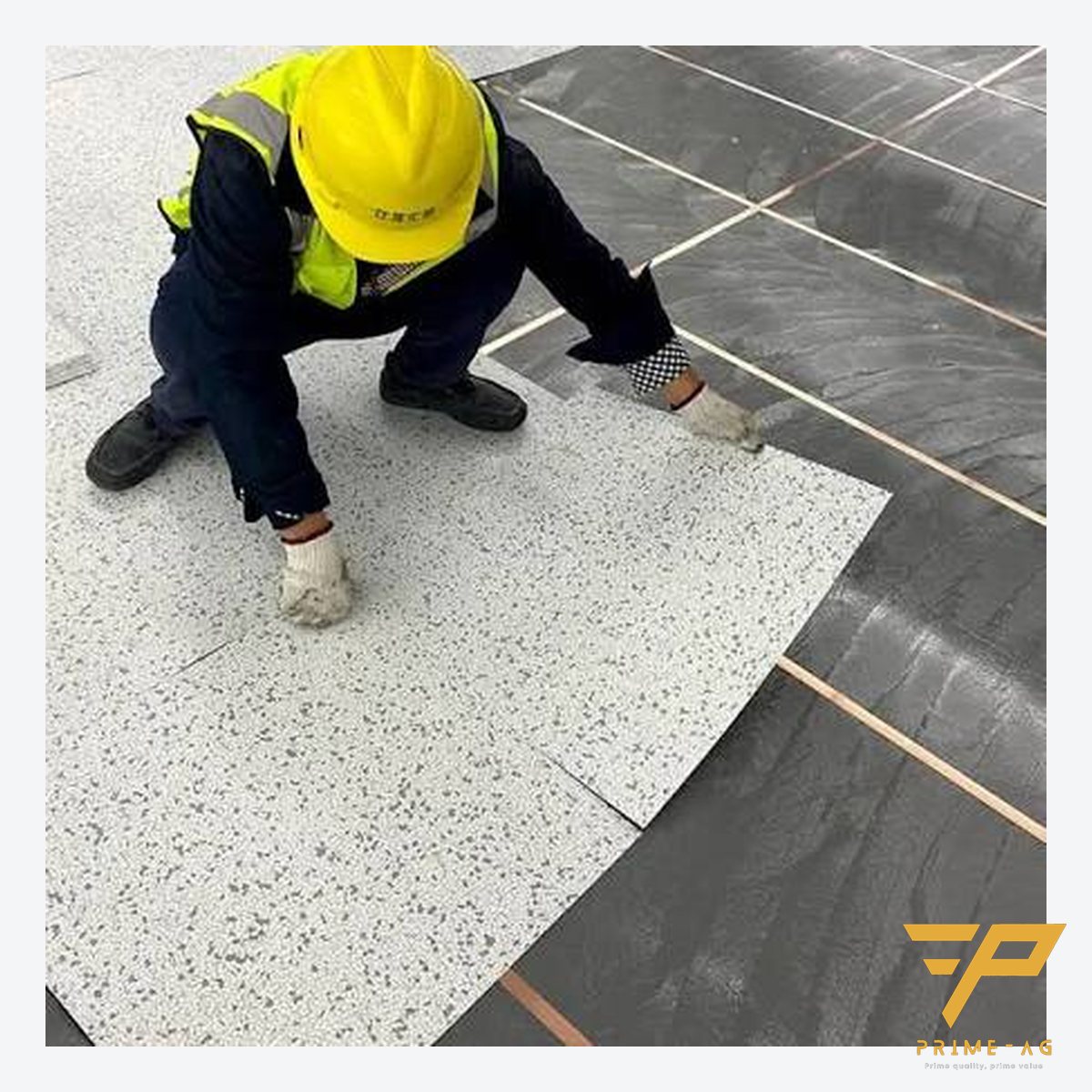
- Lay copper tape in a 3×3 m grid, running to the grounding points.
- Spread conductive adhesive, covering the copper tape as well.
- Lay tiles, roll them down, weld seams if specified.
- Connect the grounding points to the factory earth.
- Wait 72 hours for the adhesive to cure, clean, apply JD-37 if selected, then measure.
Example for 500 m²: 3–5 days of installation depending on the subfloor, plus 3 days of adhesive curing. Materials and labour are included in the ESD floor installation package.
Acceptance testing of the floor after laying
The floor is a series chain: person, footwear, floor surface, adhesive, copper tape, grounding point, earth. One open link fails the whole system, so measurements must be made on the installed floor.
- Point-to-ground: 5 lb electrode, measured on a 3×3 m grid (ANSI/ESD STM7.1), limit < 1×10⁹ Ω. Measure point-to-point when you need to isolate a faulty area.
- Person–footwear–floor: < 3.5×10⁷ Ω, or < 1×10⁹ Ω together with walking voltage < 100 V. Measure with the shoes workers actually wear, for example the ESD safety shoes and steel-toe boots in the warehouse.
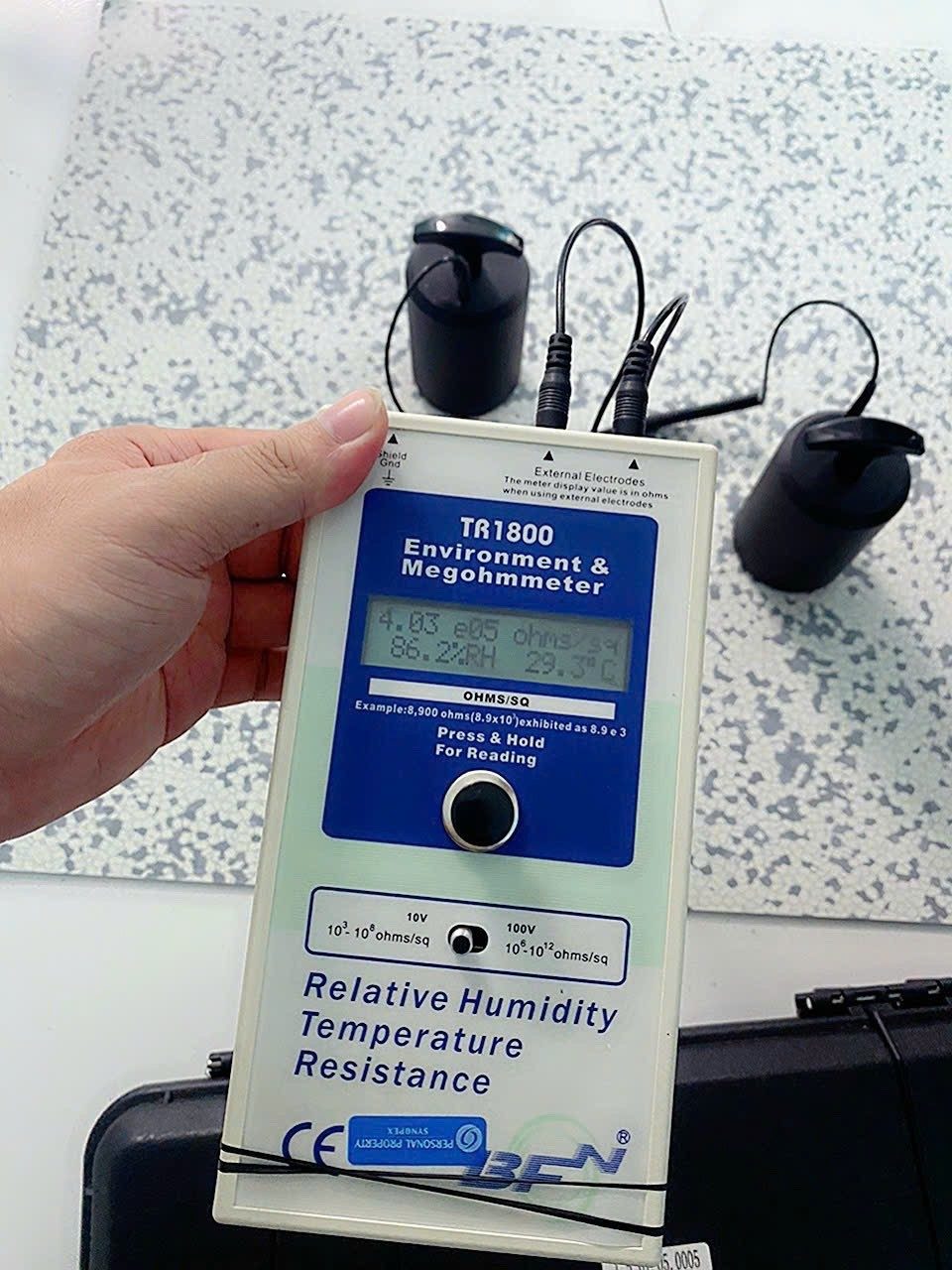
- Conditions: record %RH and temperature. High humidity pulls resistance down; a loose tile PRIMEAG measured in 10/2026 gave 4.03×10⁵ Ω at 86.2 %RH, 29.3 °C.
10/100 V resistance meters and the TR1800 are on the wrist strap testers and resistance meters page. Ohm limits for each surface: see resistance standards for ESD mats and floors.
Self-check before signing
- Does the quote list adhesive, copper tape and grounding points separately?
- Who is responsible for floor preparation?
- Is there a grid measurement report and a grounding diagram?
- Does the cleaning team know not to use wax or silicone?
Frequently asked questions
Why do ESD PVC flooring quotes in Vietnam vary so much? Because the scope differs: some leave out conductive adhesive, the copper grid, polish coat or acceptance testing. Compare each quantity line.
How long after installation can an ESD floor be tested for acceptance? About 72 hours, once the adhesive has cured. Measuring earlier does not reflect the floor in operation.
Can ESD PVC flooring be installed over existing ceramic tiles? Yes, if the tiles are firmly bonded, sanded, joint-filled and a copper grid is laid underneath. A weak subfloor or moisture above 4 % must be treated first.
Updated: 20/10/2026 — PRIMEAG engineering team
Mon–Sat, 8:00–17:00 (GMT+7) · Phone/Zalo: +84 906 108 292 · Email: info@primeag.vn
Start where it suits you: Free technical advice · Send a drawing or layout · Get a quote within 30 minutes
Written by the PRIMEAG engineering team
Updated: 2026-10-21