
Whether your SMT line in Vietnam runs Panasonic, Fuji or Yamaha machines, it needs the same set of ESD supplies; what changes is the position on the line: a 2-layer mat and a 1 MΩ wrist strap wherever hands touch boards; carbon-loaded PP trays 10³–10⁹ Ω at board loading and packing; an ionizer at the repair station. PRIMEAG delivers trade goods in 24–48 hours.
Customers usually start with the machine brand: “our Panasonic line”, “the Fuji line”, “the Yamaha machines”. The machine does not decide which mat or wrist strap you need; the machine name only helps label each station: board loading – solder paste printing – placement – reflow oven – AOI – repair – packing. This article lists ESD supplies by position and does not cover machine specifications.
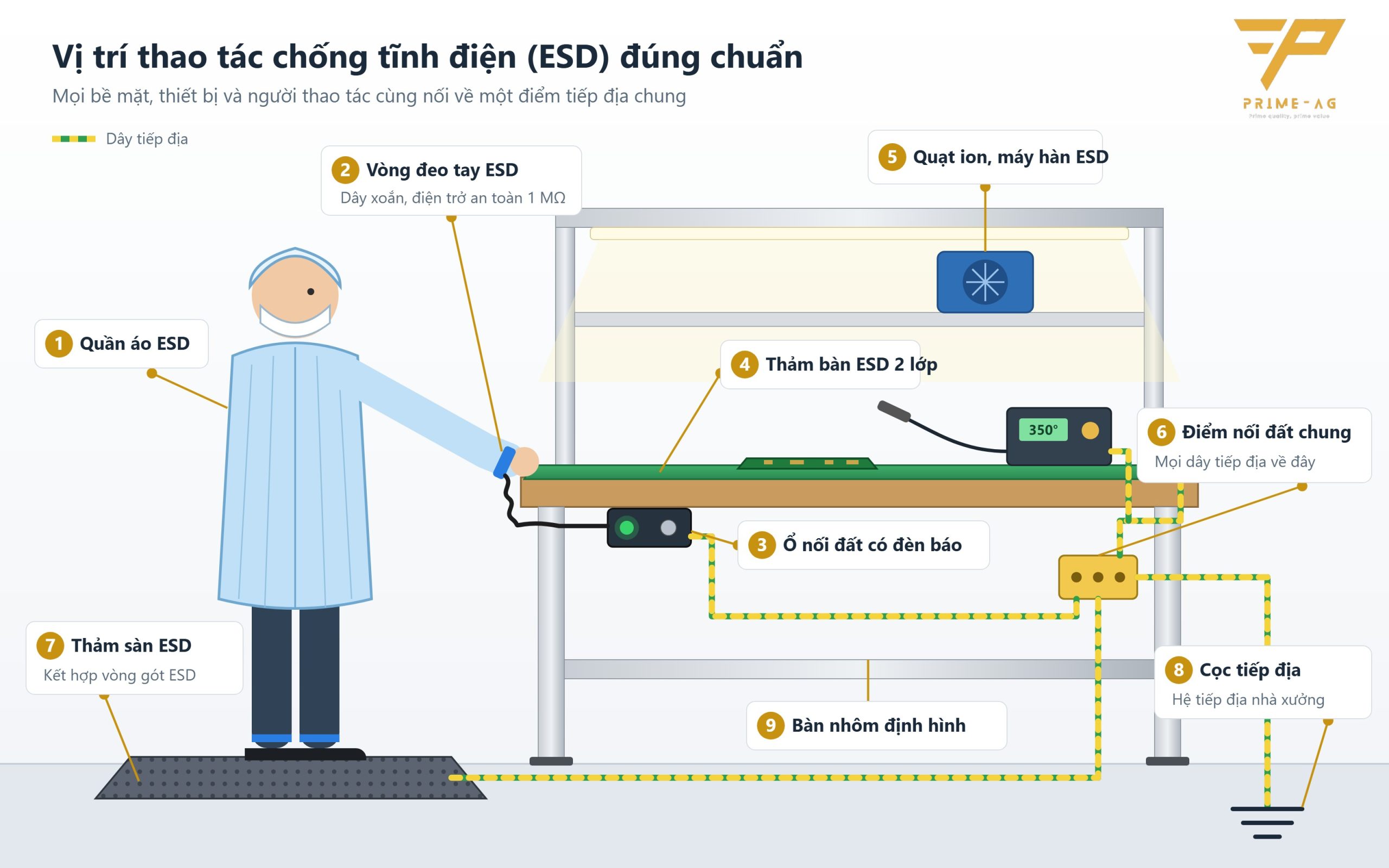
- Where hands touch boards (board loading, AOI, rework, packing): 2-layer bench mat + corded wrist strap with 1 MΩ resistor, tied to a common ground point.
- Holding and moving boards and reels: carbon-loaded PP trays 10³–10⁹ Ω, size 354×210×143 or 482×308×178 mm.
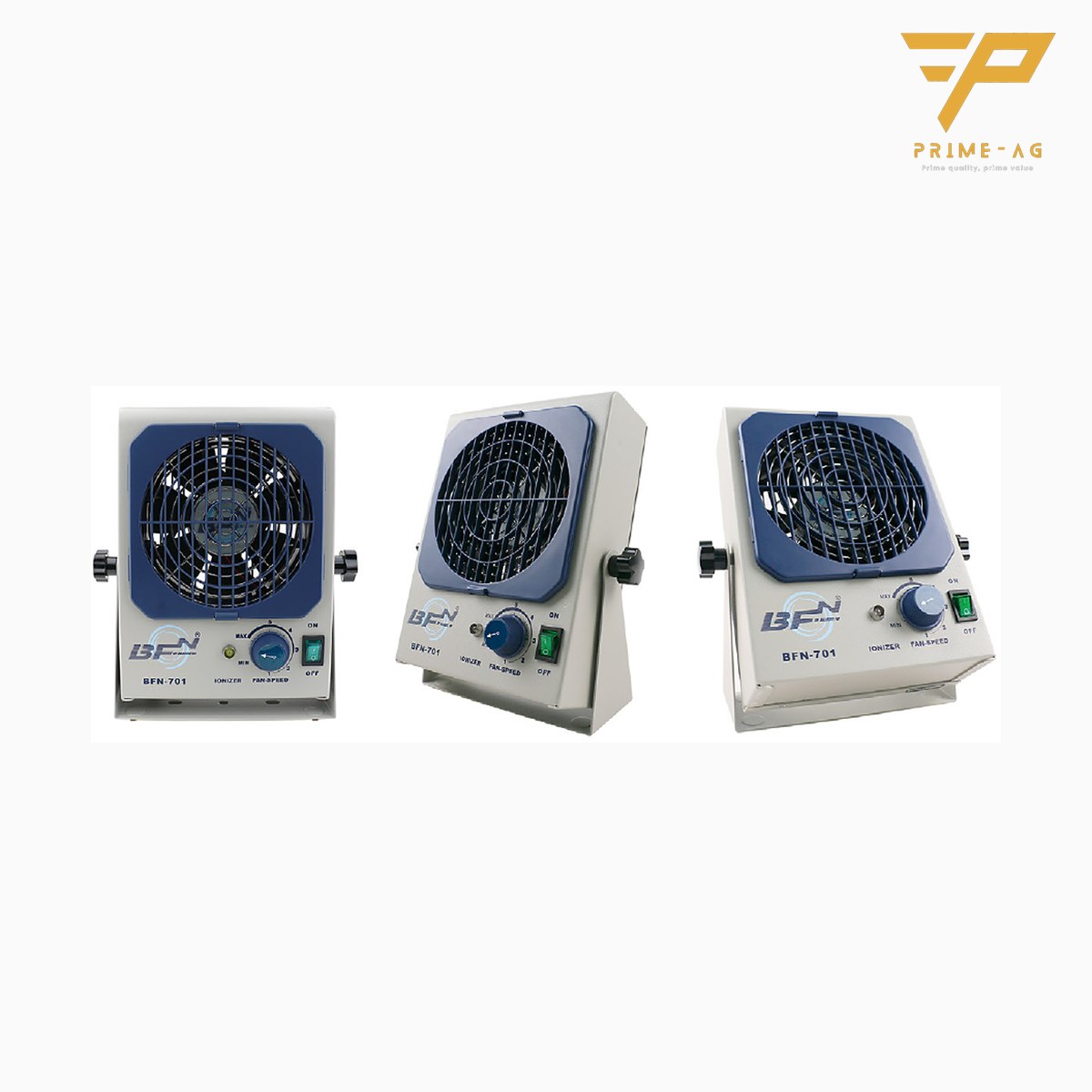
- Where insulators are present (rework, packing): benchtop ionizer, offset balance ≤ ±10 V.
- Automated machine area: flooring, ESD shoes, and a wrist strap whenever an operator intervenes.
1. Board loading and kitting at the start of the line
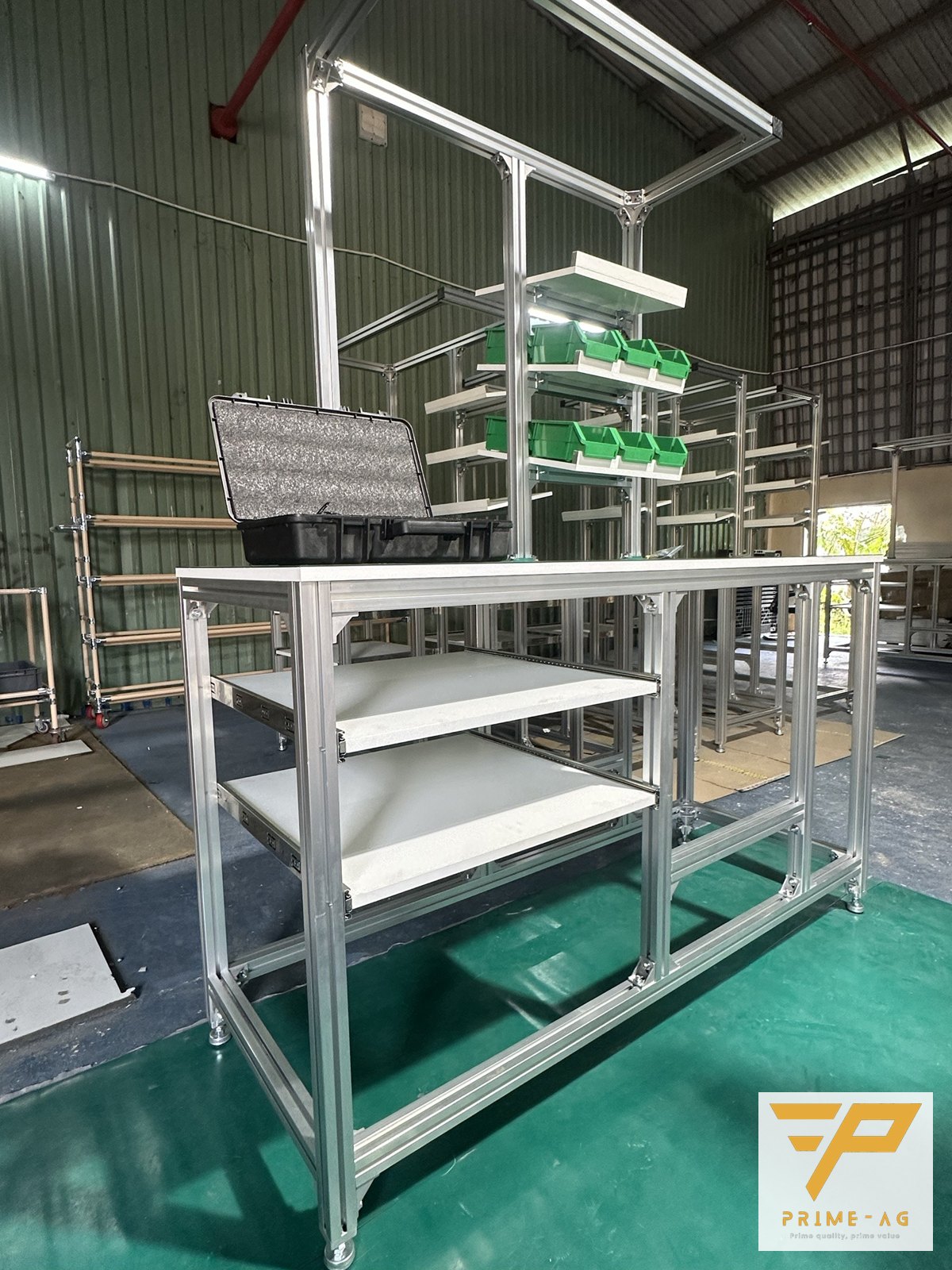
This is where bare boards and reels are handled by hand the most. You need a 2-layer ESD rubber mat (1.2 m × 10 m × 2 mm; top layer 10⁶–10⁹ Ω, bottom layer 10³–10⁵ Ω, grounded via a 10 mm snap and a 1 MΩ cord; cut to bench size within 2 days), an ESD wrist strap with coiled cord 1.8 m, 1 MΩ safety resistor, tested at the start of every shift, and an ESD component bin 354×210×143 (10.6 litres) for loose reels, with a label card slot. Bench surface to ground must be <1×10⁹ Ω.
2. Solder paste printing, placement, reflow oven
The board is inside the machine; people only intervene to load feeders or change stencils. The supplies here are for people and the floor: ESD shoes, ESD garments, and flooring that achieves person–footwear–floor <3.5×10⁷ Ω (or <1×10⁹ Ω together with walking voltage <100 V). Feeders and magazines removed temporarily go on a grounded rack or in an ESD component bin 482×308×178 (26.4 litres), the largest size in the bin range.
3. AOI, inspection and repair/rework
The repair station carries the highest risk: boards are already populated, handling takes long, and there are many insulators (plastic housings, microscopes, films). In addition to the mat and wrist strap, add a 701 single-fan benchtop ionizer: 120 CFM, working distance 300–900 mm, discharges ±1,000 V to ±100 V in ≤2.0 s, offset balance ≤ ±10 V (limit ±35 V). The ionizer is an order item with 7–15 days lead time, and it does not replace the wrist strap and mat. Boards waiting for repair stay in an ESD tray on the mat.
4. End-of-line packing
Boards leaving the EPA must go into a shielding bag before the carton; PE film and white foam must not touch the boards. The packing bench still needs a mat and wrist strap; if film rolls and labelling are used there, add an ionizer. For moving boards internally, use ESD trays and boxes chosen by board size.
ESD supplies checklist by position on the line
| Position | Supplies needed | Figure to achieve |
|---|---|---|
| Board loading, kitting | 2-layer mat, wrist strap, PA8 bin 354×210×143 | Bench to ground <1×10⁹ Ω; strap 1 MΩ, tested at shift start |
| Printing, placement, oven | ESD shoes, flooring, PA9 bin 482×308×178 | Person–footwear–floor <3.5×10⁷ Ω |
| AOI, inspection | Mat, wrist strap, ESD tray | Tray 10³–10⁹ Ω on a grounded surface |
| Repair/rework | Mat, wrist strap, 701 ionizer | Balance ≤ ±10 V, re-measure after cleaning the emitter pins |
| Packing | Mat, wrist strap, shielding bags, ionizer if needed | Boards do not touch ordinary materials |
S20.20 does not set a measurement frequency; in practice benches every 6 months, floors every 12 months. See also the article on setting up an EPA for an SMT line.
Self-check before buying more
- Mark every point where hands touch boards; each point must have a mat + wrist strap + ground socket.
- Flip the mat over: is there a 10 mm snap and a cord to ground? Measure bench to ground at 100 V following the article on resistance acceptance testing of ESD supplies.
- A black tray on a rack with insulating paint has no path to ground.
- No meter yet: factories in Ho Chi Minh City, Binh Duong and Dong Nai can call PRIMEAG to bring a TR1800 and 5 lb electrodes for free resistance testing of every mat, tray and floor in use, including items bought elsewhere, with no limit on measurement points and no obligation to buy; a PDF report with photos follows in 3–5 working days, for reference only, not a substitute for audit documents.
Frequently asked questions
- Do Panasonic, Fuji and Yamaha SMT lines need different ESD supplies? — No. Mats, wrist straps, trays and ionizers depend on where hands touch boards, not on the machine brand; the machine name only helps identify each station so you pick the right item.
- Can I put reels and PCBs directly in a 10³–10⁹ Ω component tray? — Yes, when the tray sits on a mat or a grounded rack; a tray on a rack with insulating paint cannot dissipate charge. Boards taken out of the EPA must go into a shielding bag.
- Where on an SMT line should I put an ionizer? — At the repair and packing stations, where there are insulators that cannot be grounded: plastic housings, glass, films. The 701 covers 300–900 mm with balance ≤ ±10 V; it does not replace the wrist strap and mat.
Mon–Sat, 8:00–17:00 (GMT+7) · Phone/Zalo: +84 906 108 292 · Email: info@primeag.vn
Start where it suits you: Free technical advice · Send a drawing or layout · Get a quote within 30 minutes
Written by the PRIMEAG engineering team
Updated: 2026-10-28