
Why does an ESD floor fail its resistance test right after mopping or polishing? Usually because of ordinary insulating wax, cleaner residue, a floor that is not yet dry, or copper strips that have lost their ground connection. PRIMEAG recommends checking in exactly that order, stripping the wax with EAR-11, recoating with a 10⁶–10⁹ Ω dissipative finish, then measuring point-to-ground; it passes below 1×10⁹ Ω.
At the weekend, the maintenance team scrubs and waxes the floor to a high gloss. On Monday morning, QA measures the whole area and it all fails. The floor tiles are not damaged; the coat that was just applied is the problem.
- Ordinary wax and cleaners containing silicone form an insulating film.
- Check in turn: coating, chemical residue, dryness, dirt and mud, grounding.
- Strip with EAR-11, recoat with ESD products, measure per ANSI/ESD STM7.1.
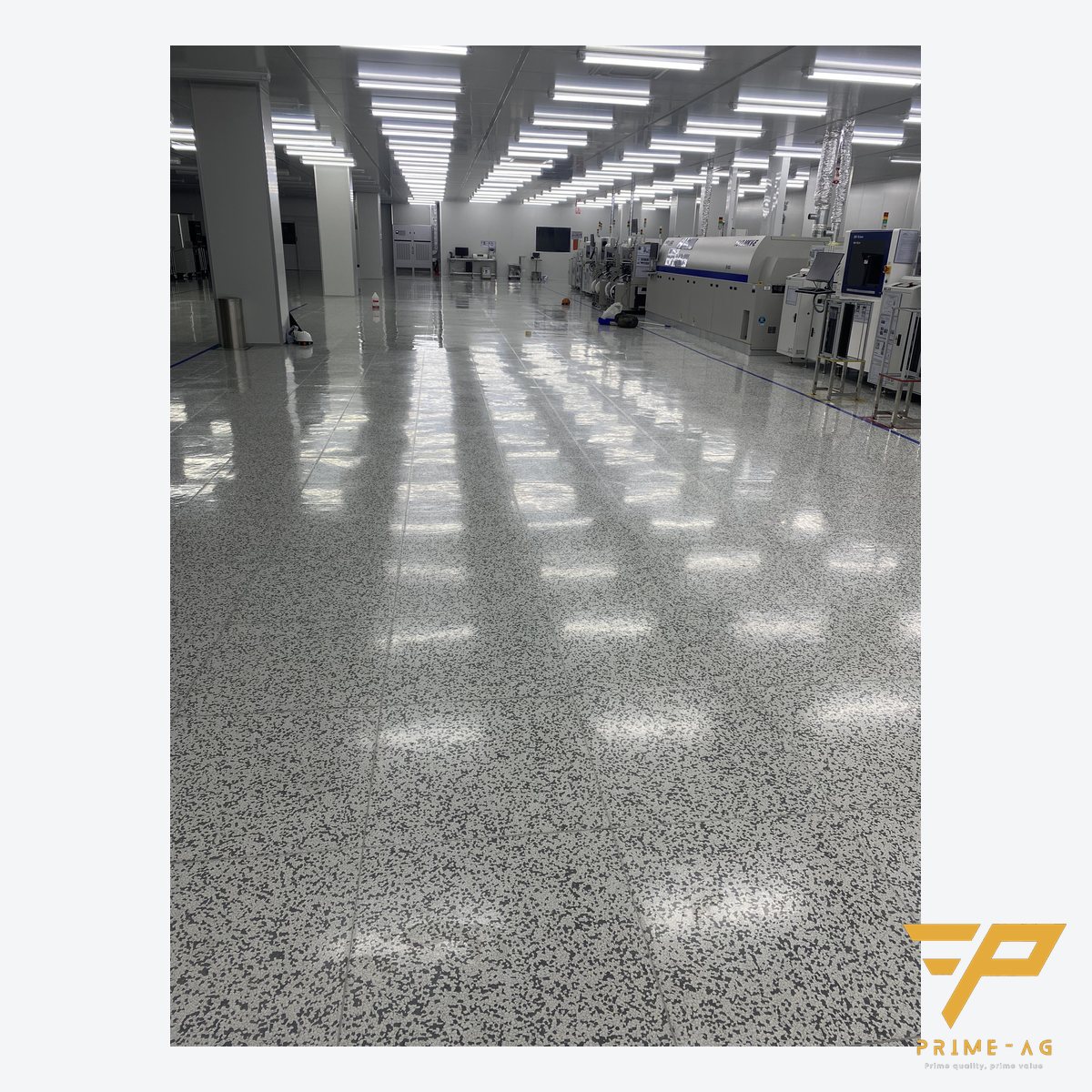
Why an ESD floor fails the test after cleaning
The charge path is: floor surface → conductive adhesive → copper strip → ground point. Homogeneous PVC tiles conduct through their full thickness; what blocks the current is usually the top coating.
Five things to check, in order
1. Ordinary wax or polish
Wood floor wax and office floor wax leave an insulating film. Sign: readings jump exactly in the area that was just polished.
2. Cleaner leaving a film
“Self-shining” cleaners often contain silicone that stays on the floor and changes the shoe–floor contact resistance. Resistance rises gradually with repeated mopping.
3. Measuring while the floor is still wet
Mopping heavily and measuring straight away gives unstable readings; standing water dries into residue streaks. Wait until the floor is fully dry before measuring.
4. Dust and mud along walkways
Warehouse doors and forklift routes bring mud in. Main walkways read high while low-traffic corners still pass.
5. Copper strips lost their ground
The 3×3 m copper strip grid is collected to a ground point every 100 m², connected to an earth below 1 Ω. If a junction box is knocked or a wire disconnected, point-to-ground readings are high across the whole section.
Isolate the fault with point-to-point and point-to-ground
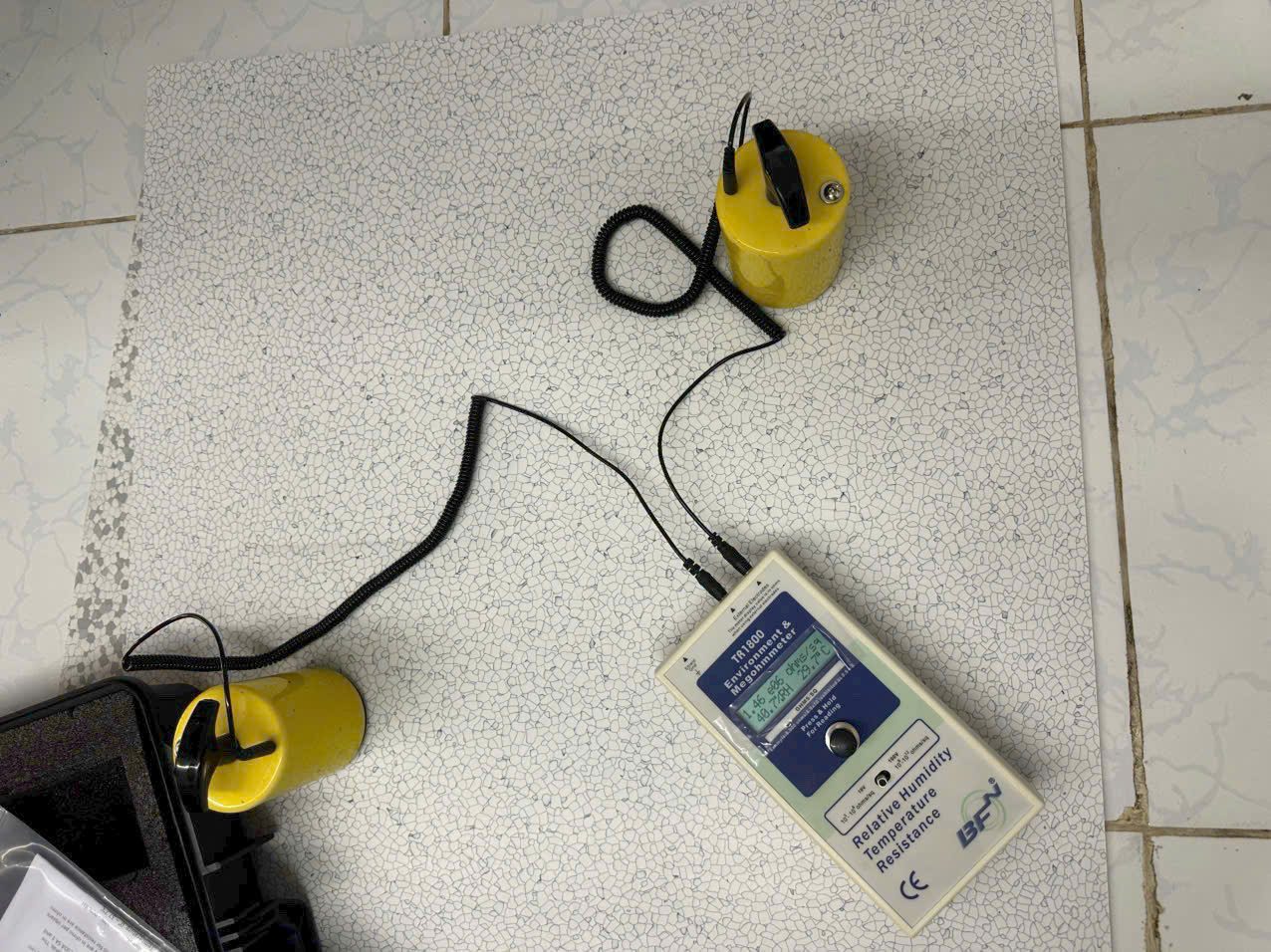
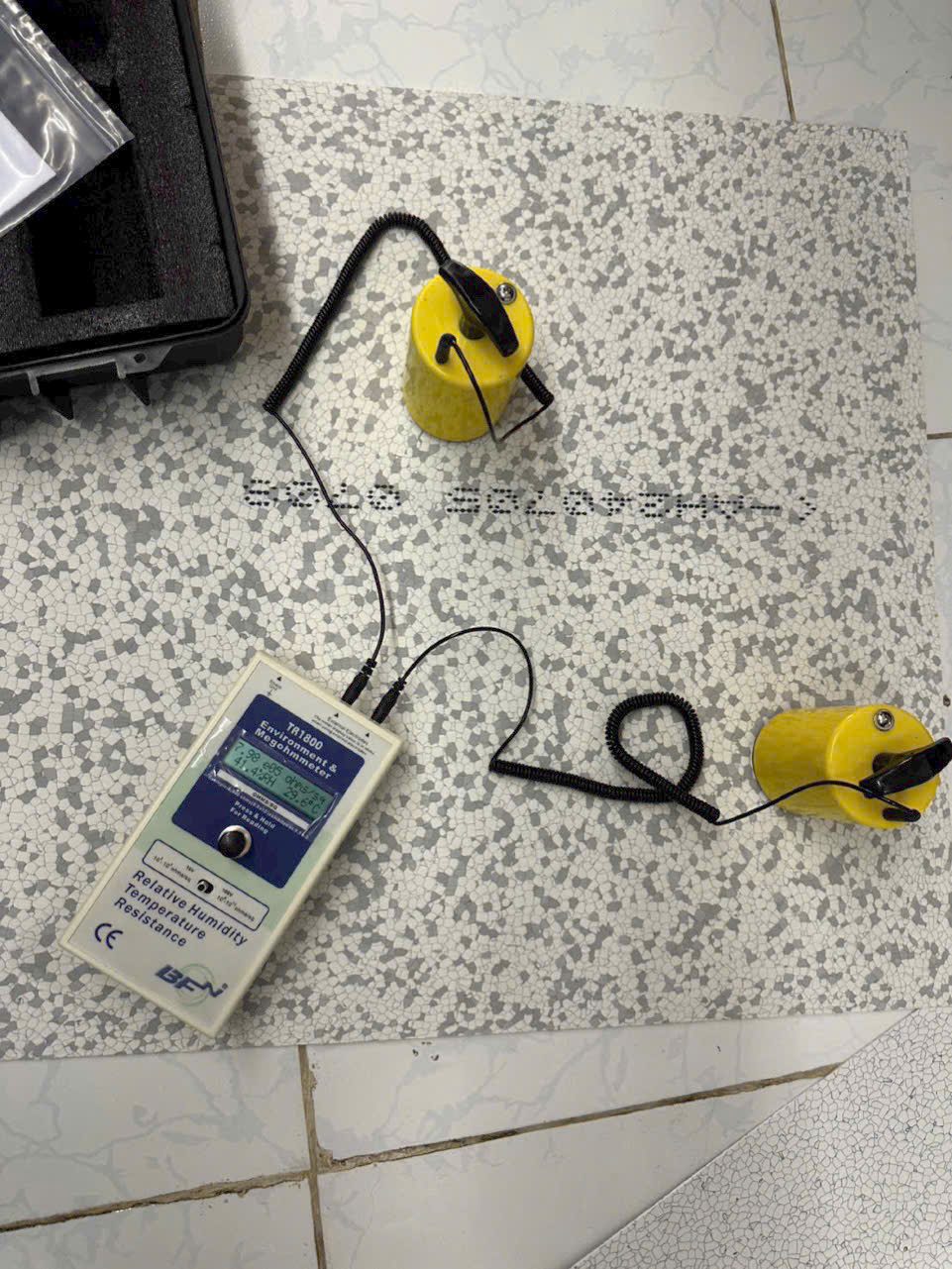
Measure per ANSI/ESD STM7.1 with the TR1800 digital resistance meter (10–100 V, range 10³–10¹² Ω, also displays temperature and humidity), on a 3×3 m grid, at the same positions before and after treatment.
| Result | Most likely | Action |
|---|---|---|
| Both measurements high in the area just polished | Wax film | Strip the wax, recoat |
| Point-to-point passes, point-to-ground high across a section | Lost ground | Check junction box, wires |
| Walkways high, corners pass | Mud, cleaner residue | Scrub, measure when dry |
| Same point, different reading each time | Floor still damp | Measure again, record %RH |
Strip the wax and recoat with the right products
- Strip with EAR-11, 1 L per 20 m²; machine scrub, vacuum thoroughly, rinse with water.
- Let it dry and do a test measurement. Homogeneous tiles usually return to the conductive range 10⁴–10⁶ Ω or the dissipative range 10⁶–10⁹ Ω.
- If gloss is needed: apply 2 coats of JD-37 (10⁶–10⁹ Ω, 50 m²/L); for higher gloss use conductive WAX.
- Daily mopping with maintenance chemical diluted 1:50.
These products belong to the ESD floor finish and maintenance products range. Homogeneous PVC floors do not require a coating.
ESD epoxy floors: some systems have an insulating top layer, so know the build-up before scrubbing or coating.
When tiles really need replacing
When a grid square still exceeds the limit after wax stripping, measuring dry and with grounding confirmed; or when tiles are burnt, deeply scratched or debonded. Local damage is repaired tile by tile.
Replacement tiles: ESD PVC floor tiles 600×600, in the same conductive or dissipative grade as the existing floor; colours available KB-6001, KB-6003; warranty 24 months on materials, 12 months on installation.
Self-check after treatment
- Compare each grid square with its reading before wax stripping.
- Record %RH, temperature and maintenance date alongside.
- Person–footwear–floor: below 3.5×10⁷ Ω, or below 1×10⁹ Ω together with walking voltage below 100 V.
After stripping and recoating, PRIMEAG can bring a TR1800 and 5 lb electrodes to your plant, measure each floor area on a grid and send a PDF report with photos showing which areas are still high – free on-site floor measurement at plants in Ho Chi Minh City, Binh Duong and Dong Nai; this report guides the corrective work and is not an audit document.
Open seams are a different fault: ESD PVC floor edges lifting and seams opening. How to measure a new floor at handover: ESD PVC floor installation and acceptance procedure.
Frequently asked questions
- Does an ESD PVC floor need waxing? — It is not required. If you need gloss, use only a dissipative floor finish or a conductive wax made for ESD floors.
- What should we use to clean an ESD floor every day? — Water, a neutral detergent or ESD maintenance chemical; avoid cleaners containing wax or silicone.
- How often should an ESD floor be re-tested? — ANSI/ESD S20.20 does not set an interval; floors are usually measured every 12 months, plus after every wax stripping or polishing.
Email: info@primeag.vn · Phone/Zalo: +84 906 108 292
Written by the PRIMEAG engineering team
Updated: 2026-10-26