
A garment trims warehouse in a Vietnam factory stops issuing the wrong colors when every button, thread and zipper code has its own lidded plastic bin with a label card, on medium-duty racks rated 200–500 kg/level zoned by customer and PO, and trims are kitted per cutting order before going to the line. PRIMEAG builds racks and carts to fit the warehouse dimensions.
The line has received the cut panels and is only waiting for buttons. The storekeeper opens three cartons before finding the right color, only for the label to show a different PO. Errors like this are rarely down to careless staff; mostly it is because trim codes have no fixed location.
- One code, one bin, one label.
- Zone racks by customer and PO with label colors; move leftover stock from old POs to a separate area.
- Kit trims per cutting order and deliver them to the line by cart.
- FIFO and cycle counting instead of shutting the warehouse for a full count.
Why trims warehouses issue the wrong items
- Many near-identical codes: buttons a shade off, threads of the same tone with different color codes, customer-specific labels.
- Goods sit in plastic bags or supplier cartons with small-print labels.
- Rack locations are not assigned; new lots get stacked on old ones.
- Counting and splitting happen while the line is waiting, so it is easy to grab the wrong item.
Racks and bins: a fixed place for every code
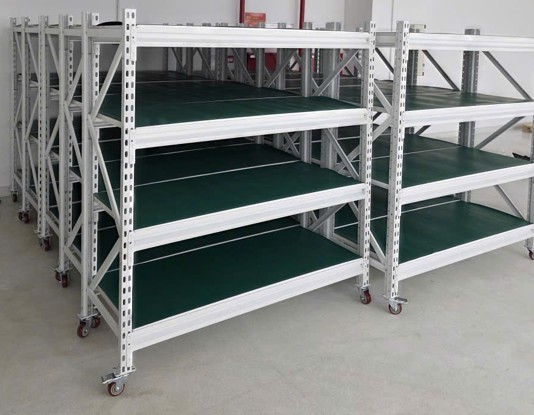
Medium-duty racks with closely spaced levels
Trims are light but come in many codes, so you need more levels rather than higher load capacity; set the level spacing to match bin height. Elastic rolls and hangers go on the lower levels; buttons and labels at eye level. How to choose rack width and number of levels is covered in choosing a 250 kg medium-duty rack for a parts warehouse.
Solid lidded bins by trim group
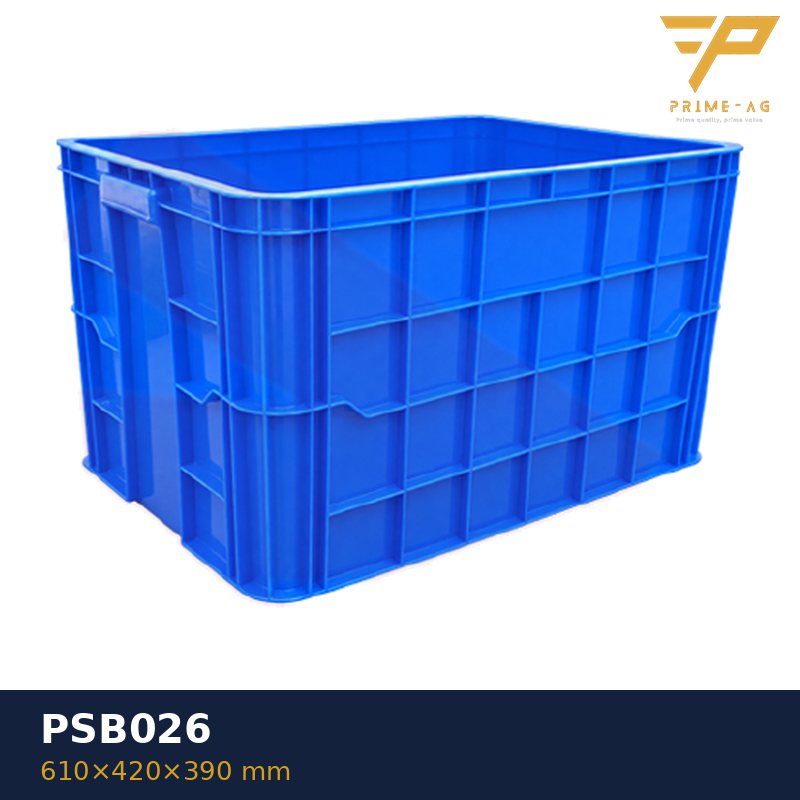
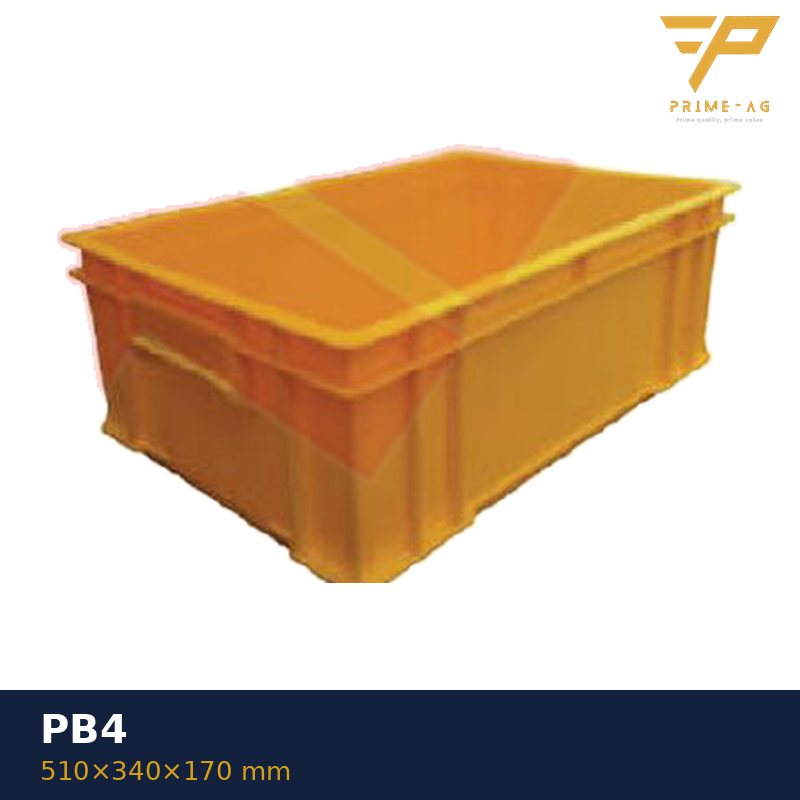
Virgin PP industrial plastic bins of the solid type hold small items, and with lids they keep dust out and can be stacked. External dimensions per the product page, tolerance ±3%.
| Trim group | Suggested size | External L×W×H (mm) | Notes |
|---|---|---|---|
| Buttons, eyelets, small hooks | PB2 | 455 × 270 × 120 | One bin per color, do not mix sizes |
| Zippers, woven labels, hangtags | PB4 | 510 × 340 × 170 | Keep bundles intact by PO |
| Thread cones | PSB017 | 610 × 420 × 250 | Stand cones upright, color code labels facing out |
| Elastic rolls, hangers | PSB026 | 610 × 420 × 390 | Bulky items, lower levels |
Insertable label cards, dividers and logo printing are made to order; lead time is confirmed at ordering.
Labels and color codes by customer and PO
The label card shows the trim code, color, customer, PO and receiving date. Each customer gets one label color, so the zone is clear from the end of the aisle. Print labels on A4 label sheets and colored printing paper: 65 or 40 labels per sheet, and A4 paper in five colors for picking slips by customer color.
Trims kitting area by cutting order
Once a cutting order is issued, the warehouse kits the full set of buttons, labels, hangtags and thread for each bundle and writes the order number on the bag. The line receives a complete kit and does not recount.
Kitting bench: a lean pipe workbench (plastic-coated steel pipe, Φ28) with an 800 × 600 mm top rated 150 kg and two upper shelf levels at 20 kg/level for the bins currently being kitted; the powered version adds 2 LED lights of 0.6 m.
Supplying the line: a multi-level lean pipe trolley 1500 × 600 × 1600 mm, 3 levels, 100 kg/level, one order per level. Incoming cartons travel on a 500×700 plastic-deck folding hand truck, 200 kg capacity.
Φ28 pipe benches and carts are assembled with bolted joints and built to size; standard designs take 5–7 working days, frames carry a 3-year warranty. Work-in-progress piling up on the line is a different issue; see WIP backlog between garment processes.
FIFO, leftover old-PO stock and cycle counting
- FIFO: load new lots from the back or the upper level and pick from the front; write the receiving date on the card.
- Leftover old-PO stock: gather it in a separate area with a different label color and ask the customer to confirm reuse, return or disposal.
- Cycle counting: count a few locations every day on a schedule; count fast-moving codes more often.
Where to start
- Pick one customer and list the number of codes and average stock per code.
- Measure the warehouse: rack row length, aisle width, ceiling height.
- Send PRIMEAG these figures to select bin sizes and number of levels; quotation within 30 minutes.
If the garment factory is an export processing enterprise (EPE), it can be invoiced at 0% VAT and PRIMEAG handles the on-the-spot import/export customs declaration free of charge for orders from VND 20 million.
Frequently asked questions
- Should garment trims be stored in lidded bins or open trays? — Use solid lidded bins for reserve stock, since they keep dust out and stack; open trays suit the kitting bench.
- Can you print our customer name or logo on the plastic bins? — Yes, as a made-to-order item: minimum 10 bins, embossed logo from 500 bins; delivery time is confirmed at ordering.
- What is the difference between cycle counting and a full warehouse stocktake? — Cycle counting counts groups of locations in rotation without stopping issues; discrepancies show up early and are corrected on the spot.
Email: info@primeag.vn · Phone/Zalo: +84 906 108 292
Written by the PRIMEAG engineering team
Updated: 2026-10-27