
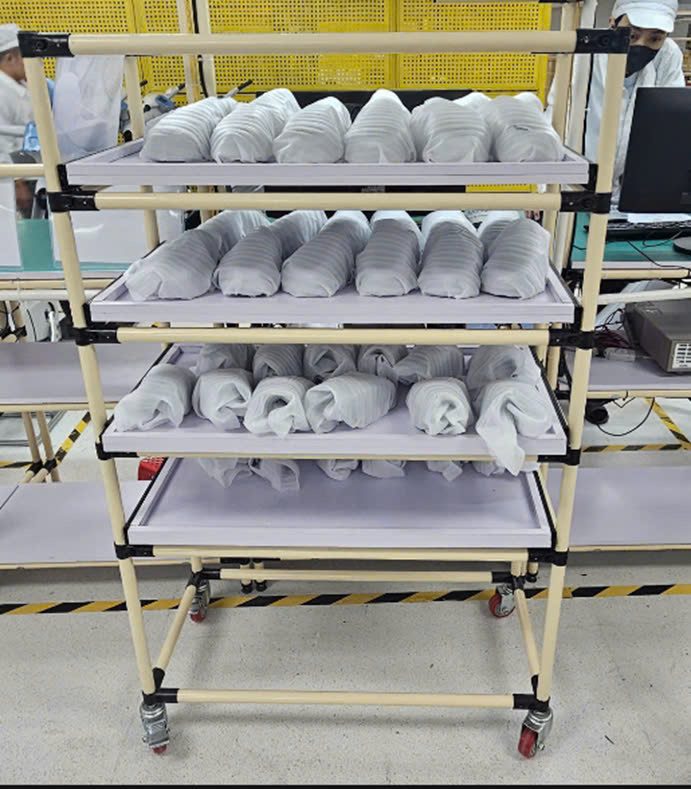
WIP pile-ups between operations in a garment factory usually happen because semi-finished goods have no limited storage space: bundles are stacked on tables and on the floor, and sizes and colors get mixed. PRIMEAG proposes capping WIP with racks with a fixed number of slots and bundle trolleys, built on a Φ28 steel pipe frame whose tiers can be readjusted in-house when the style changes.
- Cap WIP: each operation has only a fixed number of slots; when they are full, the upstream operation stops or helps out.
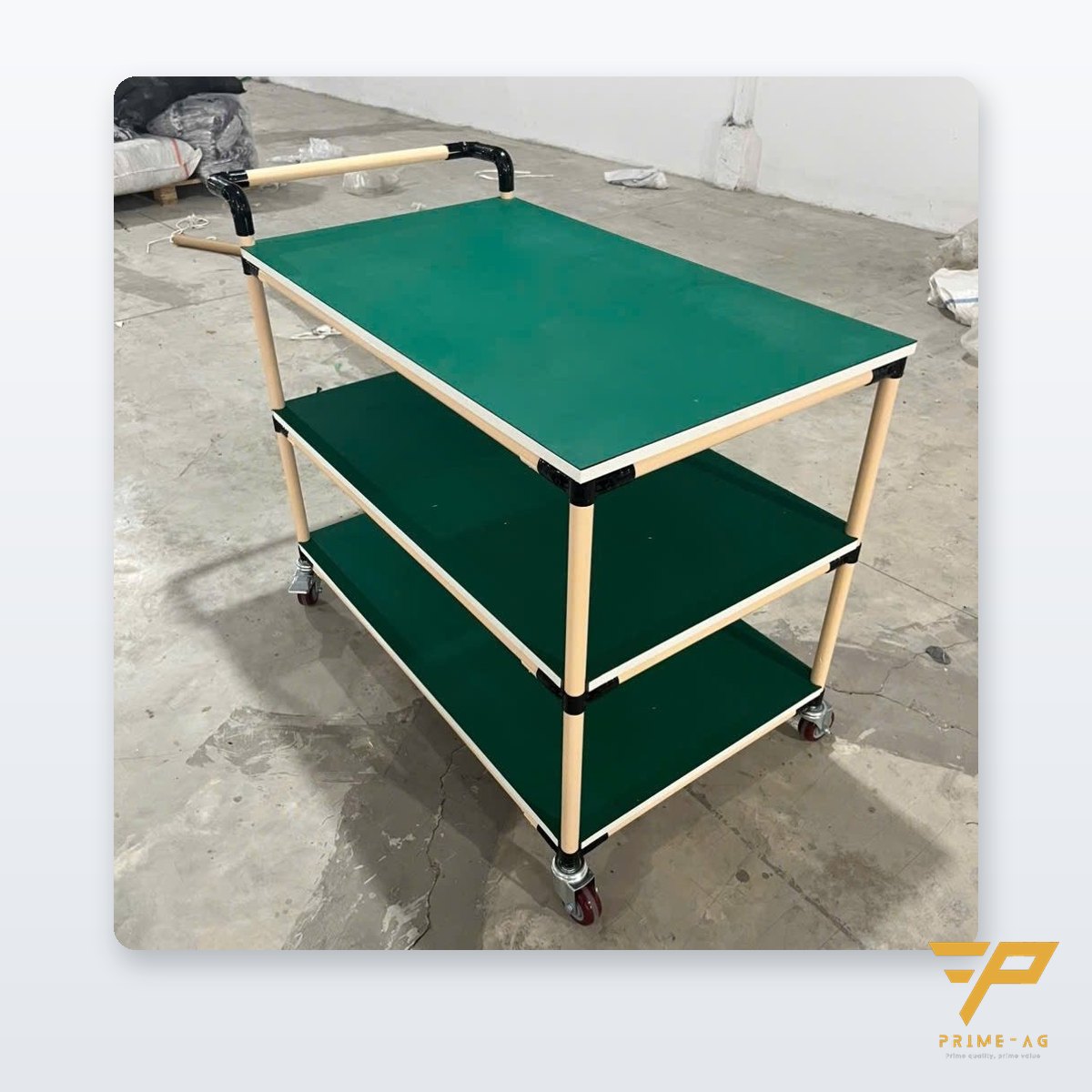
- Move by bundle: a multi-tier steel pipe trolley carries ticketed bundles instead of operators hand-carrying them.
- Narrow aisles between sewing machines: a narrow 720×430 trolley.
- Visible at a glance: floor lines and color-coded slot labels; an empty slot means the next bundle can be supplied.

Signs that a sewing line is piling up WIP
- Bundles lie on the floor, on chairs, under machines.
- Line leaders have to hunt for bundles by size and color when the customer chases the order.
- The first operations run at full output while the last ones are still waiting for work.
- By the time a defect is caught at end-of-line QC, there are already hundreds of pieces with the same defect behind it.
The larger the WIP, the longer it takes a piece to go through the line and the further defects spread. The core problem is the method: with no limit on storage space, there is no stop signal.
1. Cap WIP through storage space
Instead of letting operators stack goods as they like, give each point between two operations a rack or trolley with a fixed number of slots, for example 2–3 bundles. Full slots mean the downstream operation is slowing down: the upstream operation stops, moves someone to help, or alerts the line leader to rebalance the line. Calculate the number of slots from line takt and bundle size, then reduce it gradually as the line stabilizes.
The plastic-coated steel pipe rack frame is assembled with joints, not welded, so tier spacing can be changed on the shop floor with a hex key when switching from shirts to trousers or changing bundle size. PRIMEAG supplies components so you can modify racks or add tiers yourself (stocked items delivered in 24–48 hours, ordered items 3–7 working days): Φ28 pipe, joints, adjustable feet.
2. Move by bundle with trolleys
Hand-carrying bundles one by one is slow and tickets easily fall off. A multi-tier steel pipe trolley (1500×600×1600 or 1400×600×1550) carries many bundles of the same style between cutting, sewing and finishing. The 15–17 mm MDF decks are smooth and do not snag fabric. Between sewing machine rows with 600–800 mm aisles, use a small 720×430×1500 trolley weighing about 18 kg that can be pushed with one hand.
3. Labels and floor lines for visual management
Every trolley and every slot carries an operation label; label color follows the style or the cutting date. Mark trolley parking spots with floor marking tape. An empty slot is the signal to supply more; exceeding the slot count is the pile-up signal.
Rack or trolley?
| Location | Recommended | Reason |
|---|---|---|
| Between two adjacent sewing machines | Small 2–3 slot rack next to the machine | Clear WIP limit, no walking |
| From cutting to the sewing line | multi-tier steel pipe trolley | Carries many bundles of the same style and size |
| Narrow aisles within the line | narrow trolley PT-7243 | Fits 600–800 mm aisles |
| Semi-finished store, finished goods waiting for packing | medium-duty rack | 200–500 kg/tier |
Lead time for trolleys and racks: standard designs 5–7 working days; new designs 10–15 working days (including drawing approval). Frame warranty 3 years, casters 12 months.
First steps
- Walk the line and count the bundles sitting between each pair of operations.
- Pick the 1 section with the worst pile-up and place a rack or trolley with a fixed number of slots.
- Define clearly: what to do when slots are full, and who decides.
- Monitor for 2 weeks, reduce the number of slots once the line runs evenly, then roll out.
General principles for reducing walking and WIP at the workstation: see lean workstation improvement: less walking, WIP and 5S.
Frequently asked questions
How many bundles should sit between two sewing operations? Calculate it from line takt and bundle size; usually start with 2–3 bundles and reduce gradually as the line runs evenly. What matters is a fixed number of slots, so there is a stop signal when they are full.
Can the steel pipe trolley’s tier spacing be changed when the style changes? Yes. The plastic-coated Φ28 steel pipe frame is assembled with metal joints, not welded; loosen the bolts with a hex key to move tiers, add tiers or add guard bars right on the shop floor.
How long does it take to order WIP trolleys and racks? Standard designs 5–7 working days; new designs 10–15 working days including drawing approval. Frame warranty 3 years, casters 12 months.
Updated: 14 October 2026 — PRIMEAG engineering team
Mon–Sat, 8:00–17:00 (GMT+7) · Phone/Zalo: +84 906 108 292 · Email: info@primeag.vn
Start where it suits you: Free technical advice · Send a drawing or layout · Get a quote within 30 minutes
Written by the PRIMEAG engineering team
Updated: 2026-10-19