
Under ANSI/ESD S4.1, test an ESD workbench surface at 10 V first; if the result is 1×10⁶ Ω or higher, switch to 100 V, measure again and record the 100 V value. For point-to-point tests, place the two 5 lb electrodes 254 mm apart; for resistance to ground use one electrode. PRIMEAG recommends recording the test voltage next to every reading.
The QA team has just received a meter with a 10 V/100 V switch. On the same bench surface the two levels give two different numbers, and nobody is sure which one goes in the log. The second question: how far apart should the two 5 lb electrodes be?
- Start at 10 V: if the reading is not below 1×10⁶ Ω, measure again at 100 V.
- No conversion: 10 V and 100 V are two separate measurements.
- Electrode spacing: work surface 254 mm (10 inch), floor about 0.9 m (3 ft).
- Work surface to ground limit: < 1×10⁹ Ω; when buying, choose 10⁶–10⁹ Ω.
1. Using a 10 V / 100 V surface resistance meter: the sequence
Set the meter to 10 V, measure and wait for the reading to stabilise. Below 1×10⁶ Ω: record that value with “10 V”. Equal to or above this level: flip the switch to 100 V, measure a second time and take the new value. Dissipative materials need a higher voltage so the test current is large enough.
The TR1800 digital surface resistance meter has a test voltage of 10–100 V and a range of 10³–10¹² Ω. The TR1801 analogue surface resistance meter has 2 voltage levels, ±3 % accuracy and a range up to 100 GΩ.
2. There is no 10 V to 100 V conversion table
Dissipative materials are usually non-linear. On the same mat, the 100 V reading can be lower than the 10 V reading, by an amount that depends on the material, humidity and cleanliness. There is no conversion factor. Comparing two inspections only makes sense at the same voltage, with the same electrodes, at the same location.
3. How far apart to place the 5 lb electrodes for each test
A common English search query: how far apart should two 5lb electrodes be when measuring rtt on an esd mat (i.e. the spacing of the two 5 lb electrodes for a point-to-point test on an ESD mat). Under S4.1, each electrode weighs 5 lb (2.27 kg) with a contact surface 63.5 mm in diameter.
| Test | Setup | Limit |
|---|---|---|
| Work surface to ground (Rtg) | 1 electrode in the middle of the surface, other lead to the ground point | < 1×10⁹ Ω |
| Work surface point-to-point (Rtt) | 2 electrodes, centres 254 mm apart | Fault isolation |
| Floor point-to-point (S7.1) | 2 electrodes, about 0.9 m apart | Fault isolation (floor to ground: < 1×10⁹ Ω) |
4. Record humidity and temperature too
Each log line includes location, test, voltage, value, %RH and temperature. The TR1800 has a built-in temperature–humidity sensor. A reading that keeps jumping at one location is a different issue: see what to do when the TR1800 reading jumps. The incoming inspection procedure is in the article resistance testing for acceptance of ESD materials.
5. Aluminium-frame benches
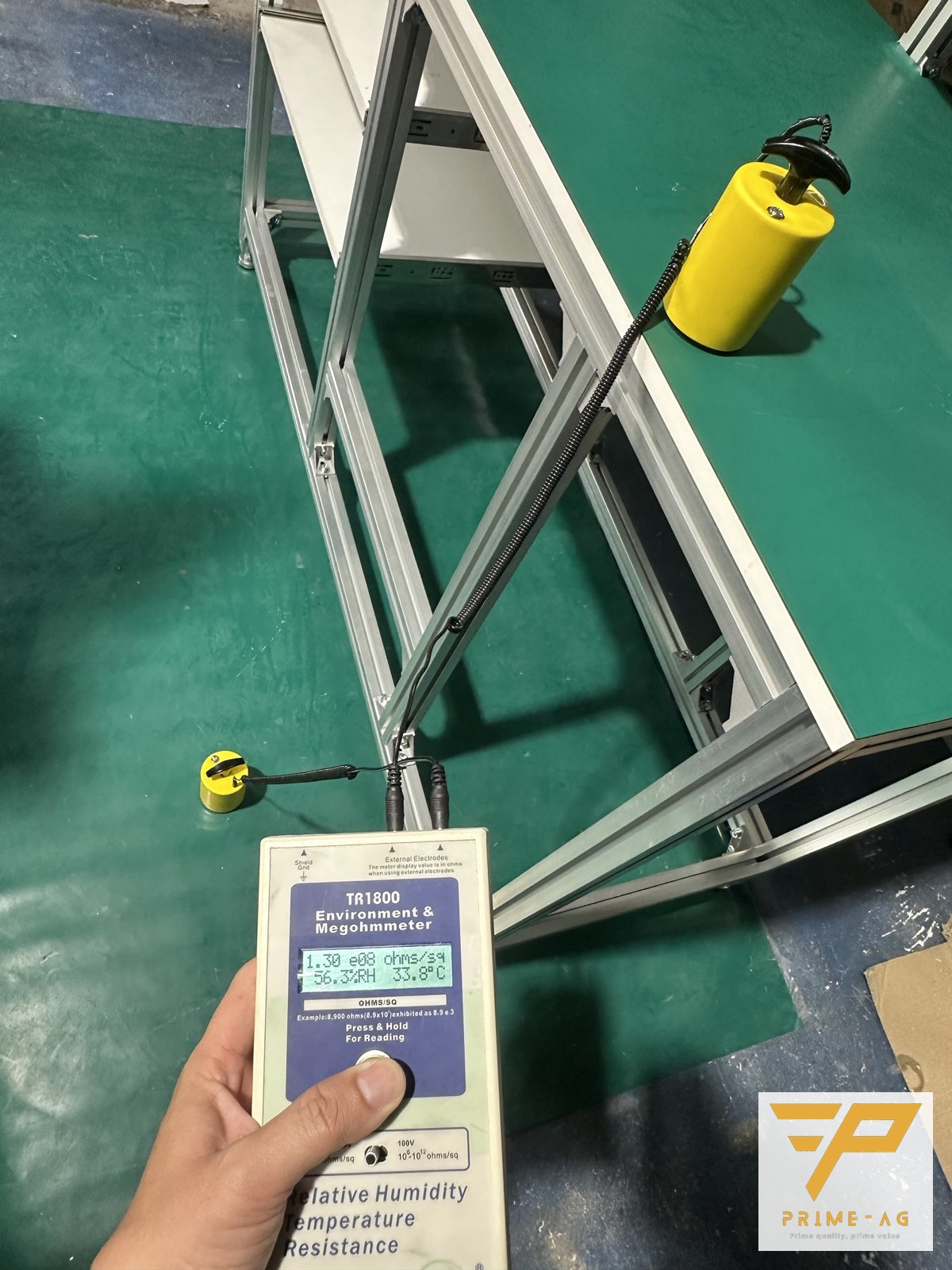
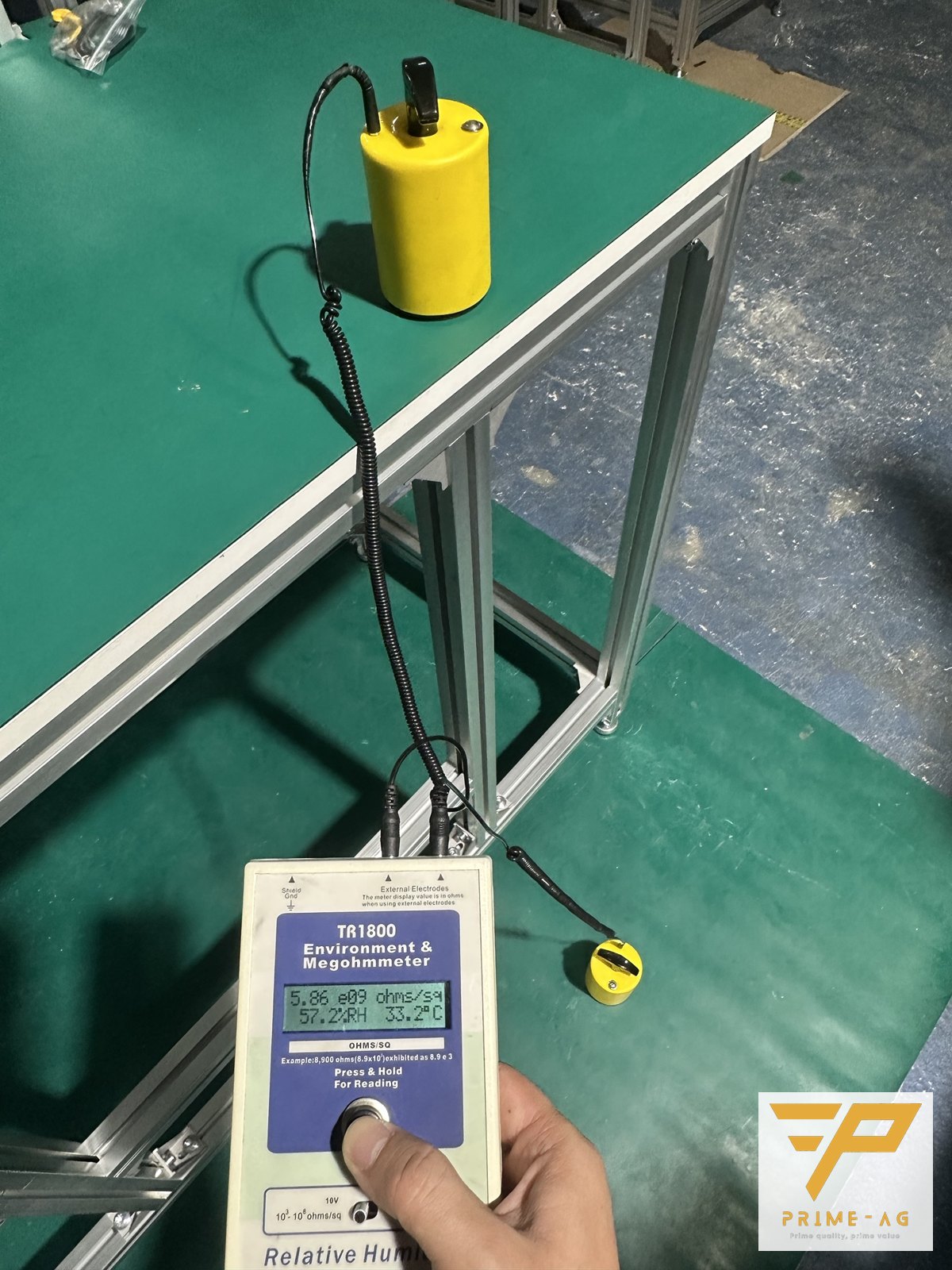
Anodised aluminium has an insulating oxide layer. An ESD top grounded through the frame gave 5.86×10⁹ Ω, as in the second photo; with a dedicated ground cord fitted it dropped to 1.30×10⁸ Ω. With an aluminium profile workbench with ESD top, check this cord before concluding the bench top is faulty.
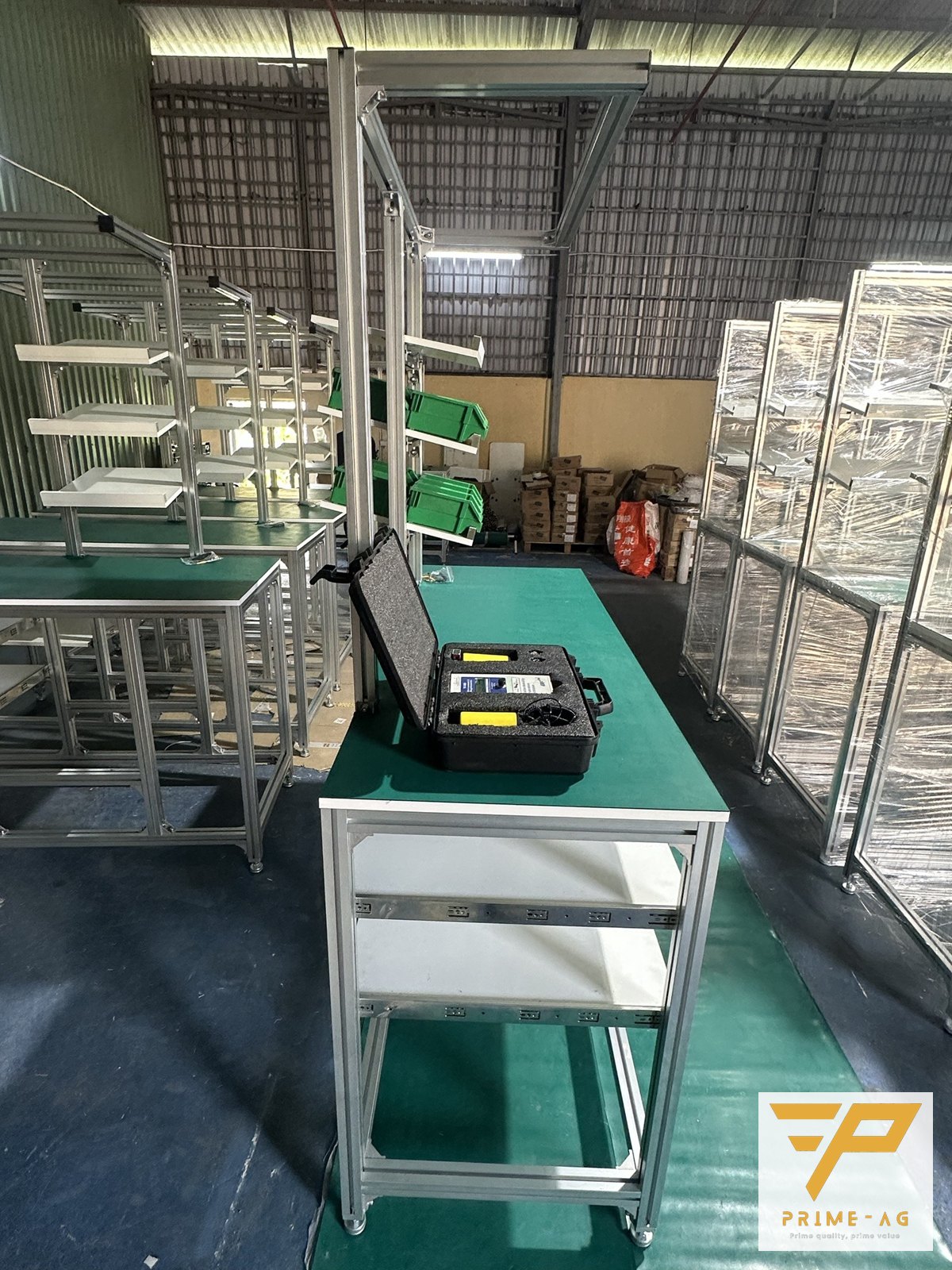
A dedicated ground cord was also a factory-fitted item when PRIMEAG delivered about 500 ESD benches with lights and sockets to a Taiwanese-invested electronic components factory in Da Nang (2024–2025), in 4 batches.
Self-check before logging
- Measured at 10 V first, moving to 100 V only when needed?
- The two electrodes exactly 254 mm apart?
- Voltage, %RH and temperature columns all filled in?
If you do not have a meter yet or want to cross-check your QA team’s method, you can invite a PRIMEAG technician to bring a TR1800 and two 5 lb electrodes to your workshop (Ho Chi Minh City, Binh Duong, Dong Nai) for free ESD resistance testing; a PDF report is sent within 3–5 working days, and the data are for reference only and do not replace an audit record.
Frequently asked questions
- Can I test an ESD workbench surface at 100 V straight away? — Not recommended. S4.1 requires testing at 10 V first; only when the reading reaches or exceeds 1×10⁶ Ω do you switch to 100 V and record the value at that level.
- Is there a formula to convert a 10 V reading to 100 V? — No. Dissipative materials are non-linear, so the two levels give two different readings; always record the voltage next to each result.
- Should I use 254 mm electrode spacing for Rtt on an ESD floor mat? — No. 254 mm applies to work surfaces under S4.1; for floors under S7.1 the two electrodes are placed about 0.9 m apart.
Email: info@primeag.vn · Phone/Zalo: +84 906 108 292
Written by the PRIMEAG engineering team
Updated: 2026-10-28