
When an aluminum profile ESD workbench passes on the top but the frame and shelves read open circuit to ground, the cause is mostly the anodized 6063 aluminum profiles: the oxide layer is an insulator. PRIMEAG measures every surface to ground with a TR1800, requiring below 1×10⁹ Ω, then adds dedicated wires with ring terminals and serrated washers.
The bench has just been installed and the laminate top passes. Move the electrode to the upper shelf or the tool hanging bar, and the meter shows over-range. The meter is not broken.
- Anodizing is an insulating oxide; an aluminum frame does not ground itself.
- Measure every surface components touch separately, not just the bench top.
- Shelves, hanging bars and metal trays need their own wire to the common ground point.
- Usually only wires and connecting parts need adding, not a new frame.
Why an aluminum profile ESD workbench reads open circuit on the frame
The anodized layer on 6063 aluminum is about 1.8–25 µm thick, hard, corrosion-resistant and insulating. Profiles joined with corner brackets and T-bolts are therefore not reliably continuous. Check in this order:
- Shelves and hanging bars only mechanically fixed to the frame: no dedicated wire.
- Electrical connectors between profiles missing or loose: common after moving the line or adding levels.
- Ring terminal fixed on the anodized surface with a flat washer: mechanically secure but not touching the base aluminum.
- Ordinary melamine shelf top: the shelf is wired but its surface is still insulating.
- Loose common ground point: then the bench top also reads off, so check it last.
Measuring to isolate the fault
Use the TR1800 digital resistance meter, 5 lb electrode, measuring to ground per ANSI/ESD S4.1; clamp the other lead to the common ground point.
| Electrode placed on | Typical reading | Interpretation |
|---|---|---|
| ESD laminate top | Below 1×10⁹ Ω | Bench top wire is good |
| Aluminum profile with intact anodizing | Over-range | Normal, the anodized surface does not conduct |
| Screw head with serrated washer | Low | That profile has a path to ground |
| ESD shelf top, metal tray | Over-range | Wire missing, needs adding |
A high reading on an anodized surface is not a fault; the fault is a place where components sit that does not reach ground below 1×10⁹ Ω.
Grounding the frame and shelves correctly
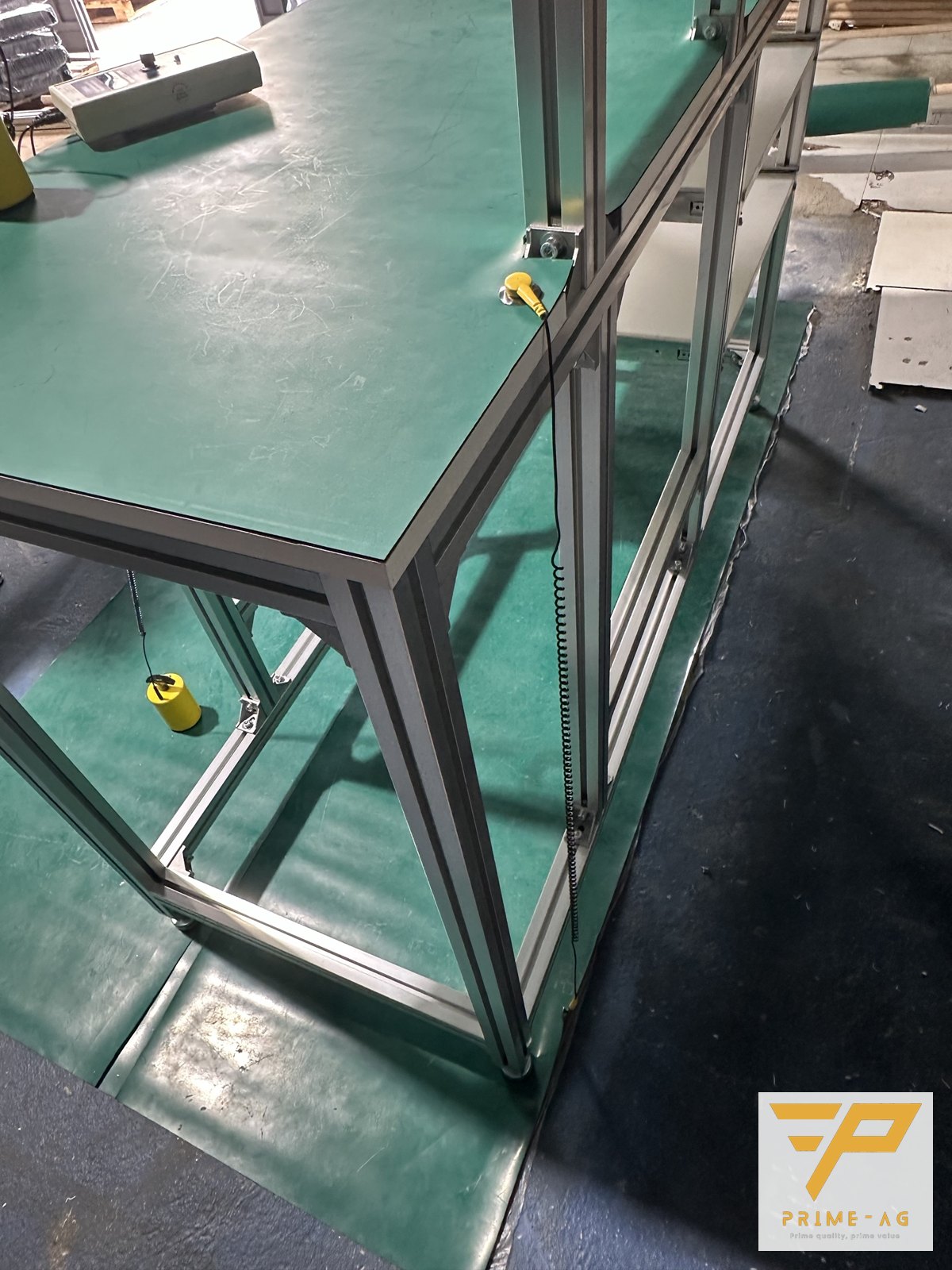
Wire the bench top straight to the common ground point; the hole for the ground snap must be drilled down to the conductive layer of the laminate.
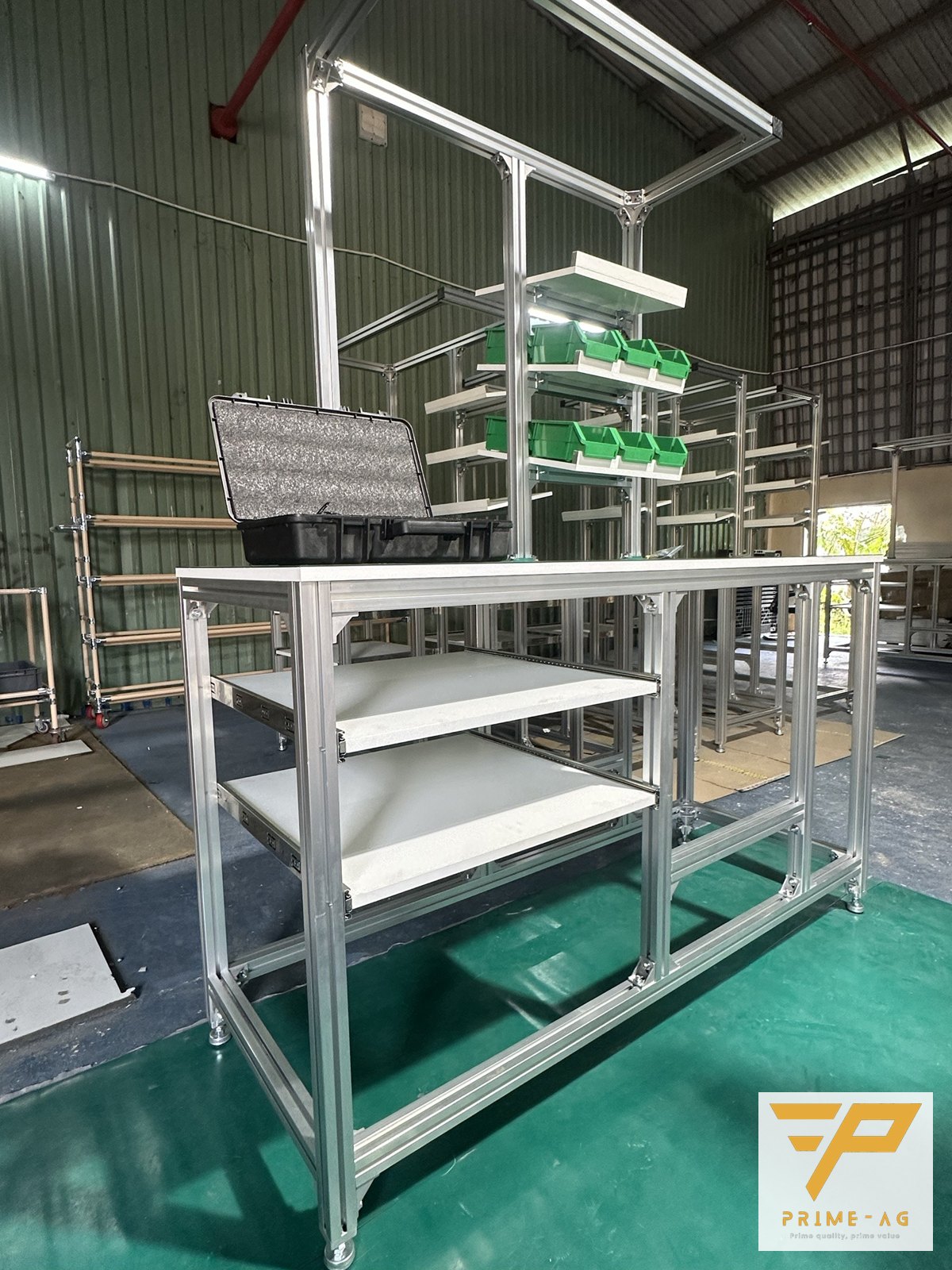
Shelves, hanging bars, metal trays: one wire per item, with the ring terminal tightened under a serrated washer that bites through the anodizing. Between profiles use pin-type electrical connectors that break through the anodizing when tightened.
PRIMEAG’s 40×40 aluminum profile bench with ESD top already has electrical connectors between profiles; the ground socket is an optional accessory. When adding shelves later, choose T-nuts and 8 mm slot corner brackets from the aluminum profile components range and run a wire to the new part.
When to repair, when to replace
An open-circuit frame can almost always be fixed with wires and washers; shelf tops are usually changed to ESD tops if components are placed on them. Replace the bench top only when the conductive layer of the laminate is damaged; how to isolate that is in ESD bench top fails in some zones. Frames carry a 3-year warranty, ESD tops 12 months.
Where to start
- List every surface components touch on each bench.
- Measure each surface to the common ground point and record the humidity.
- Where a reading exceeds 1×10⁹ Ω: check the wire and washer at that spot.
- Re-measure after every repair or added shelf.
The sign-off procedure for new benches is in 5 steps to accept ESD workbenches. If you have no meter yet, you can invite PRIMEAG technicians to your factory in Ho Chi Minh City, Binh Duong or Dong Nai (Mon–Sat) to measure your benches and shelves free of charge with a TR1800 and 5 lb electrode, including items bought elsewhere, with no purchase obligation; a PDF report by position with photos is sent within 3–5 working days, and the readings are for reference.
Frequently asked questions
The aluminum profile frame is metal, so why isn’t it grounded by itself? The surface of aluminum profiles is an insulating anodized oxide layer. The profiles are joined with corner brackets and T-bolts, so continuity is not reliable; dedicated wires and connectors are needed.
Should we scrape off the anodizing where the electrode sits to get a better reading? No. Scraping only changes the reading at one point. Measure the actual surfaces components touch and wire those parts.
Does a shelf used only for paperwork need grounding? If components and PCBs are never placed on it, the risk is low. A shelf that holds component trays should have an ESD top wired to ground.
Updated: 01/11/2026 — PRIMEAG engineering team
Email: info@primeag.vn · Phone/Zalo: +84 906 108 292
Written by the PRIMEAG engineering team
Updated: 2026-11-01