
JEDEC trays for Fuji, Panasonic and Yamaha pick-and-place tray feeders need the nominal 322.6 × 135.9 mm outline, a pocket matrix that fits the component package, a flat tray surface, and conductive or dissipative material per ANSI/ESD S541. PRIMEAG recommends reading the temperature rating embossed on the tray end before putting it into a 125 °C bake oven.
322.6 × 135.9 mm (12.7 × 5.35 inch): thanks to this common outline, stacks of QFP, BGA and QFN trays load into the tray feeders of Fuji, Panasonic or Yamaha placement machines on SMT lines in Vietnam. When the machine reports jams or picks from the wrong pocket, the cause is usually tray flatness, bake temperature or tray resistance.
- A standard outline is not enough; the pockets must fit the component package.
- Read the temperature embossed on the tray before it goes into the oven.
- Warped or chipped trays: take them out of circulation.
- Tray material: conductive (< 10⁴ Ω) or dissipative (10⁴–<10¹¹ Ω).
How JEDEC trays work in a tray feeder
A JEDEC tray is a matrix tray for ICs: a standard outline for stacking and loading into a tray feeder or tray changer, with pockets molded specifically for each package type. The machine picks components by pocket coordinates; warped trays or misaligned stacks easily cause wrong-position recognition or jams.
Three points when choosing JEDEC trays
Pocket matrix by component package
Specify the package code, rows × columns and pocket depth. Two trays with the same outline but a different pocket matrix are not interchangeable.
Temperature rating
The maximum temperature is usually embossed on the tray end. Only trays rated at or above the bake temperature may go into the oven. J-STD-033 includes a 125 °C bake profile; if the tray is not rated high enough, move the components to high-temperature trays or use a low-temperature bake profile. Details: MSL components past floor life: re-baking and repacking per J-STD-033.
Surface resistance
JEDEC trays are usually made of conductive (below 10⁴ Ω) or dissipative (10⁴ to below 10¹¹ Ω) material according to the ANSI/ESD S541 ranges. Measure with a surface resistance meter and record by lot.
Check for warpage before loading the machine
Three common causes: baking above the temperature marked on the tray; stacking trays high while still hot; a tray reused for too many cycles. Place the tray on a flat table and press each corner to see if it rocks. Discard warped or chipped trays.
| Symptom at the machine | Common cause | Action |
|---|---|---|
| Tray feeder jams when pushing the tray stack | Warped or chipped tray | Remove faulty trays, review bake temperature |
| Nozzle picks from the wrong pocket | Bent tray, misaligned stack | Check flatness, restack |
| Tray deformed after the oven | Baked above the temperature embossed on the tray | Switch to high-temperature trays |
| Resistance ≥ 10¹¹ Ω (insulative range per S541) | Wrong material type | Replace trays, record the lot |
Supplies around the tray feeder
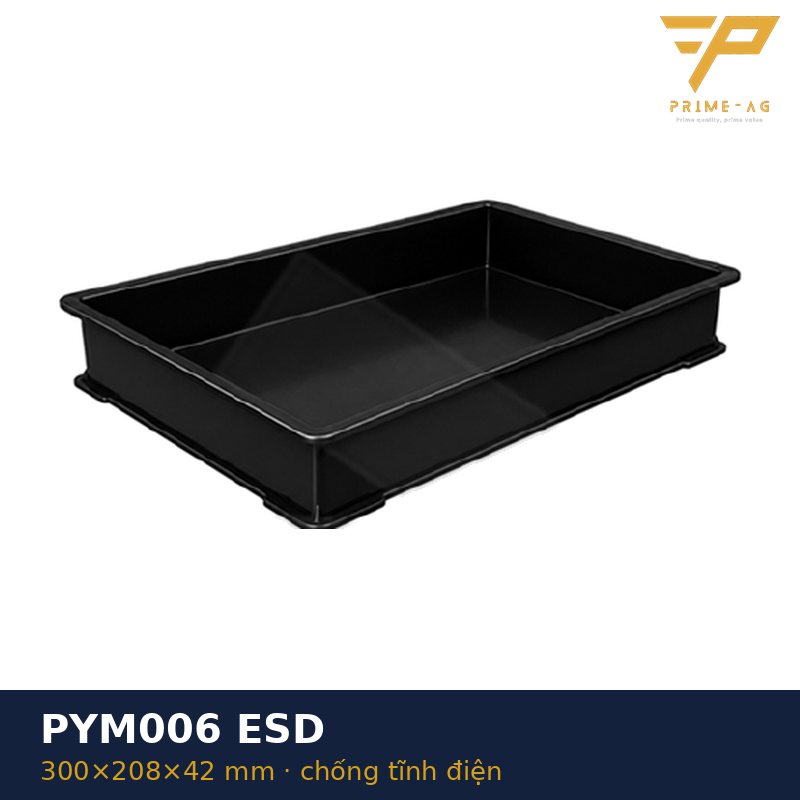
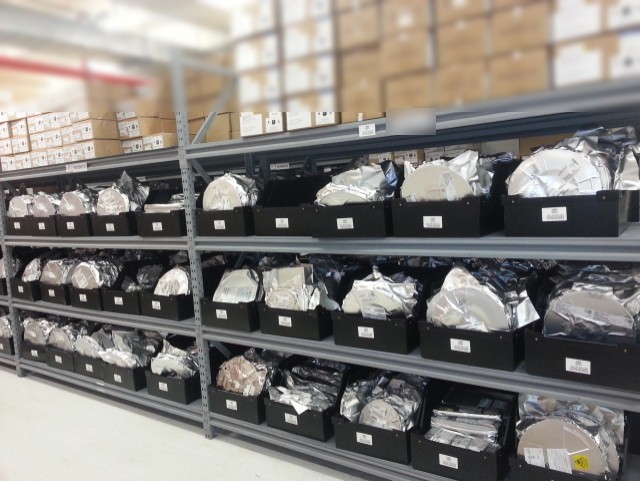
PRIMEAG anti-static plastic trays in carbon-loaded PP (10³–10⁹ Ω) are rated only for 0–80 °C, so they cannot replace high-temperature trays for baking. After baking, ICs are resealed in aluminium moisture barrier bags with desiccant packs and HIC cards. By process step: ESD supplies for Panasonic, Fuji and Yamaha SMT lines.
PRIMEAG makes custom JEDEC trays to order; the minimum order quantity is high, and photos or a sample of your current tray are needed to check the mold.
Where to start
- Photograph the tray end: package code, pocket matrix, embossed temperature.
- Compare it with the bake profile you are running.
- Take warped trays out of circulation.
- Measure the resistance of a few trays from each lot.
No meter yet? PRIMEAG visits factories in Ho Chi Minh City, Binh Duong and Dong Nai (Monday–Saturday) for free resistance testing of ESD materials with a TR1800 meter and 5 lb electrodes – including trays bought from other suppliers, with no purchase required. The factory receives a PDF file with readings by location and photos within 3–5 working days; the data is for internal reference and does not replace audit records.
Send tray photos and quantities via the quote request page for a reply within 30 minutes. Export processing enterprises (EPEs) are invoiced at 0% VAT, and PRIMEAG handles the on-the-spot import/export customs declaration free of charge for orders from VND 20 million.
Frequently asked questions
- Can JEDEC trays go into a 125 °C bake oven? — Only if the temperature embossed on the tray is 125 °C or higher. If it is lower, bake the components on a different tray that can withstand the heat.
- Can JEDEC trays used on Fuji machines also be used on Panasonic or Yamaha machines? — The outline is a common standard; what must match is the pocket matrix for the component. You should still check the tray feeder documentation for each machine.
- What resistance should a JEDEC tray have? — Trays usually fall within the conductive or dissipative range of ANSI/ESD S541, i.e. below 10¹¹ Ω; conductive trays are below 10⁴ Ω.
Updated: 29/10/2026 — PRIMEAG engineering team
Email: info@primeag.vn · Phone/Zalo: +84 906 108 292
Written by the PRIMEAG engineering team
Updated: 2026-10-29