
A reused ESD shielding bag in a Vietnam SMT factory still shields only while its VMPET metallised layer is intact, and the surface resistance of both the inner and outer faces must still be within 10⁶–10⁹ Ω. PRIMEAG recommends discarding the bag as soon as you see white cracked creases, holes, a torn zip edge, labels stuck on in several layers, or readings outside the range.
In many SMT workshops, one silvery-grey bag travels between the warehouse, the assembly line and the test room dozens of times. It gradually wrinkles, gains new labels and the zip loosens. It still looks like an antistatic bag, but the metal layer inside may already be cracked and the board is no longer shielded as it was when the bag was new.
- Shielding comes from the VMPET layer: once it cracks the bag stops working, even if it still looks intact.
- 5 discard signs: white cracks at creases, holes, torn zip or seal edge, stacked labels, contamination or readings out of range.
- Reuse with rules: fold the edge, no staples, close with an ESD label, limit the number of trips.
- Use containers internally: for movement inside the workshop, replace bags with ESD trays or bins.
Why reused shielding bags lose their shielding
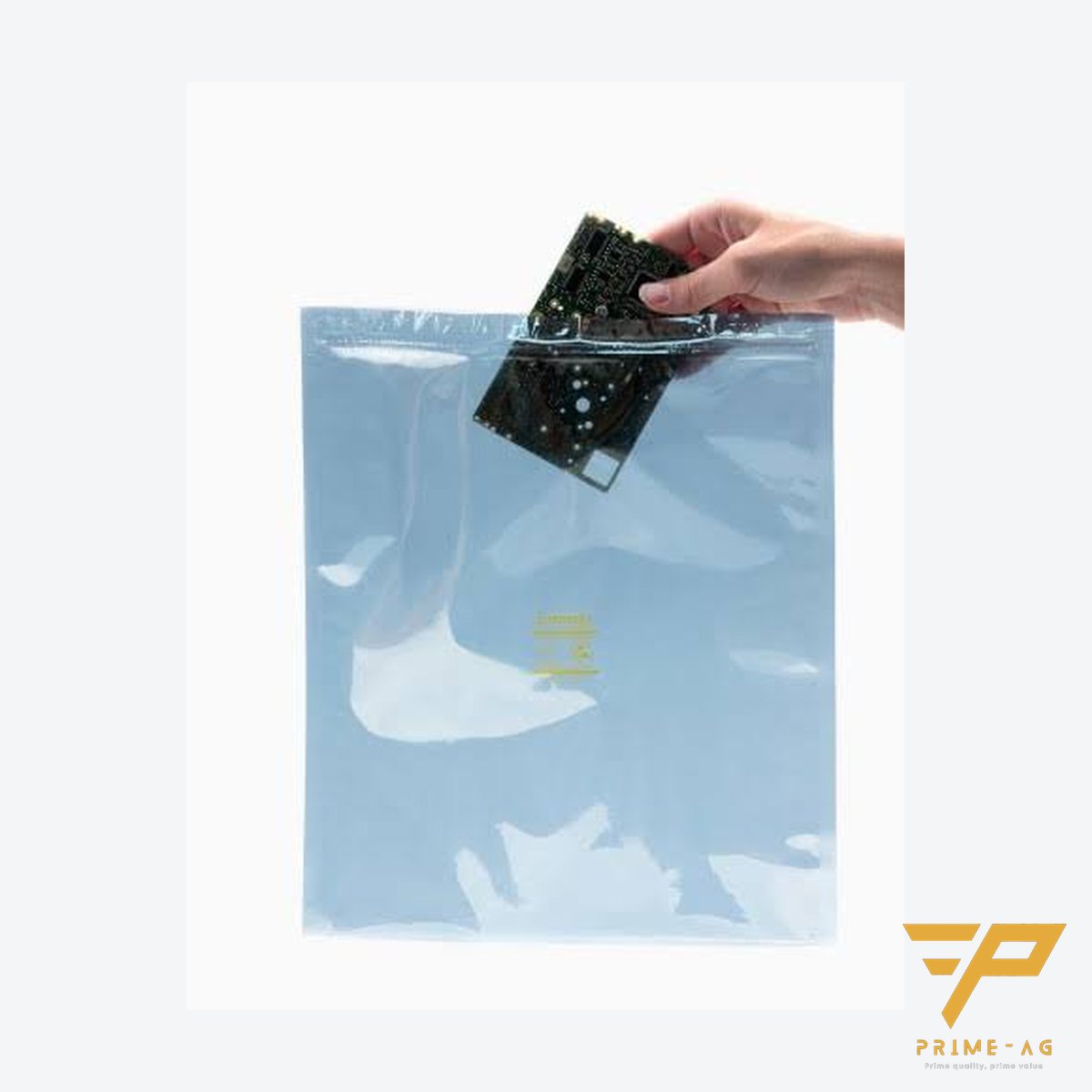
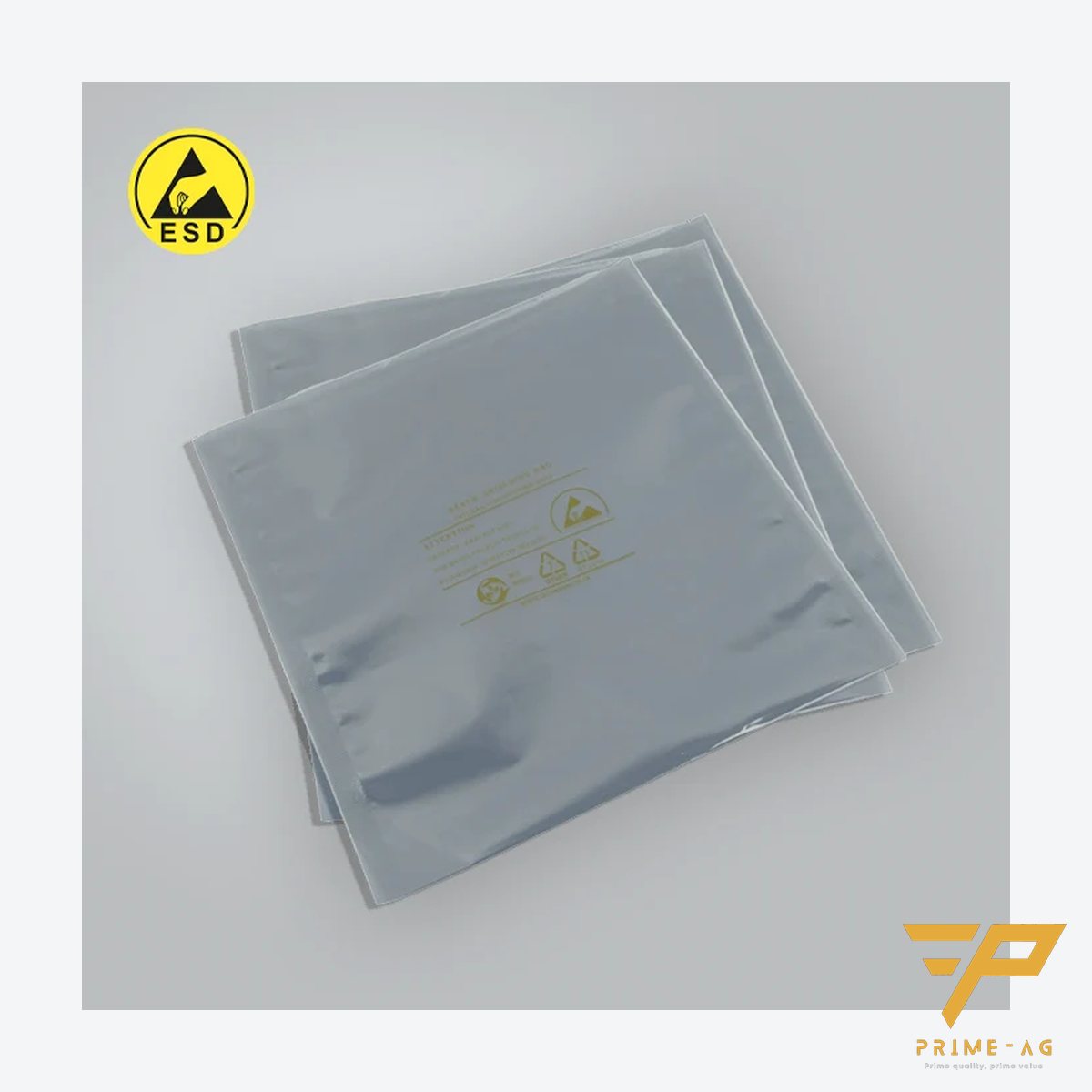
The shielding bags PRIMEAG supplies have three layers: dissipative PET outside, a VMPET metallised layer in the middle and dissipative CPP inside. Surface resistance of both the inner and outer faces is 10⁶–10⁹ Ω. The two dissipative layers bleed off charge slowly, while the metal layer forms a Faraday cage that blocks discharges from outside. ANSI/ESD S541 limits the energy that penetrates the bag, tested to ANSI/ESD STM11.31.
The VMPET layer is very thin. Sharp folding and repeated crumpling crack it while the two plastic layers stay intact, which is hard to see with the naked eye. Another distinction: a shielding bag is not a moisture barrier bag; components with an MSL label must be packed in aluminium bags, see how to pack moisture-sensitive components with aluminium bags and HIC cards.
5 signs a bag must be discarded
1. White cracked creases, light shining through
Hold the bag up to a lamp. A white break or a bright line running along a crease shows the metal layer is broken there.
2. Holes and staple marks
Component leads, board corners and staples all leave openings in the shielding cage.
3. Torn zip edge or damaged seal
A zip that no longer closes fully or a peeling seal edge means the bag no longer fully encloses the board.
4. Labels and tape stuck on in several layers
Labels cover the dissipative surface, and peeling them off tears the outer layer.
5. Oil contamination or surface resistance out of range
Oil and adhesive change the surface. Measure both the inner and outer faces with a TR1800 surface resistance meter; if the reading falls outside the bag’s specification (PRIMEAG bags: 10⁶–10⁹ Ω; the dissipative limit under ANSI/ESD S541 is 10⁴–<10¹¹ Ω), discard it.
Rules for reuse in internal transfers
- Fold the bag edge over; do not crease it sharply.
- No staples; close the opening with an ESD label.
- Set a maximum number of uses and inspect bags periodically.
- Put boards moving inside the workshop into a black PP antistatic plastic bin or ESD tray; reserve shielding bags for legs that leave the EPA; use aluminium moisture barrier bags only for MSL components.
| Transfer leg | Recommended | Notes |
|---|---|---|
| Between process steps inside the EPA | ESD trays or bins | Durable, no folding |
| Leaving the EPA, to another workshop | Zip-lock or heat-sealed shielding bag | Check the 5 signs before every trip |
| Moisture-sensitive components per MSL | Aluminium bag + desiccant + HIC card | A shielding bag cannot replace it |
Choosing between trays, bins and corrugated plastic (danpla) boxes: where to use ESD trays, bins or danpla boxes.
Where to start
- Collect all bags in circulation, check them against a lamp and discard those showing signs 1–4.
- Randomly measure a few of the remaining bags, recording the test voltage and humidity.
If you are not sure whether the bags and trays in use are still within range, factories in Binh Duong, Dong Nai or Ho Chi Minh City can invite PRIMEAG for a free on-site test together with ESD benches, mats and trolleys, including items not bought from PRIMEAG; results are for reference only.
Export processing enterprises (EPEs) receive a 0% VAT invoice; for orders from VND 20 million, PRIMEAG handles the on-the-spot import/export customs procedures free of charge.
Frequently asked questions
- How many times can an ESD shielding bag be reused? — There is no universal number. It depends on how the bag is folded, how it is closed and the route it travels; set your own limit and discard the bag as soon as you see cracks, holes or tears.
- Can a wrinkled but untorn shielding bag still be used? — Yes, if you see no white crease lines when holding it up to a light and the surface resistance of both sides is still within 10⁶–10⁹ Ω; if there are many sharp creases, discard it.
- Can moisture-sensitive (MSL) components be stored in shielding bags? — No. Shielding bags block moisture far worse than aluminium bags; MSL components need an aluminium moisture barrier bag with desiccant and an HIC card.
Email: info@primeag.vn · Phone/Zalo: +84 906 108 292
Written by the PRIMEAG engineering team
Updated: 2026-10-28