
ESD wrist strap tester keeps showing red (FAIL) even though the strap is on? It is usually one of six faults: dry skin, a loose strap or one worn over the sleeve, a coiled cord broken inside or a failed 1 MΩ resistor, an oxidised ground clip, a bench that is not actually grounded, or a wrong tester limit. PRIMEAG shows how to rule them out in this order within 10 minutes.
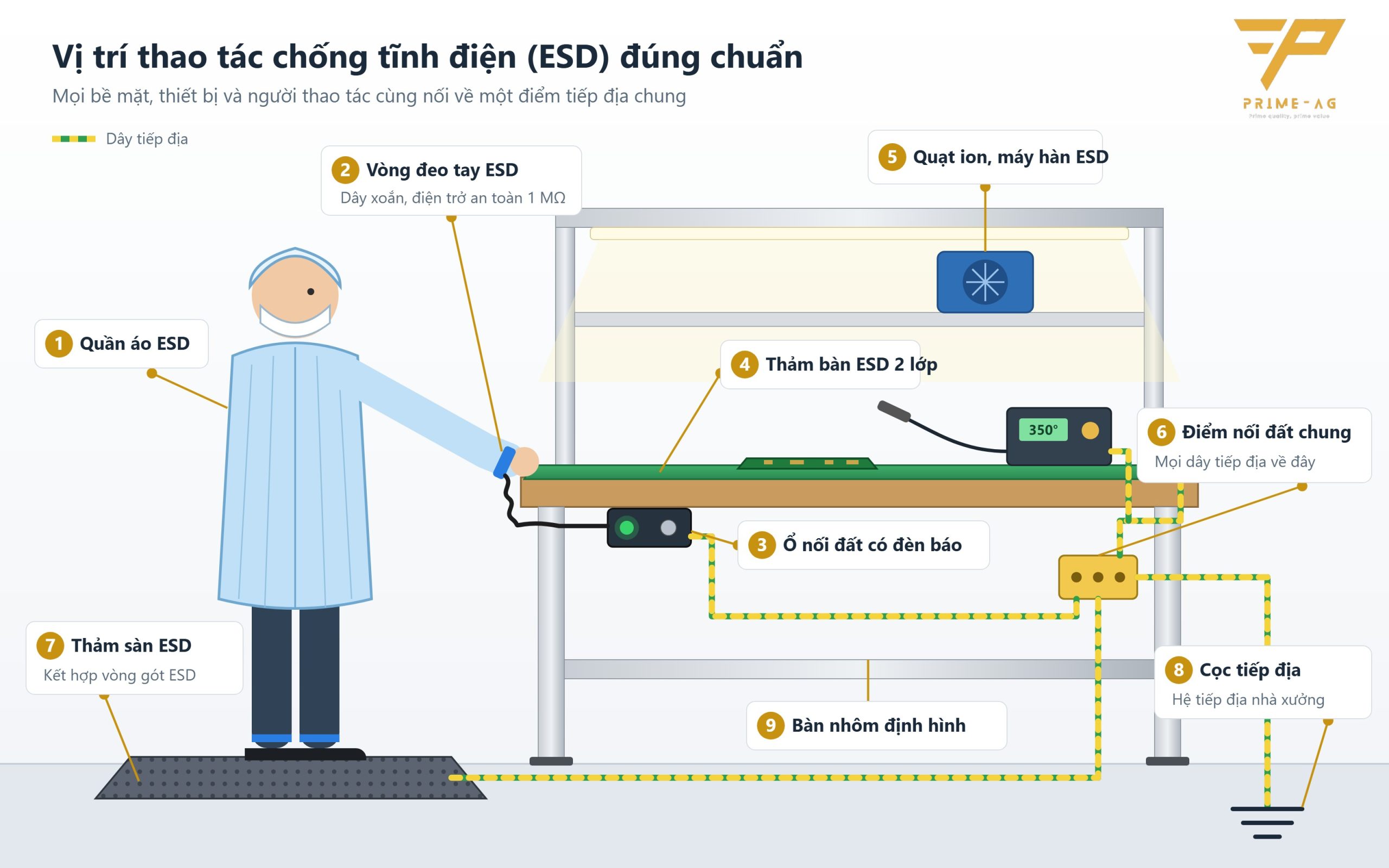
If your ESD wrist strap tester keeps showing red (FAIL) while the strap is worn, the fault is somewhere in the circuit: the tester measures the whole circuit skin – 1 MΩ resistor – coiled cord – clip – ground; any weak link pushes it above 35 MΩ.
- Check the person first, then the equipment: dry skin and a loose strap account for most red results.
- Swap one item at a time: strap, cord, socket; if it turns green after a swap, the item you just swapped is faulty.
- The coiled cord is a wear part: it breaks internally after 6–12 months; replace the cord separately.
- A whole row turns red: the fault is in the bench ground or the tester limit.
1. Dry skin, or hand cream or dust on the skin
The point where the stainless steel plate touches the skin is the weakest link; in the dry season, after washing hands with soap or with powder dust on the hands, skin resistance rises sharply. Test: rub both hands to warm them and test again. Fix with a skin lotion made for ESD areas (no lanolin, no silicone); ordinary hand cream forms an insulating film.
2. Strap worn loose, over the sleeve or with the contact plate turned away
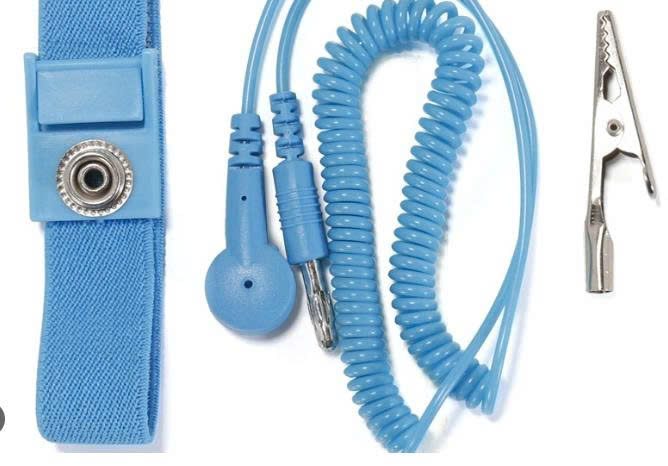
The adjustable 150–230 mm strap must fit snugly, with the stainless plate against the inside of the wrist. Wearing it over a sleeve, over a glove or with the contact plate turned to the bony side all exceed the limit. Test: tighten one notch, turn the plate inward and test again.
3. Coiled cord broken inside or 1 MΩ resistor failed
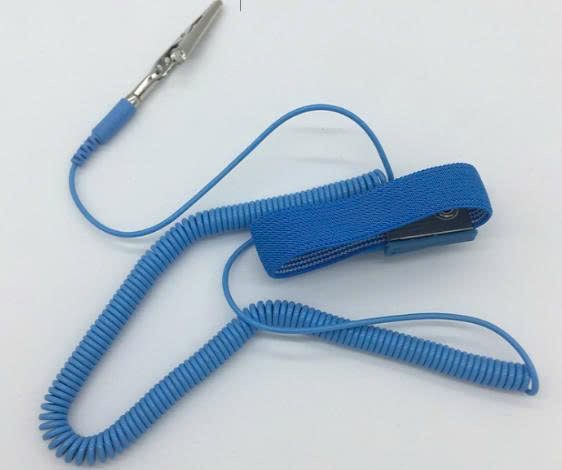
The PU cord stretches to 1.8 m every time the operator reaches; after 6–12 months the copper core breaks inside even though the jacket looks intact, and the lamp flickers red – green when the cord is shaken. If the 1 MΩ resistor in the snap head shorts, the tester shows red at the lower limit of 0.75 MΩ. Test: plug the cord into a strap that passes; if it is still red, replace the cord. PRIMEAG’s ESD wrist strap with coiled cord is sold with separate replacement cords, with resistance measured per batch and a test sheet.
4. Loose or oxidised alligator clip or ground socket
Clipping onto a painted bench edge or a rusty bolt, or clip teeth dulled by sweat, all increase resistance. Test: clip onto bare metal; better still, change to a 10 mm snap plugged into a fixed ground socket. If the socket has an indicator lamp and the lamp is off, the fault is behind the socket.
5. The bench ground point does not reach ground
Symptom: the whole bench or the whole row is red, but a different bench is green. The ground wire was removed during a workshop clean-up, the lug is broken, or it is bolted to an anodised aluminium frame whose oxide layer insulates. Test: measure from the ground socket to the common ground point with a surface resistance meter with a 10³–10¹² Ω range.
6. Wrong tester limit or tester past its calibration date
The tester has an adjustable range of 0.75–35 MΩ; if someone lowers the upper limit to 10 MΩ, operators with dry skin will read red even though person-to-ground is still below 3.5×10⁷ Ω. Check the limit, the 12-month calibration date and the hand-contact electrode. For lines that use continuous monitors, see the article continuous ESD monitors or start-of-shift wrist strap testing.
10-minute self-check
| Minute | What to do | If green, the cause is |
|---|---|---|
| 1–2 | Warm hands, tighten strap, turn contact plate, test | Dry skin / loose strap |
| 3–4 | Borrow the cord, then the strap, of someone who passes | Faulty cord or strap |
| 5–6 | Move the clip to bare metal or another socket | Oxidised clip / socket |
| 7–8 | Test at the neighbouring bench | Lost ground on the original bench |
| 9–10 | Compare tester limit and calibration date; log it | Tester set wrongly |
If you also want the ground points and ESD materials in use checked, PRIMEAG visits factories in Ho Chi Minh City, Binh Duong, Dong Nai (Mon–Sat) for free ESD resistance testing with a TR1800 and 5 lb electrode, with no limit on test points and no obligation to buy, and a PDF report within 3–5 working days; results are for reference only and do not replace audit documents.
When to replace
Replace the cord when the lamp flickers as it is shaken, the PU jacket is cracked or the resistance drifts outside 1 MΩ ± 10 %; replace the strap when the stainless plate is worn hollow or the buckle no longer holds. For a checklist for a new line, see the article setting up an EPA for an SMT line; straps, cords and ground sockets are delivered in 24–48 hours.
Frequently asked questions
- Red on one tester, green on another: which wrist strap tester is right? — The one set to the correct 0.75–35 MΩ range and still within its 12-month calibration; use a new strap to decide.
- My skin is dry: can I wear the ESD wrist strap over a glove or sleeve? — No, the stainless plate must touch the skin; apply ESD-safe skin lotion at the start of the shift.
- Can a coiled cord with an internal break be repaired, or do I need a new one? — Not recommended; the damaged PU jacket will break again. Replace the cord separately and keep the strap; PRIMEAG replaces cords that break within 3 months.
Mon–Sat, 8:00–17:00 (GMT+7) · Phone/Zalo: +84 906 108 292 · Email: info@primeag.vn
Start where it suits you: Free technical advice · Send a drawing or layout · Get a quote within 30 minutes
Written by the PRIMEAG engineering team
Updated: 2026-10-21