
Made to order: delivered and installed as quoted, covered by warranty, no returns. Shipping & return policy
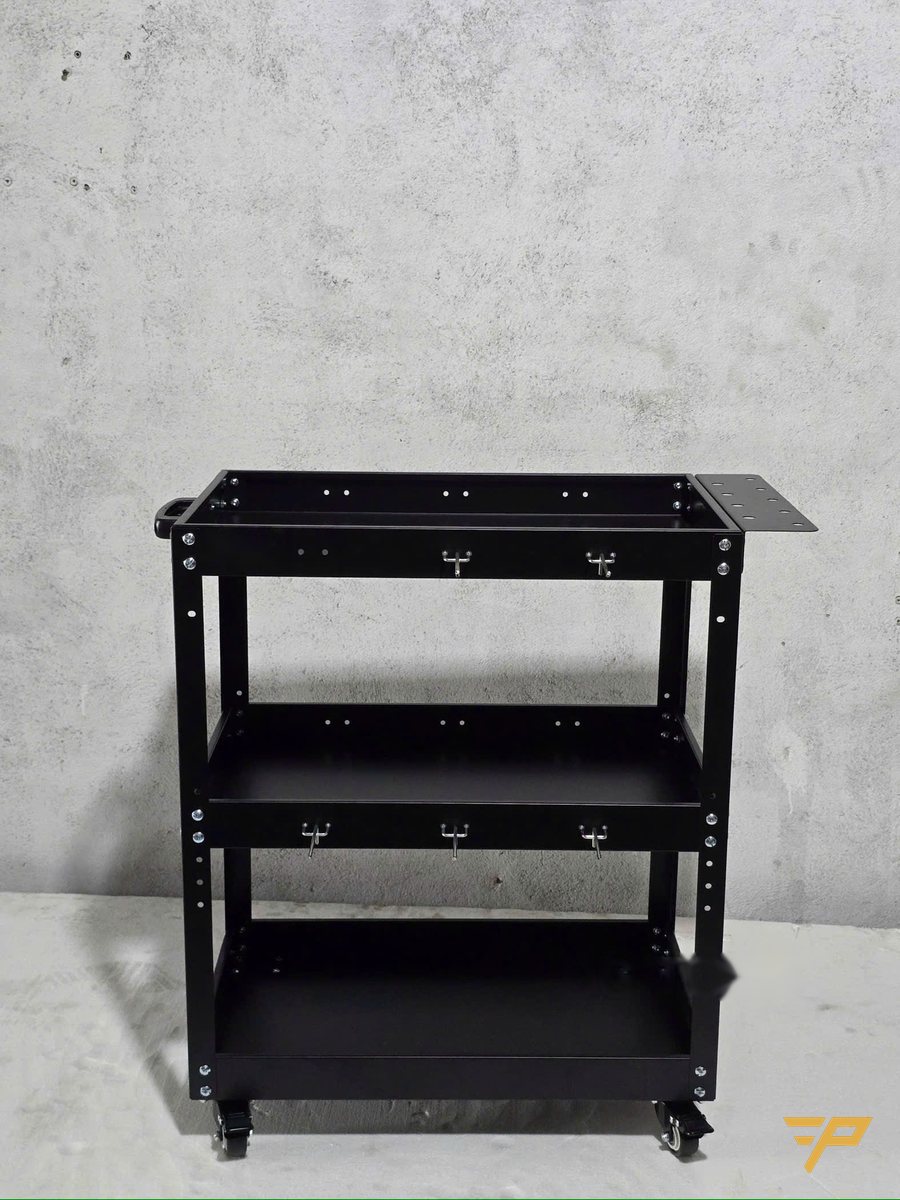
Product code: TC-5936 · Specification: 3-tier mechanical tool cart, 590 × 360 mm trays
3-Tier Steel Tool Cart 590×360×725 mm
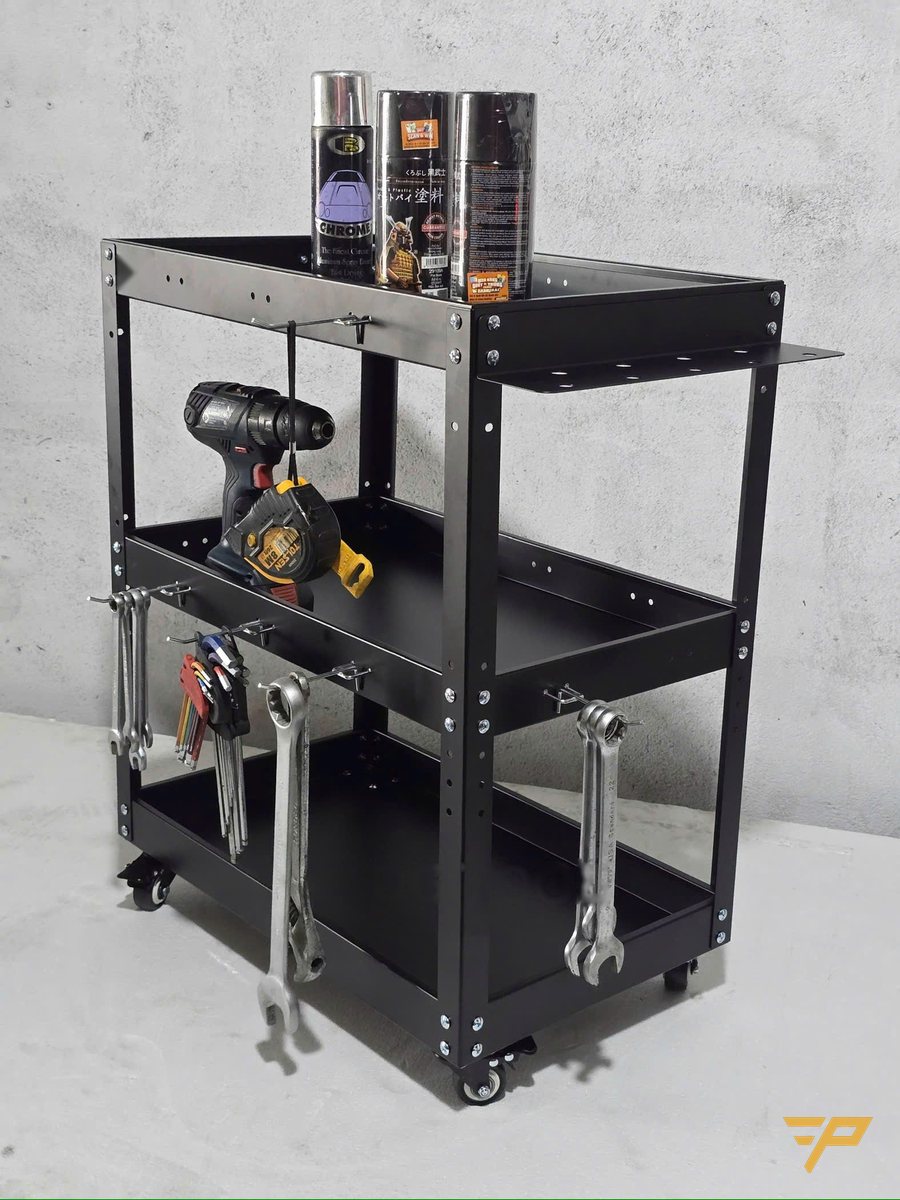
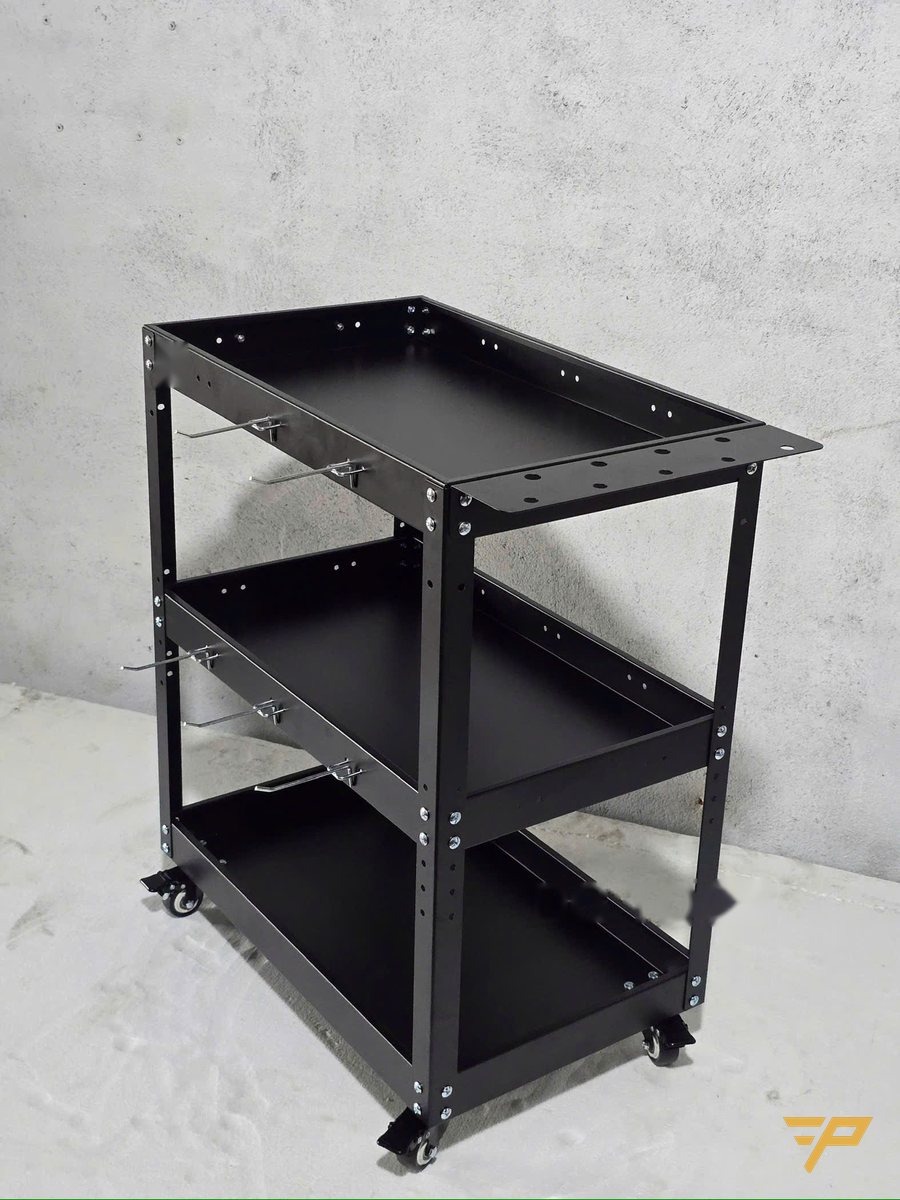
A compact, lightweight tool cart for machine shops, maintenance and electronics repair: 3 steel trays with raised lips so tools, parts and chemical bottles do not fall off while pushing. Black powder-coated steel frame — this is not an ESD (anti-static) cart; load capacity 150–180 kg, own weight only 10 kg. Supplied with hooks for spanners, hex keys and a drill, plus a side-mounted screwdriver rack — everything the technician needs is within reach and follows them to each machine.
| Item | Value |
|---|---|
| Tray size | 590 × 360 mm (length × width), 3 trays with raised lips |
| Overall dimensions | Length 700 mm (including handle and tool rack) · height 725 mm (including castors) |
| Material | Black powder-coated sheet steel |
| Steel thickness | Trays 0.8 mm · uprights 1.5 mm |
| Load capacity | 150–180 kg |
| Cart weight | 10 kg |
| Castors | Black 70 mm wheels, hard rubber + steel fork, with brake |
| Included accessories | Push handle, side rack for screwdrivers/test pens, tool hooks on the top and middle trays |
What it is used for
– Machine shops, maintenance: carrying spanners, hex keys, cordless drills, screw guns, nuts and bolts right to the machine being repaired.
– Electronics repair, equipment engineering: meters, soldering irons and spare parts organised tray by tray.
– Warehouses, production lines: issuing small materials and maintenance chemicals (spray paint, oil, adhesives) between stations.
Why choose this model
– Deep trays with lips: tools do not slide off when crossing door thresholds or floor channels.
– Powder-coated steel: durable surface, oil and grease wipe off easily, limits rust.
– Hang instead of stack: hooks on both sides and the side rack free up tray space.
– Compact: 590 × 360 mm trays fit through narrow aisles between machines and racks.
– Stays put while working: braked castors keep the cart from rolling while the technician works.
Selection guide
– Carrying tools and kit around the workshop → this model.
– Carrying 600 × 400 bins, heavy loads on several tiers → lean pipe trolley 1500 × 600.
– Very narrow aisles between assembly lines → small trolley 720 × 430.
– ESD areas, cleanrooms → aluminium profile trolley with ESD shelves.
FAQ
– How much weight can the cart carry? — Total load 150–180 kg; spread it evenly over the trays and put heavy items on the bottom tray.
– Is it delivered assembled or does it need assembly? — Contact PRIMEAG to choose pre-assembled delivery or flat-pack with instructions; the frame is bolted together.
– Do the castors have brakes? — Yes, the 70 mm hard rubber castors have brakes.
– Buying in quantity for several maintenance teams? — Send the quantity and PRIMEAG will quote per lot and deliver to your factory.
“Powder coated” does not mean anti-static
The cart body is cold-rolled sheet steel finished with electrostatic powder coating. “Electrostatic” here refers only to the spraying method: the powder is charged so that it clings to the earthed steel part, then baked into a polymer film. This coating is an insulating material, and combined with ordinary rubber castors it means the cart is not an ESD cart and cannot be earthed through the floor. For carrying PCBs and bare components inside an EPA, use an aluminium-frame cart with ESD shelves and conductive castors (AT-8612); this cart is suited to machine shops, maintenance and warehouses.
Advantages of powder coating over liquid paint: a thick, well-bonded film with good resistance to impact and oil, and less rust. Its weak point is chipped spots: exposed steel rusts and the rust creeps under the coating, especially in humid workshops or where coolant is present — touch up chips early.
Load capacity: calculate for the castors and for each tray
There are two independent limits: the trays (0.8 mm steel, fine with evenly spread loads, sagging under point loads) and the castors. Castor manufacturer TENTE recommends calculating the load per castor as:
Load per castor = (cart weight + load) ÷ (number of castors − 1)
The reason: on uneven floors only 3 of the 4 castors may carry the load at times. For a 10 kg cart carrying 180 kg: (10 + 180) ÷ 3 ≈ 63 kg/castor. The 70 mm castors used on this model mostly have a rated load above 100 kg/castor, a margin over the calculated figure. When replacing castors, choose ones rated at least at this level, plus a safety factor if the cart often crosses thresholds or channels.
- Put drills, socket sets and heavy items on the bottom tray — this lowers the centre of gravity so the cart does not tip forward over door thresholds.
- Do not stand on the trays or use them as an anvil for hammering: 0.8 mm trays will dent and the lips will deform.
- Do not let long items (threaded rod, pipe) stick out of the cart — they can easily hit people when the cart turns.
Rubber castors: quiet and floor-friendly, but harder to push
| Wheel material | Starting / rolling force | Floor protection | Notes |
|---|---|---|---|
| Solid rubber (approx. 80 Shore A) | Higher than PU, plastic, metal | Very good, damps vibration, absorbs impact | Black treads can leave marks on light-coloured floors; grey non-marking versions are available |
| PU (approx. 92 Shore A) | Low | Good, non-marking | Common on line trolleys and ESD trolleys |
| Nylon/polyamide (approx. 70 Shore D) | Very low | High floor pressure | Noisier; dimensions change with humidity |
Rubber castors are a sensible choice for a tool cart: smooth running, tools bounce less, and they do not scratch epoxy floors. Small wheels (70 mm) catch easily in floor joints and drain covers; guidance from the HSE (UK) notes that larger wheels help offset the higher push force on uneven floors.
Acceptable push forces
ISO 11228-2 and the Liberty Mutual tables (Snook & Ciriello, 1991) assess the initial force (to get the cart rolling) and the sustained force (to keep it rolling) separately; a 2014 review published in the NIOSH/CDC repository confirmed that the Snook tables remain valid. The HSE gives guideline figures for screening:
- Starting or stopping: men approx. 200 N (≈ 20 kg), women approx. 150 N (≈ 15 kg).
- Keeping the load moving: men approx. 100 N (≈ 10 kg), women approx. 70 N (≈ 7 kg).
These are not absolute safe limits. A simple check: hook a force gauge to the handle and push the fully loaded cart along its actual route. The force increases when castors wear, become wrapped with hair or metal swarf, or when the floor has ridges.
Routine maintenance
- Remove swarf, string and hair wrapped around the castor axles; grease the swivel bearings.
- Check that the brakes still hold the cart still when the technician leans on a tray.
- Retighten the frame bolts after the initial period of use — the cart is subject to vibration when pushed across the floor.
- Wipe off oil and grease with a mild cleaner; avoid strong solvents that dull or blister the coating.
Technical references
- Blickle – Material description for wheel treads
- TENTE – Static and dynamic load capacity of casters
- HSE (UK) – Doing a push/pull risk assessment (guideline figures)
- NIOSH/CDC – Garg et al. 2014, Psychophysical basis for maximum pushing and pulling forces
Request a quotation: send the number of carts and the delivery address — PRIMEAG will provide a quotation and delivery time within 30 minutes.
Price: from 1,400,000 VND (excl. 8% VAT).
Hotline/Zalo +84 906 108 292 · info@primeag.vn
Written by the PRIMEAG engineering team.
Related guides:ESD EVA Foam Tray Liners Flattened, Shedding or Peeling:…Oily, slippery floor around CNC machines in Vietnam: 5…
Related products:PCB Magazine Racks & TrolleysAnti-Static (ESD) Multi-Tier Steel Pipe TrolleyNarrow-Aisle Lean Pipe TrolleyPlastic Deck Hand Trolley
Updated: 2026-10-23
Giao tận nhà máy TP.HCM, Bình Dương, Đồng Nai, Long An, Tây Ninh · Kèm biên bản đo điện trở ESD theo lô · Hotline 0906 108 292