
Stocked item: delivered in 1–2 working days in Ho Chi Minh City, Binh Duong and Dong Nai; free delivery for orders from VND 20,000,000; defective items exchanged within 7 days. Shipping & return policy
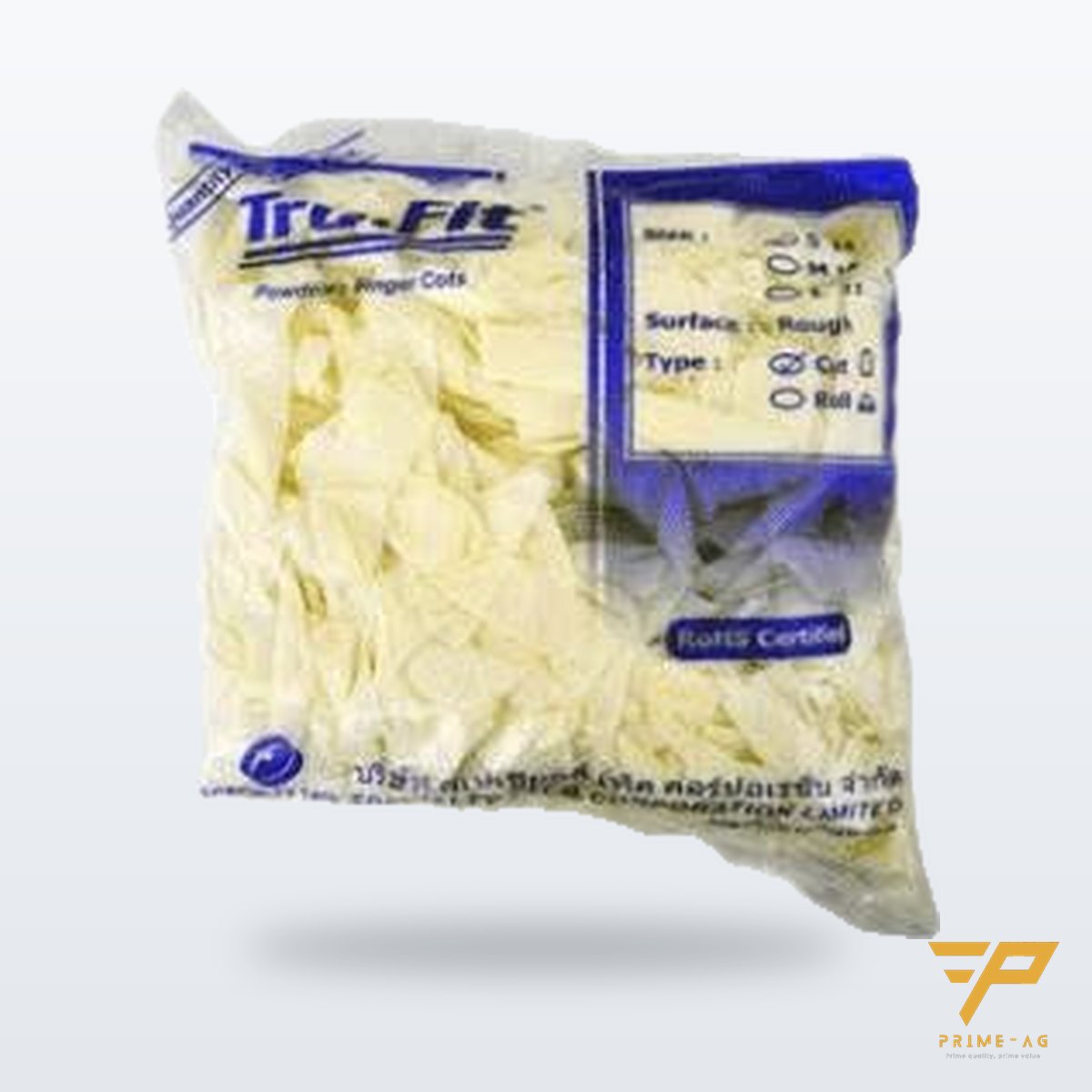
Code: FC-TF · Specification: ESD (anti-static) finger cots (Trufit, banded and unbanded). Delivery: stock items delivered within 24–48 hours (Ho Chi Minh City, Binh Duong, Dong Nai); lead time for bulk orders is confirmed with the quotation.
Also known as: Trufit M18, “Trufit finger cots”, “anti-static finger cots”, “yellow-band finger cots” — the difference: available in 2 types (smooth Trufit and textured yellow-band), in standard bags for per-shift issuing.
Powder-free rubber finger cots, chlorinated to reduce ions, worn on 2–3 fingers when picking components, PCBs and lenses — an alternative to gloves when real fingertip feel is needed. Smooth Trufit for cleanrooms; textured yellow-band for steps that need grip (pulling tape, handling reels).
| Item | Value |
|---|---|
| Material | Powder-free natural latex, chlorinated (latex-free nitrile optional) |
| ESD | Trufit ESD: resistance per batch CoA; yellow-band: basic anti-static |
| Size | S / M / L (Trufit); M (yellow-band) |
| Thickness | 0.08–0.10 mm |
| Surface | Smooth (Trufit) / textured (yellow-band) |
| Colour | Off-white / yellow |
| Cleanliness class | Class 100 (Trufit) |
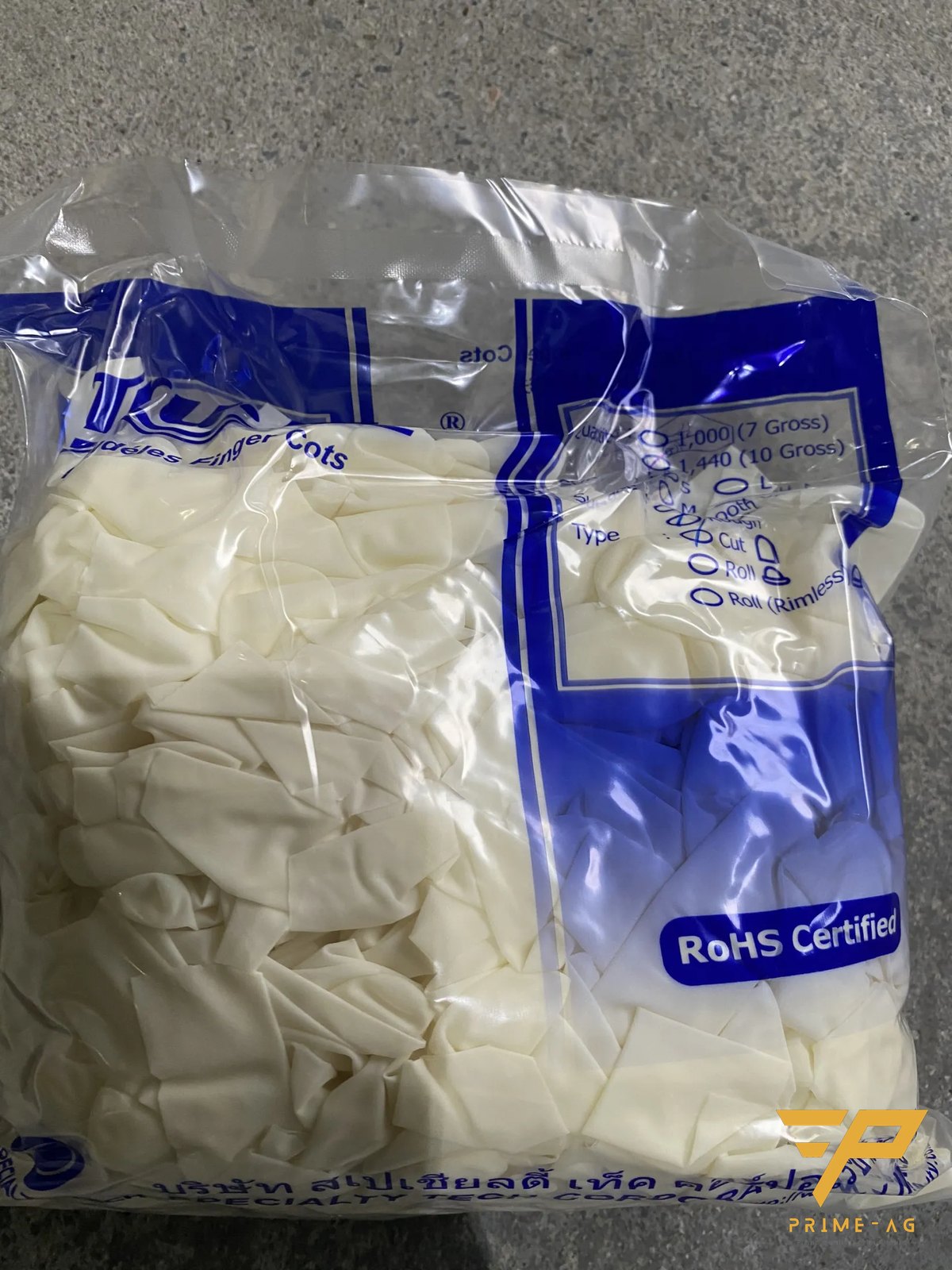
| Packing | Trufit: 1,440 pcs/bag; yellow-band: 500 pcs/bag |
| MOQ | 1 bag |
Choose by process step
– SMT, cleanroom, handling PCBs → smooth Trufit (this code).
– Grip needed, handling reels/tape → textured yellow-band (FC-Y).
– Latex allergy → nitrile (order in advance).
– Whole-hand contact → PU fingertip-coated gloves (GP-F).
Documents per batch: CoA (ions, particles), RoHS; samples of 50 pcs.
Recurring orders: price held for 6 months, minimum stock of 5 bags.
Material and manufacturing process
The finger cots are dip-moulded from natural rubber latex with a rolled edge so they roll on easily and grip the base of the finger. Two process steps determine quality for electronics and cleanroom environments:
- Powder-free: donning powder (corn starch) is a source of particles and carries latex proteins.
- Chlorination: reduces surface tack so the cots go on easily without powder; the washes in this process also significantly reduce soluble proteins — the cause of latex allergy. Side effect: a smoother surface with less grip, which is why PRIMEAG also offers a textured type for steps that need grip.
As an international quality reference: the QRP Qualatex 8C dissipative latex finger cot line states a thickness of 0.09 mm, an average surface resistance of 10⁷ Ω/sq, powder-free, chlorinated, for Class 100 (ISO 5) cleanrooms, tested to IEST-RP-CC005.
Why use dissipative finger cots rather than ordinary ones?
Ordinary latex is an insulating material. Desco explains two risks of wearing ordinary finger cots in an EPA:
- The wrist strap stops working at the fingertip: the operator is grounded, but the insulating latex layer prevents charge between the component and the hand from equalising through the ground path.
- Charged device model discharge (CDM): a component can become charged on its own (sliding in an IC tube, or induced by a nearby insulator). When a grounded finger touches it, the component discharges very quickly. A dissipative finger cot increases contact resistance so the charge drains more slowly — which is why Desco recommends mandatory dissipative gloves/finger cots where CDM must be controlled.
Standards and testing
- ANSI/ESD STM15.1-2019 is the test method for gloves and finger cots: it measures the intrinsic resistance of the material and the system resistance when worn (person – finger cot – ground).
- Acceptance limits are set by each factory. Many organisations use a limit of < 1×10¹¹ Ω (per ANSI/ESD S541) for ESD gloves; companies controlling CDM often require 1×10⁶–1×10⁹ Ω. Some customers also test charge decay from ±1,000 V to ±10 V in under 2 seconds.
- Test samples from each batch at low humidity — material resistance rises when the air is dry.
- Remove finger cots when testing wrist straps at the start of a shift: a finger cot of about 10⁸ Ω will make the tester (upper limit about 10⁷ Ω) report a fail even though the wrist strap is fine.
Latex allergy — what EHS needs to know
According to NIOSH (USA), reactions to latex products take three forms:
- Irritant dermatitis: the most common; dry, itchy skin from friction and powder — not a true allergy.
- Allergic contact dermatitis: caused by chemical additives used in rubber manufacturing.
- Immediate allergy: caused by latex proteins; from rash and itching to runny nose and asthma-like symptoms.
NIOSH notes that latex proteins attach to powder and become airborne when gloves are changed; a “hypoallergenic” label does not reduce the risk of latex allergy. Workers with a history of allergy should switch to nitrile finger cots. Do not use oil-based hand creams with latex — oil degrades the rubber.
Donning, changing and disposal
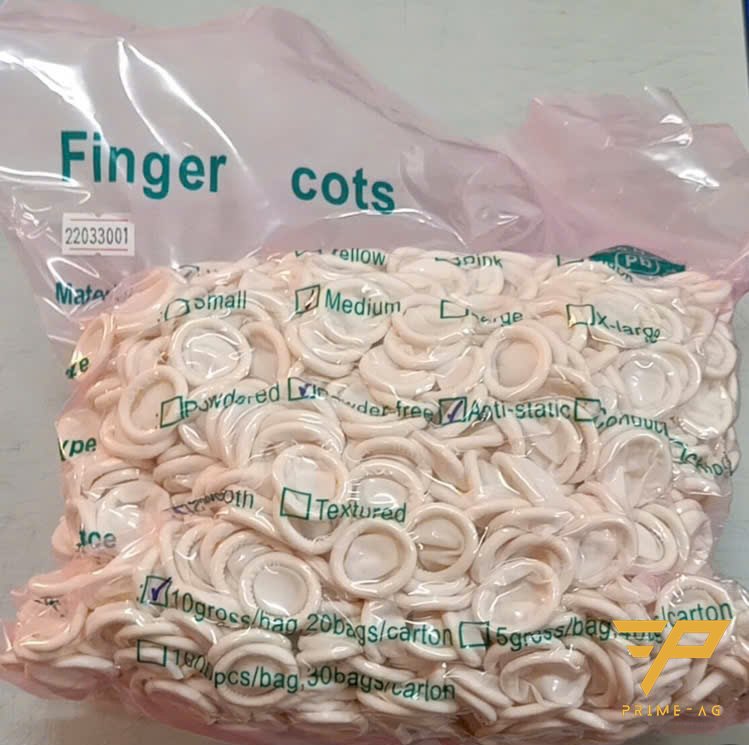
- Wash and dry hands before donning; place the finger cot on the fingertip and roll the edge down the full length, without stretching it thin.
- Choose the right size: a loose cot slips off easily; one that is too tight tears easily and tires the finger.
- Finger cots are single-use; change them when torn, contaminated with flux or oil, or when leaving the work area.
Storage and shelf life
- Latex oxidises faster in heat: store in a dry, cool place at about 10–22 °C, in the original packaging until use.
- Avoid UV — including fluorescent lamps — and ozone sources such as electric motors, fans, air conditioners and spark-generating equipment. Ozone can pass through plastic bags.
- Issue first in, first out; discard finger cots that are brittle, tacky or have a pungent smell.
FAQ
- Are the finger cots really anti-static? — Trufit ESD has measurable resistance stated on the CoA for each batch; ordinary types only reduce powder/lint and are not measurable — specify clearly when ordering.
- How many fingers? — Usually thumb, index and middle; change when torn or at the end of the shift.
- Do they smell of rubber? — Chlorinated, so almost odourless and powder-free.
- Who does size M fit? — Finger diameter 16–18 mm; S for women with small hands, L for the thumb.
Certificates and test reports
- RoHS (10 substances) — CPST – Eurones Products Testing (Dongguan), report no. C230522074001-1 (24/05/2023): latex finger cots (white, black, pink, yellow): all 10 RoHS substances not detected (ND). Download PDF
Submitter/manufacturer details on the reports are masked to protect the supply chain; full copies are sent to customers on request. See all: PRIMEAG product certificate and test report file.
Technical references
- Desco – Finger cots, gloves and wrist strap testing; CDM (Q&A)
- ESDA – ANSI/ESD STM15.1-2019 Gloves and Finger Cots
- Interference Technology – Evaluation methods for static control gloves
- NIOSH – Latex Allergy: A Prevention Guide (98-113)
- Fisher Scientific – QRP Qualatex 8C static dissipative latex finger cots
- DentistryIQ – Proper glove storage (latex)
Price: from 160,000 VND (excl. 8% VAT).
REQUEST A QUOTE: send bags per month and type — PRIMEAG quotes within 30 minutes.
Hotline/Zalo +84 906 108 292 · info@primeag.vn
Written by the PRIMEAG engineering team.
Related guides:ESD gloves: fingertip-coated or palm-coated – which to choose…ESD Finger Cots Tearing, Slipping or Marking PCBs: Causes…PU Fingertip Gloves Peeling or Holed After One Shift:…
Updated: 2026-10-26
Giao tận nhà máy TP.HCM, Bình Dương, Đồng Nai, Long An, Tây Ninh · Kèm biên bản đo điện trở ESD theo lô · Hotline 0906 108 292