
Stocked item: delivered in 1–2 working days in Ho Chi Minh City, Binh Duong and Dong Nai; free delivery for orders from VND 20,000,000; defective items exchanged within 7 days. Shipping & return policy
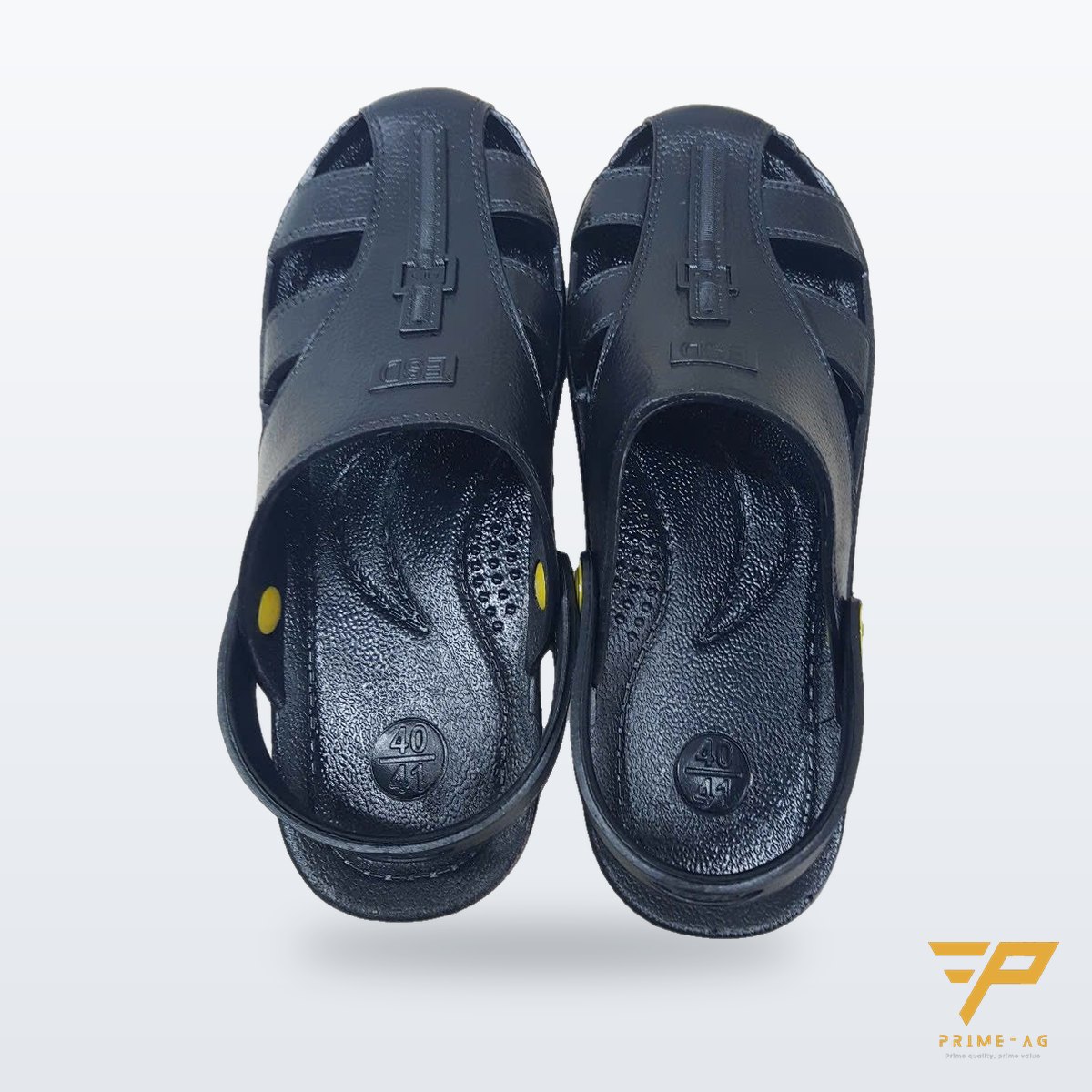
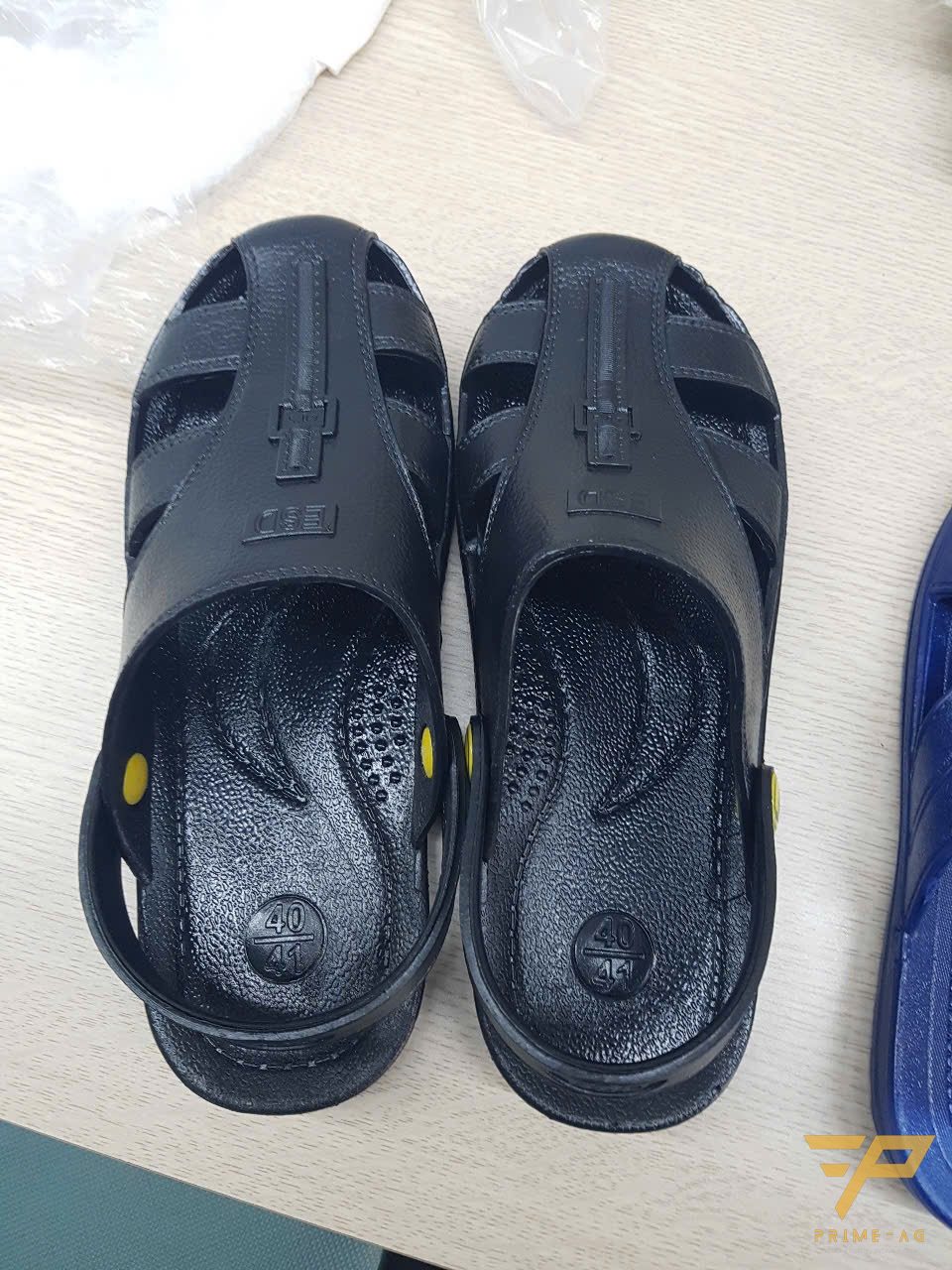
Code: SL-SANDAL · Specification: ESD (anti-static) sandals with instep strap + heel strap. Delivery: in stock, delivered within 24–48 hours (Ho Chi Minh City, Binh Duong, Dong Nai); lead time for bulk orders is confirmed with the quotation.
Common specification: black sandals, sizes 38–44.
ESD sandals with an instep strap + adjustable heel strap: they hold the foot securely when walking fast and do not slip off like slides — the most widely used footwear code in electronics factories in southern Vietnam. Conductive sole 10⁵–10⁸ Ω, anti-slip tread, washable with water. For use in EPAs and lower-grade cleanrooms — combined with ESD flooring/mats to take body charge to ground. Resistance measured per batch.
| Type | Sole | Resistance | Size | Colour | Packing |
|---|---|---|---|---|---|
| ESD sandal | Conductive PU | 10⁵–10⁸ Ω | 36–46 | Black, blue | 20 pairs/carton |
| Linkworld 4-hole | PU | 10⁵–10⁸ Ω | 36–44 | White, blue | 10 pairs/carton |
MOQ 10 pairs; IEC 61340-4-3.
Selection: lots of walking, secure footing needed → sandals; fixed seated stations → PVC/PU slides; enclosed cleanrooms → shoes.
ESD sandal construction
- Conductive PU sole moulded in one piece with an anti-slip tread; the conductive additive runs through the whole sole, so it stays conductive as it wears until the tread is gone.
- Instep strap keeps the foot pressed against the footbed.
- Adjustable heel strap keeps the heel from lifting off the footbed when walking fast or on steps.
The heel strap is not only for secure footing. The grounding path of a person wearing sandals runs through contact between the skin of the sole and the footbed — when the heel lifts or slides inside the sandal, contact becomes intermittent. So choose the correct size: too large and the heel is loose; too small and the straps dig in, so workers loosen them and wear the sandals like slides.
Walking generates voltage — and why footwear must be tested with the floor
With every step, the sole contacts and separates from the floor, generating triboelectric charge. Good footwear and flooring must drain this charge faster than it is generated. ANSI/ESD S20.20 qualifies the flooring–footwear system with two tests at commissioning:
- Resistance person – footwear – floor – ground < 1×10⁹ Ω (ANSI/ESD STM97.1).
- Body voltage while walking < 100 V (ANSI/ESD STM97.2). The test is carried out at 15 % ±3 % humidity with materials conditioned for at least 72 hours; the tester walks 10 cycles of 6 steps each, lifting the feet about 3 inches, without shuffling.
Studies published in In Compliance magazine show:
- Footwear measuring about 10 MΩ and flooring about 10 MΩ can still give a person-to-ground resistance above 1 GΩ — because the contact resistance between sole and floor dominates.
- The same floor can pass with ESD shoes but fail with heel grounders, and vice versa; one vinyl floor sample combined with heel grounders produced up to 827 V.
- The qualification must therefore include every type of footwear allowed in the EPA, sandals included.
When the factory changes footwear models or refinishes the floor, re-measure the system rather than relying only on the footwear resistance report.
Where to use sandals?
- Standing stations with lots of movement: wave soldering, kitting, line QC, internal transport. ANSI/ESD S20.20 allows standing personnel to be grounded through the flooring–footwear system instead of a wrist strap.
- Seated stations handling components: a wrist strap is still required; the footwear is only supplementary.
- Cleanrooms: usable in ISO 7–8 with ESD flooring; ISO 5–6 requires coveralls, hoods, gloves and shoe covers/boots — closed shoes are needed, as stated in the FAQ.
- Not a replacement for safety shoes in areas with falling heavy objects, forklifts or sharp objects.
Testing, cleaning and replacement
- Test the footwear daily while worn, each foot separately on a footwear tester; record the results (per ESD TR53).
- Step over a tacky mat at the entrance to the EPA/cleanroom to clean the soles; thick dust and oil build-up increases contact resistance.
- Wash with water and a mild silicone-free soap and air-dry; do not soak in hot water for long.
- Replace when: the tread is worn flat, the sole is cracked, the heel strap is torn or its buckle broken, or the footwear still fails the test after cleaning.
Common mistakes
- Flipping the heel strap forward and wearing them like slides — the heel lifts off the footbed, contact is poor and tripping is more likely.
- Wearing thick socks or socks with rubber anti-slip soles inside the sandals.
- Buying a new batch from a different brand without re-measuring it on the factory floor.
- Sharing footwear between day and night shifts instead of issuing a pair to each person.
- Mopping ESD floors with floor cleaner containing gloss agents — this changes both contact resistance and the charge generated when walking.
FAQ
- Can sandals be worn in cleanrooms? — Yes in ISO 7–8 with ESD flooring; ISO 5–6 requires closed shoes.
- Is size 46 available? — Yes, black and blue are stocked.
Technical references
- In Compliance – Qualifying ESD flooring (walking test, heel straps)
- In Compliance – Understanding footwear and flooring in ESD control
- ESDA – Fundamentals of ESD, Part 3 (flooring & footwear)
- Desco – Foot grounders: standing personnel, grounding both feet
- Lighthouse – Cleanroom gowning (garments by ISO class)
Price: from 60,000 VND (excl. 8% VAT).
REQUEST A QUOTE: send codes, specifications and quantities — PRIMEAG quotes within 30 minutes.
Hotline/Zalo +84 906 108 292 · info@primeag.vn
Written by the PRIMEAG engineering team.
Related guides:How to Set Up an EPA for an SMT…
Related products:ESD Cleanroom SlippersIndustrial Safety ShoesLinkworld ESD ShoesWhite PU ESD Cleanroom Shoes
Updated: 2026-10-24
Giao tận nhà máy TP.HCM, Bình Dương, Đồng Nai, Long An, Tây Ninh · Kèm biên bản đo điện trở ESD theo lô · Hotline 0906 108 292