
Stocked item: delivered in 1–2 working days in Ho Chi Minh City, Binh Duong and Dong Nai; free delivery for orders from VND 20,000,000; defective items exchanged within 7 days. Shipping & return policy
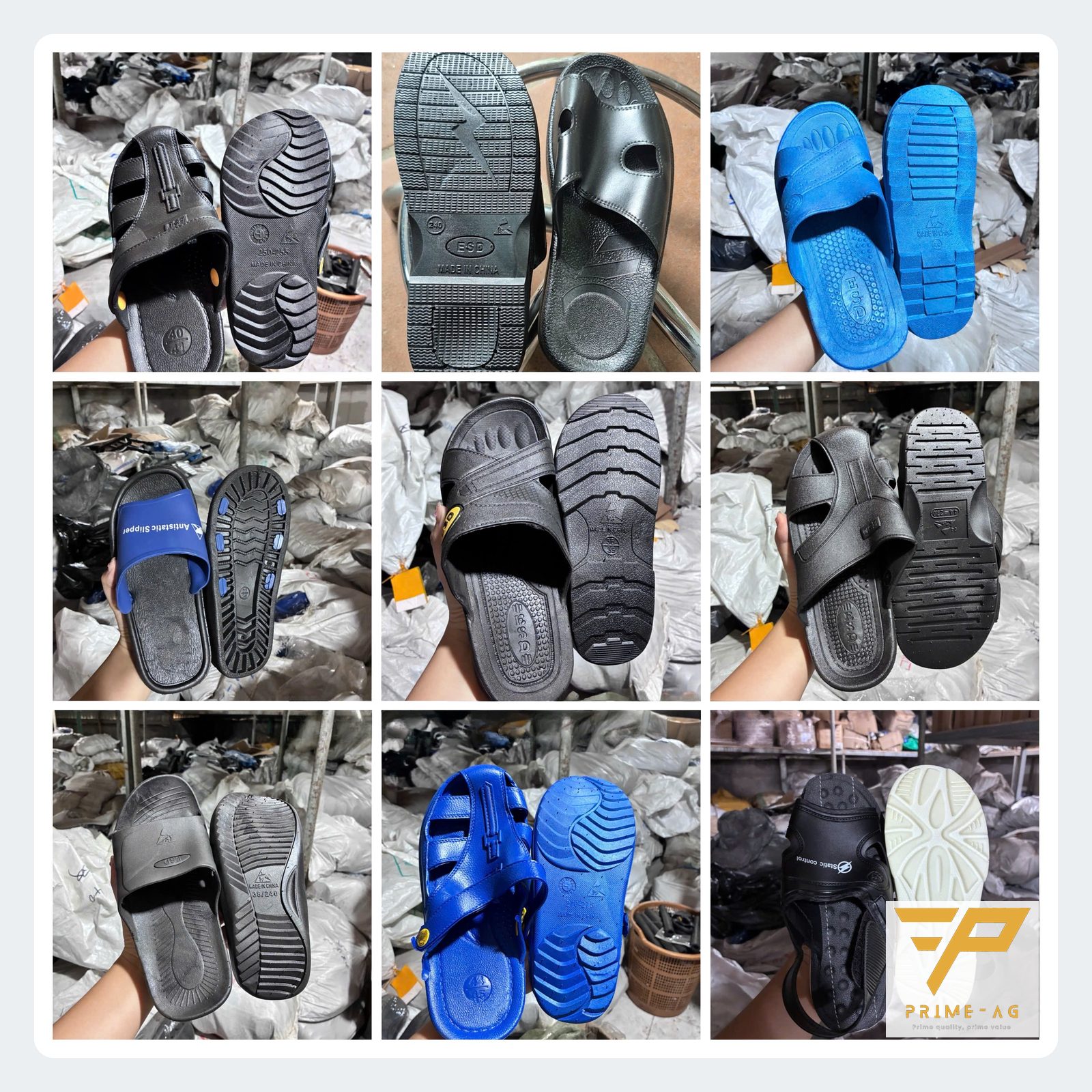
ESD cleanroom slippers (ESD cleanroom slippers) — full antistatic function for cleanrooms and EPAs in electronics factories.
Many styles: slides, cross-strap, ventilated PU, closed-toe/back-strap sandals, sports soles · black, blue · sizes 36–46.
Prices from 29,000 VND/pair (lowest-priced model) · MOQ 10 pairs · samples available.
Group code: SL-PU
ESD cleanroom slippers (ESD slippers / cleanroom slippers) are slippers worn in electronics plants, cleanrooms and EPAs: the sole and straps are made of conductive material that continuously drains static from the body to the ESD floor while walking, with no cord needed as with a wrist strap. The slippers do not hold dust, are washable with water, and are worn together with cleanroom garments and hoods.
Many styles, many price points — prices from 29,000 VND/pair. Customers choose by budget and location of use: economy models for bulk issue, cushioned PU models for workers standing all shift, closed-toe models for areas needing more protection.
Available slipper styles
| Style | Features | Suitable for |
|---|---|---|
| Single-strap slides | Compact, light, easy to slip on; black or blue | Bulk issue, visitors, gowning areas — lowest price point |
| Cross-strap slippers | Straps wrap over the instep; some models have a yellow grounding stud | Workers walking a lot along the line |
| Ventilated PU slippers | Soft PU foam, massage-nub footbed, perforated breathable straps | Standing all shift, hot climates |
| Back-strap / closed-toe sandals | Toe covered, back strap holds the heel, won’t slip off when walking fast | Areas with trolleys, warehouses, places needing more protection |
| Sports-sole back-strap slippers | Cushioned white sneaker-style sole, hook-and-loop strap | Technicians and QC staff who walk a lot |
General specifications
| Item | Value |
|---|---|
| Material | Conductive PVC or PU foam (sole + straps), depending on model |
| Function | Antistatic (ESD), for cleanrooms and EPAs; resistance stated per model |
| Sizes | 36 – 46 (depending on model) |
| Colours | Black, blue |
| Price | From 29,000 VND/pair (lowest-priced model); other models quoted by style and quantity |
| Packing | 1 pair/bag · 20 pairs/carton |
| MOQ | 10 pairs |
Quick selection: low price, large quantities → PVC slides; standing all shift, need cushioning → PU slippers; need toe coverage → closed-toe sandals; need full enclosure → ESD shoes.
FAQ
– Are low-cost slippers really antistatic? — Yes; the differences between price points are mainly cushioning, durability and style. Send a request and PRIMEAG will quote with the resistance range of each model.
– Can they be washed with water? — Yes; do not dry with heat and do not use soap containing silicone.
– Are samples available? — Yes, samples are sent so customers can test them on a footwear tester before ordering in volume.
How do ESD slippers carry charge to ground?
The human body is a conductor and builds up charge continuously while walking. ESD slippers are one link in the grounding chain: skin of the foot (sweat) → footbed → conductive sole → ESD floor → ground. Charge drains continuously, so people can move freely without a cord as with a wrist strap. Two mandatory conditions:
- The floor or mat must be ESD and grounded. Wearing ESD slippers on ordinary tile or epoxy floors has practically no effect.
- The foot must make good contact with the footbed. Moisture from sweat is the “conductor” between skin and footbed; the footbed, adhesive and stitching must also be conductive or dissipative, not just the sole.
Material: PVC or PU?
ESD cleanroom slippers are moulded from PVC or PU foam with conductive additives blended into the material itself, so the antistatic property runs through the entire sole and straps rather than being a surface coating — it is not lost through washing.
- PVC: lowest price, durable, easy to wash; somewhat stiffer and heavier. Suitable for bulk issue, visitors and gowning areas.
- PU foam: light, cushioned, resilient, resists compression set — suitable for workers standing or walking all shift. Its weak point is hydrolysis when stored for a long time in hot, humid warehouses (soles become brittle and crack), so rotate stock.
Resistance levels to distinguish
| Classification | Resistance range | Standard |
|---|---|---|
| ESD footwear (footwear tested alone) | < 1×10⁸ Ω (typically stated as 10⁵–10⁸ Ω) | EN 61340-5-1, measured per IEC 61340-4-3 |
| Footwear in an ESD system (USA) | < 1×10⁹ Ω | ANSI/ESD S20.20, measured per ANSI/ESD STM9.1 |
| Person – footwear – floor system | < 1×10⁹ Ω and body voltage < 100 V while walking | ANSI/ESD STM97.1 and STM97.2 |
| Antistatic safety footwear | 10⁵–10⁹ Ω | EN ISO 20345 |
All ESD slippers are “antistatic”, but not all antistatic slippers meet ESD requirements: slippers measuring 5×10⁸ Ω are still antistatic but exceed the ESD limit of 10⁸ Ω. When quoting, PRIMEAG states the resistance range of each model so customers can choose the right type for the EPA.
Daily testing
- The ESD TR53 guide and the ESD TR20.20 handbook recommend testing ESD footwear at least daily, while worn, on a footwear tester (with a foot plate), one foot at a time.
- Record results in a log per shift; S20.20 auditors will check this log.
- Fail: clean the sole and re-test; if it still fails, replace the slippers. Do not allow entry into the EPA until it passes.
- Readings may be higher when feet are still dry or the slippers were left overnight in a cold place; after wearing them for a while, with slight moisture on the feet, resistance usually drops.
Cleaning and service life
- Wash with water and mild silicone-free soap; air dry in a ventilated place, no heat drying, no strong sunlight.
- Do not use strong solvents (acetone, white spirit) to remove stains from soles or straps; use only water, mild soap or IPA.
- Replace slippers when the sole is worn smooth, cracked, the straps are torn, or they fail testing after cleaning. Each person uses their own pair.
- Store in a cool, dry place; rotate stock to limit hydrolysis.
Common mistakes
- Wearing ESD slippers outside the plant or to the canteen: oil, grease and dirt on the sole increase contact resistance.
- Adding ordinary insoles, or wearing thick insulating socks in back-strap slippers.
- ESD floors polished with ordinary wax or coatings — the coating changes the contact resistance between sole and floor.
- Testing slippers only at acceptance, not daily.
Technical references
- uvex – The difference between antistatic and ESD (safety footwear)
- Safety Jogger – ESD vs. antistatic
- ELTEN – ESD footwear: insoles, adhesive and stitching must also be antistatic
- Desco – Foot grounder datasheet (daily testing, TR53, STM97.1)
- Kuraray – Polyurethane soles (polyester/polyether PU, hydrolysis)
- Desco Asia – ANSI/ESD S20.20 footwear and flooring limits
Price: from 29,000 VND per pair (excl. 8% VAT).
REQUEST A QUOTE: send the quantity and specifications you need — PRIMEAG quotes within 30 minutes.
Hotline/Zalo +84 906 108 292 · info@primeag.vn
Written by the PRIMEAG engineering team.
Related guides:ESD Heel Strap Failing at the EPA Entrance Tester:…
Related products:ESD Sandals with Heel StrapIndustrial Safety ShoesLinkworld ESD ShoesWhite PU ESD Cleanroom Shoes
Updated: 2026-10-23
Giao tận nhà máy TP.HCM, Bình Dương, Đồng Nai, Long An, Tây Ninh · Kèm biên bản đo điện trở ESD theo lô · Hotline 0906 108 292