
Stocked item: delivered in 1–2 working days in Ho Chi Minh City, Binh Duong and Dong Nai; free delivery for orders from VND 20,000,000; defective items exchanged within 7 days. Shipping & return policy
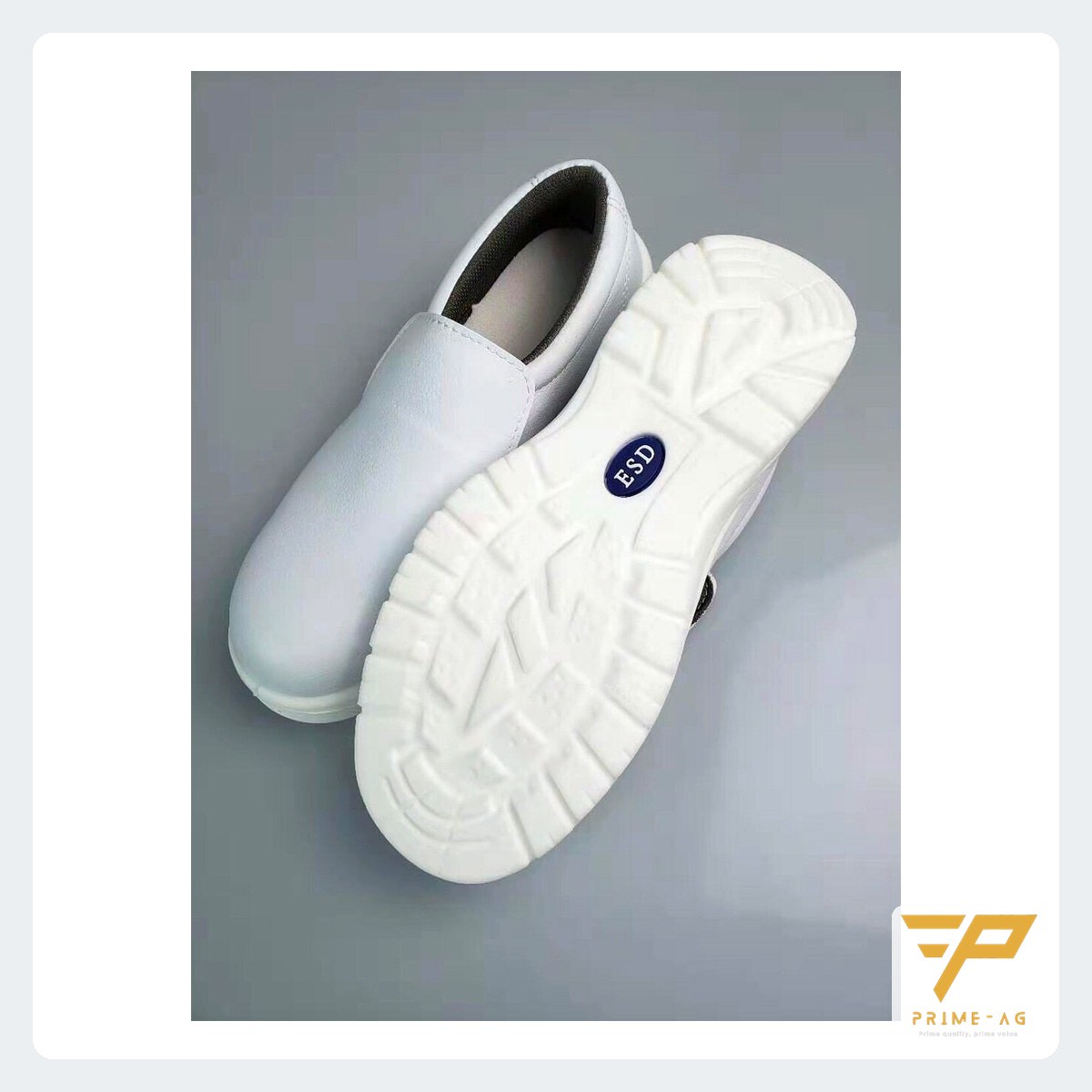
Product code: SH-PU · Specification: White PU cleanroom shoes & EVA shoes
ESD PU Leather Cleanroom Shoes & EVA Shoes
Most common items: white PU 37–42; EVA 37.
Delivery: in stock, delivered within 24–48 hours (Ho Chi Minh City, Binh Duong, Dong Nai); lead time for bulk orders is confirmed with the quotation.
White PU shoes: smooth, non-absorbent PU leather upper that can be wiped with IPA (not canvas), conductive PU sole — for pharmaceutical, optical and semiconductor cleanrooms of ISO 5–7 where fabric shoes do not qualify. EVA shoes moulded in one piece: ultra-light (~150 g), washable, quick-drying — for wet areas, food processing and visitors.
| Type | Upper | Sole | ESD | Sizes | Used for |
|---|---|---|---|---|---|
| White PU | PU leather, wipeable | Conductive PU | 10⁵–10⁸ Ω | 35–45 | ISO 5–7, pharma |
| EVA | Moulded EVA | EVA | ESD optional | 37–43 | Wet areas, visitors |
Packing 10 pairs/carton; MOQ 5 pairs.
FAQ
– Does PU leather make feet hot? — There are ventilation holes on the sides; for long shifts, have 2 pairs to alternate.
– Are EVA shoes ESD? — The standard version is not; the carbon-blended ESD version is made to order, with a per-lot resistance test sheet like the PU shoes.
PU leather uppers: why are they better than canvas for cleanrooms?
People are the largest source of particles in a cleanroom — constantly shedding skin cells, hair and microorganisms even when sitting still. Shoes are what contact the floor and dust the most, so the upper material needs:
- A closed, non-absorbent surface: PU leather (polyurethane coated on a fabric backing) has no exposed fibres like canvas and does not trap dust in the weave; the general rule for items used in cleanrooms is that covering materials must not absorb particles.
- Wipe-down disinfection on site: wipe with IPA daily instead of washing; the shoes dry immediately and do not carry moisture into the room.
- White colour: shows dirt for visual control.
In return, PU leather breathes less than fabric — PRIMEAG has added ventilation holes on the sides and recommends that each person has 2 pairs to alternate between shifts.
Conductive PU sole and insole
According to ELTEN (Germany), a shoe’s ESD property does not lie in the sole alone: the insole, adhesive and stitching must also be antistatic, so the path from the foot to the sole is not blocked by an insulating layer. In practice:
- Do not add ordinary insoles or off-the-shelf orthotic insoles; if a separate insole is needed, use an ESD insole and re-test.
- According to uvex, changing the sole or insole, dirty contact surfaces, or cold shoes (left overnight in a cold place) all increase the measured resistance; after wearing the shoes for a while with slight moisture on the feet, discharge is usually better.
- ESD shoes must achieve < 1×10⁸ Ω when the footwear is tested alone per IEC 61340-4-3 (shoe placed on a stainless steel plate, electrode inside, 12.5 kg load) — SH-PU’s 10⁵–10⁸ Ω falls within this limit.
EVA shoes: light and washable, but choose the right place
EVA (ethylene-vinyl acetate) is a closed-cell foam rubber: soft, light, waterproof, tough at low temperatures and inexpensive — the familiar material of slippers, sneaker midsoles and “crocs”-style shoes. According to Tingley, EVA boots are up to 70 % lighter than equivalent rubber or PVC boots.
| Criterion | White PU shoes | EVA shoes |
|---|---|---|
| ESD property | Yes, 10⁵–10⁸ Ω | Standard version no; carbon-blended ESD version made to order |
| Cleaning | Wipe with IPA | Wash with water, quick-drying |
| Cushioning durability | Resilient PU, stays cushioned longer | EVA gradually compresses, losing cushioning over time |
| Suitable location | Pharmaceutical, optical, semiconductor cleanrooms ISO 5–7 | Wet areas, food processing, visitors |
Do not use standard EVA shoes in the EPA: they provide no path for charge to drain. For wet areas requiring certified slip resistance, refer to the EN ISO 20345/20347 test: ceramic tile with soap solution (SLS), minimum coefficient of friction 0.31 for heel slip and 0.36 for forepart slip.
Using shoes in the cleanroom gowning procedure
- Cleanroom shoes are dedicated footwear: worn only from the gowning area inward, never into corridors or the canteen.
- Before the gowning area: step on a tacky mat — at least 3 small steps per foot according to Lighthouse’s gowning guide.
- ISO 5–6 rooms usually require shoe covers/boots worn over the shoes together with a coverall; shoe covers worn over ESD shoes must also be ESD types, otherwise they will break the grounding path.
Cleaning, storage, mistakes
- Wipe the upper and sole with 70 % IPA or a cleanroom cleaning solution; do not use shoe polish or silicone-containing shine products.
- PU hydrolyses when stored for a long time in hot, humid conditions: store in a cool, dry place and rotate stock.
- Test ESD shoes daily while worn, one foot at a time; record in a log.
- Common mistakes: sharing shoes between several people; machine-washing PU leather shoes; wearing standard EVA shoes on the SMT line because they are “light on the feet”.
Technical references
- ELTEN – ESD-Fußschutz (antistatic insole, adhesive, stitching; 10⁸ Ω)
- uvex – Antistatic vs ESD: test conditions and influencing factors
- Tingley – Footwear material guide (PVC, PU, EVA)
- Wikipedia – Ethylene-vinyl acetate
- TÜV SÜD – EN ISO 20345:2022 safety footwear testing (slip resistance)
- Lighthouse – Cleanroom gowning procedure
Price: from 120,000 VND (excl. 8% VAT).
REQUEST A QUOTE: send the quantity and specifications you need — PRIMEAG quotes within 30 minutes.
Hotline/Zalo +84 906 108 292 · info@primeag.vn
Written by the PRIMEAG engineering team.
Related guides:Cleanroom Consumables for Electronics Factories: List by Class, Selection…Paper and Pens Shedding Particles in the Cleanroom: Switch…
Related products:ESD Cleanroom SlippersESD Sandals with Heel StrapIndustrial Safety ShoesLinkworld ESD Shoes
Updated: 2026-10-24
Giao tận nhà máy TP.HCM, Bình Dương, Đồng Nai, Long An, Tây Ninh · Kèm biên bản đo điện trở ESD theo lô · Hotline 0906 108 292