
Stocked item: delivered in 1–2 working days in Ho Chi Minh City, Binh Duong and Dong Nai; free delivery for orders from VND 20,000,000; defective items exchanged within 7 days. Shipping & return policy
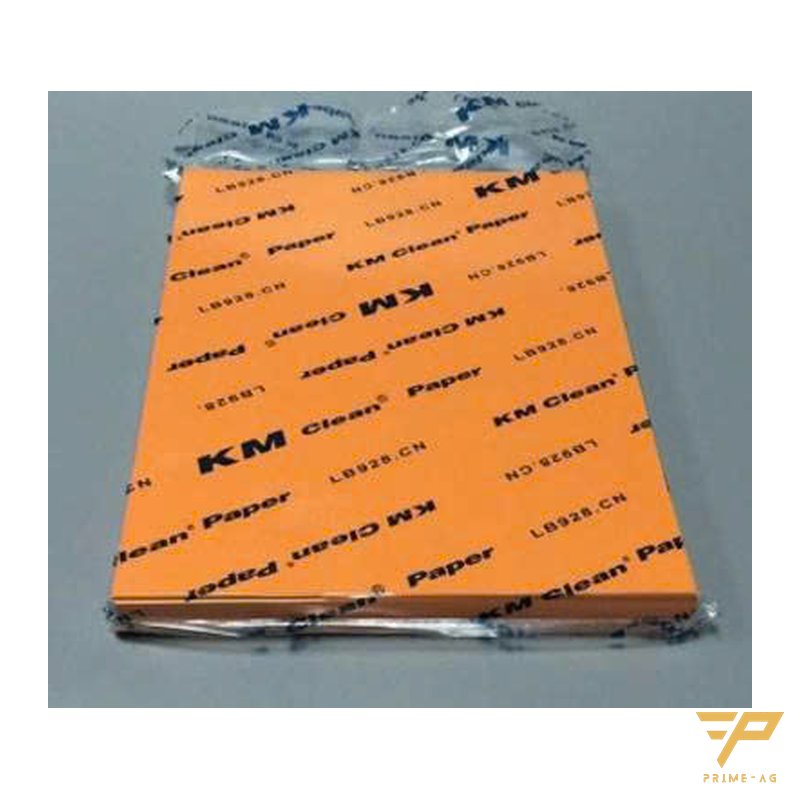
Product code: CS-PAPER · Specification: Cleanroom printing paper, notebooks, ESD ballpoint pens & label tapes
Cleanroom Paper, Notebooks, ESD Pens & Labels
Common specifications: A4 white, blue, yellow.
Delivery: in stock, delivered within 24–48 hours (Ho Chi Minh City, Binh Duong, Dong Nai), made-to-order items 3–7 working days; stock confirmed at quotation.
Ordinary paper sheds paper fibers — cleanrooms use KM Clean printing paper, impregnated with polymer, low-lint, suitable for laser printers and copiers (test-print first on inkjet), in several colors to classify documents (blue WI, yellow checklists…). Also available: cleanroom notebooks (lint-free paper, plastic cover), ESD ballpoint pens with conductive barrels, label sheets for printing labels, and TZe label tapes for Brother label printers.
| Type | Specification | Packing |
|---|---|---|
| A4 cleanroom paper | 72 g/m², white/blue/yellow/pink/green | 250 sheets/ream · 10 reams/carton |
| A3 / A5 paper | 72 g/m² | 250 sheets/ream |
| Cleanroom notebook A4 / A5 | 50 sheets, plastic cover | Per notebook |
| ESD ballpoint pen | Carbon PP barrel, black/blue ink | 10/box |
| Label sheets | A4, 65/40 labels/sheet | 100 sheets/box |
| TZe tape 12 / 18 / 24 mm | Brother, black on white | Per roll |
MOQ 1 ream.
FAQ
– Can cleanroom paper go through a normal office printer? — Yes, with laser printers and copiers; with inkjet printers, test-print first. The paper is slightly smoother than ordinary paper.
– Is there ESD cleanroom paper? — Cleanroom paper is not ESD-tested; keeping it in an ESD card case is sufficient.
Why is ordinary paper banned in cleanrooms?
Office paper is made from wood pulp: short cellulose fibers with weak bonding, plus inorganic fillers (CaCO₃ calcium carbonate, TiO₂, aluminum silicate) to make it white and opaque. Every fold, tear or page turn sheds fibers and mineral dust. That is why the rules of many university and factory cleanrooms list ordinary paper, tissues, cardboard, notebooks, books and newspapers as prohibited items. Parts and materials must be taken out of paper, wood and carton packaging before being brought in.
How is cleanroom paper made differently?
- Impregnated (saturated) with synthetic polymer: the cellulose base is saturated with a copolymer that “locks” the fibers, so the paper is tougher and sheds far fewer particles.
- No inorganic fillers: makers such as Texwipe state that no calcium carbonate, titanium dioxide or aluminum silicate is used.
- Ion control: Texwipe does not use natural latex binders, to reduce ionic and metal contamination — important for semiconductors and electronic components.
- Cleanroom packaging: each ream is sealed and opened in the clean area.
Reference data for an international cleanroom paper line (Texwipe TexWrite, typical values):
| Property | Published value |
|---|---|
| Basis weight | 70 / 80 / 110 g/m² |
| Particles ≥ 0.5 µm | 4.0–5.0 million particles/m² |
| Surface resistivity (55 % RH) | about 10¹⁰ Ω/sq |
| Cleanroom range | ISO 3–8 (EU GMP Grade A–D) |
PRIMEAG cleanroom paper at 72 g/m² is in the lightweight group, used for printing documents, work instructions (WI) and checklists.
Printing and writing
- Laser printing, copying: cleanroom paper is designed to hold toner and withstand heat well when passing through the fuser.
- Inkjet printing: the polymer-impregnated surface absorbs ink more slowly than ordinary paper. Test-print first and let the ink dry completely before stacking sheets.
- Pens: no graphite pencils — graphite sheds conductive dust. No erasers. Use only cleanroom-approved ink pens; in EPAs use ESD ballpoint pens with conductive barrels.
Paper in the ESD protected area (EPA)
With a surface resistance of around 10¹⁰ Ω/sq, cleanroom paper is not a controlled ESD material and can become charged when rubbed or when sheets are pulled out. In the EPA, keep paper away from static-sensitive components, in a document folder or ESD document holder.
Good habits
- Use paper colors to classify documents (e.g. blue WI, yellow checklists) for quick identification and to avoid using outdated versions.
- Do not bring in office printing paper as a substitute, not even “just a few sheets”.
- Do not use paper masking tape or ordinary paper labels on documents; use label sheets and dedicated labels.
- Replace torn or dog-eared documents — torn edges shed the most fibers.
Certificates and test reports
- RoHS 10 substances — SGS Guangzhou, report no. CANEC23000148301 (14/02/2023): Cleanroom printing paper: all 10 RoHS substances ND. Download PDF
Applicant/manufacturer details on the report are masked to protect the supply chain; the full version is provided to customers on request. See all: PRIMEAG product certificates and test reports.
Technical references
- Texwipe – TexWrite cleanroom paper technical data sheet
- University of Waterloo QNFCF – Maintaining a clean environment (prohibited items)
- Caltech – Clean room procedures (paper, pens, cardboard)
- ESDA – Fundamentals of ESD, Part 3 (insulators in the EPA)
Price: from 65,000 VND (excl. 8% VAT).
REQUEST A QUOTE: send the quantity and specification you need (size, color, reams per month) — PRIMEAG quotes within 30 minutes.
Hotline/Zalo +84 906 108 292 · info@primeag.vn
Written by the PRIMEAG engineering team.
Related guides:Trims Warehouse Issuing Wrong Buttons and Thread: Racks, Labeled…Paper and Pens Shedding Particles in the Cleanroom: Switch…
Related products:Silica Gel Desiccant & Humidity Indicator CardsCleanroom Swabs (Foam, Polyester, Cotton Tip)Cobalt-Free Humidity Indicator Cards, 6-Spot
Updated: 2026-10-24
Giao tận nhà máy TP.HCM, Bình Dương, Đồng Nai, Long An, Tây Ninh · Kèm biên bản đo điện trở ESD theo lô · Hotline 0906 108 292