
Stocked item: delivered in 1–2 working days in Ho Chi Minh City, Binh Duong and Dong Nai; free delivery for orders from VND 20,000,000; defective items exchanged within 7 days. Shipping & return policy
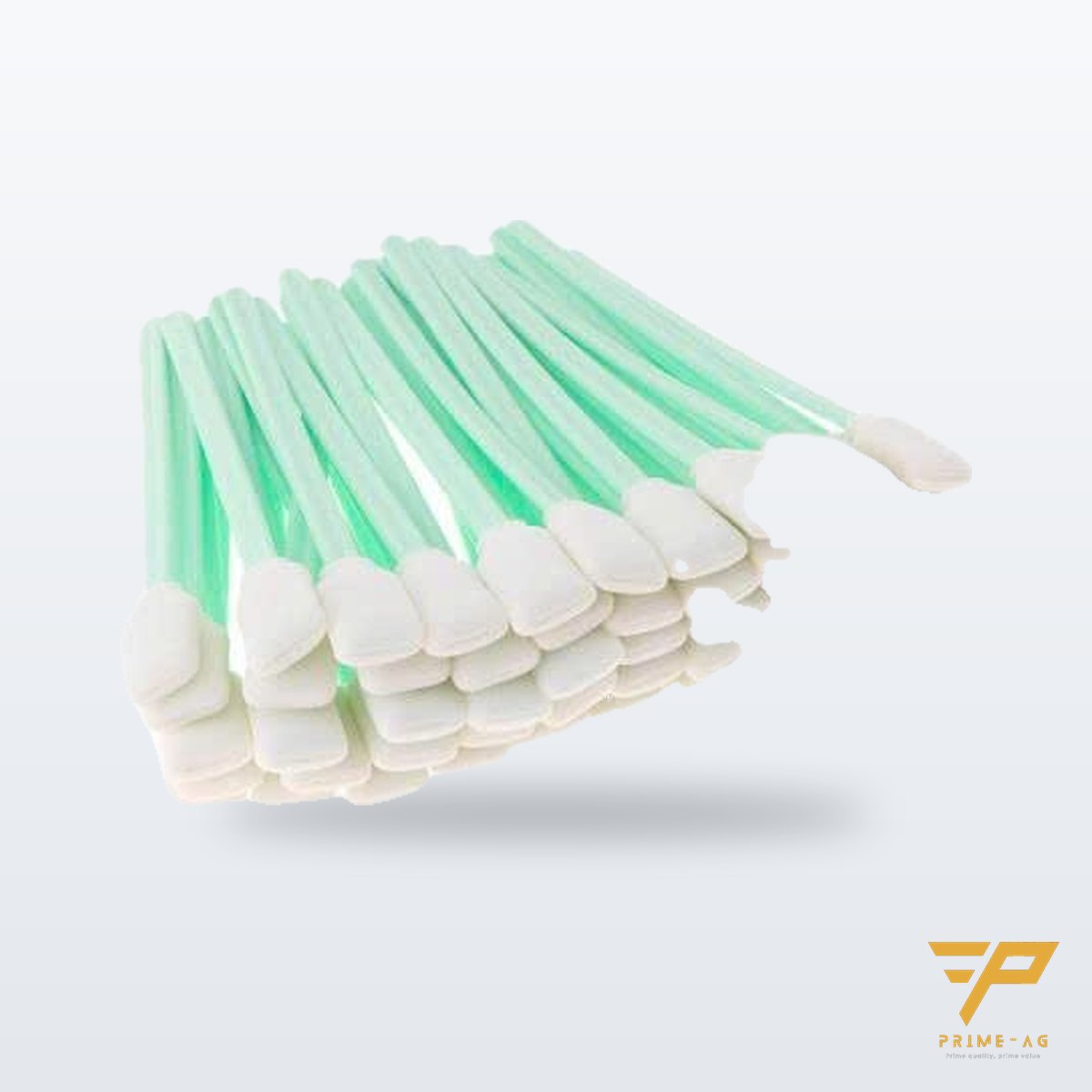
Product code: SW · Specification: Cleanroom swabs (foam tip, polyester tip, compressed cotton tip)
Cleanroom Swabs — foam, polyester, cotton tip
Equivalent to: “cleanroom swabs”, “soldering tip cleaning swabs”, Texwipe TX7xx, Huby BB-0xx — what is different: 3 tip types, a selection table by process step, particle/fibre CoA per lot.
Delivery: stocked items delivered in 24–48 hours (Ho Chi Minh City, Binh Duong, Dong Nai); made-to-order items 3–7 working days; stock is confirmed with the quotation.
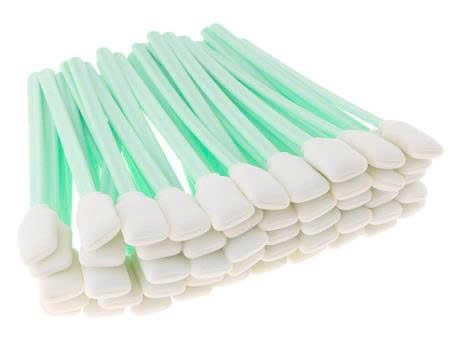
Dedicated swabs for cleaning spots a wiper cannot reach: soldering tips, SMT pick-up nozzles, connector slots, small lenses, keyboard gaps and print heads. Lint-free PU foam tips absorb solvent well; knitted polyester tips stand up to scrubbing; compressed cotton is a low-cost option for dry wiping. PP handles do not splinter like wood.
| Item | Foam SW-PU | Polyester SW-PE | Compressed cotton SW-CT |
|---|---|---|---|
| Tip | PU foam 100 ppi, thermally bonded | Knitted polyester, thermally bonded | Tightly compressed cotton |
| Handle | PP, length 70 / 125 / 160 mm | PP 70 / 125 mm | Wood / paper 75 mm |
| Lint | Very low | Low | Medium |
| Solvent resistance | IPA (acetone: depends on the foam formulation per TDS, quick wipes only) | IPA | IPA (better for dry wiping) |
| Cleanliness class | Class 100 (≈ ISO 5) | Class 100–1000 (≈ ISO 5–6) | Not class-rated |
| Packing | 100/bag · 25 bags/carton | 100/bag | 100/bag |
| MOQ | 1 carton | 1 carton | 10 bags |
Selection by process step
– Cleaning soldering tips, nozzles, flux → small foam tip (SW-PU-S).
– Cleaning connector slots, scrubbing residue → polyester (SW-PE).
– Dry wiping, applying adhesive, inspection → compressed cotton (SW-CT), the cheapest.
– Large surfaces → cleanroom wipers (CW-1009).
Documents per lot: particle/fibre/NVR CoA, RoHS; 1-bag sample.
Scheduled orders: price held for 6 months.
FAQ
– Can ordinary (medical) cotton buds be used? — They shed lint onto the board and wooden sticks splinter; cleanrooms use dedicated swabs.
– Does the foam tip dissolve in acetone? — PU foam withstands IPA; with acetone it depends on the foam formulation (see TDS) — quick wipes only, do not soak.
– Is there an ESD version? — Yes, with a black conductive PP handle, made to order.
– Equivalent to a Texwipe code? — Send your current code; PRIMEAG will match the tip/handle dimensions and send samples.
Construction of a cleanroom swab: tip, handle and bond
A cleanroom swab has three parts, and any of them can become a source of contamination if chosen wrongly:
- Tip: determines solvent absorption, particle shedding and durability when scrubbing. The three common materials are polyurethane (PU) foam, knitted polyester and cotton.
- Handle: polypropylene (PP) is light, strong and resists most common solvents. Wooden handles (usually birch) generate wood dust themselves, so under the cleanroom convention cited by Texwipe, wood and cellulose handles are not taken into the cleanroom. Rigid rolled-paper handles are a low-cost option for areas without a cleanliness class requirement.
- Tip–handle bond: good swabs are fully thermally bonded, with no adhesive. Adhesive is a source of organic residue and particles; makers such as Texwipe and Chemtronics stress that their tips are “adhesive-free, binder-free”.
For ESD swabs, the handle is made of carbon-loaded (conductive) PP or a static-dissipative polymer so the swab does not build up charge when rubbed on components.
Characteristics of each tip type
| Tip type | Advantages | Limitations | Cleanliness class per general guidance |
|---|---|---|---|
| Open-cell PU foam | Absorbs solvent well, soft, fibre-free so no lint shedding; the foam cells trap particles inside the tip | Can tear if scrubbed hard against sharp edges; ketone resistance depends on the foam formulation | ISO 5–8 |
| Knitted polyester | Very low particle and non-volatile residue (NVR) release, durable when scrubbing, does not scratch surfaces | Absorbs less solvent than foam | Down to ISO 1–4; optics, semiconductors |
| Cotton | Absorbs water well, inexpensive | Heavy lint shedding; according to Texwipe, cotton’s extractable residue is about 10 times higher than knitted polyester | ISO 9, general areas |
The cleanliness class column is compiled from the swab selection guides of international suppliers (ISO 1–4 uses polyester/microfibre, ISO 5–8 is usually fine with foam, cotton for general areas); the class of each PRIMEAG code follows its specification table and per-lot CoA. Cleanroom foam tips usually use foam of about 100 pores per inch (ppi), as published by Puritan — the finer the pores, the smoother the surface and the better the particle retention.
Solvent compatibility
- IPA, methanol: compatible with all three tip types and PP handles.
- Acetone, MEK (ketones): depends on the foam formulation. Chemtronics does not recommend ketones for its standard foam range, while some makers offer “chemical-resistant” foam ranges that withstand acetone. So with acetone, wipe quickly only and do not soak, exactly as PRIMEAG recommends for SW-PU.
- When switching to a new solvent, test on 2–3 swabs: a swollen, sticky or discoloured tip, or a softened handle, indicates incompatibility.
- Avoid solvents and packaging containing silicone in electronics plants — silicone leaves a film that causes soldering and adhesion defects.
Swabbing technique
- Wet the swab tip with a dedicated spray bottle or dropper bottle. Do not dip swabs into a shared solvent can, and do not re-dip a used swab — contamination goes back into the solvent.
- Wipe in one direction while gently rotating the handle so that a clean face is always in contact with the surface; do not scrub back and forth.
- Do not press too hard: foam tips deform, tear and leave fragments.
- For flux or adhesive residue: wipe wet first, then use a dry swab to absorb any remaining solvent.
- Use each swab for one location, then discard it; re-inspect under a magnifier or microscope for optical surfaces and connector ends.
Typical applications in electronics plants
- Cleaning SMT pick-and-place nozzles, soldering iron tips, connector slots and component leads after rework.
- Wiping flux residue and adhesive overflow around components; applying small amounts of oil, adhesive or grease in tight spots.
- Cleaning camera module lenses, sensors, barcode reader windows and thermal print heads.
- Cleaning the emitter pins of ionizing blowers and antistatic bars — Texwipe has a dedicated swab range for this; each swab cleans about 5–8 emitter points and is then replaced.
Storage and common mistakes
- Keep swabs in the sealed bag until use; open the bag inside the clean area, pick swabs up by the handle and never touch the tip (not even with a used glove).
- Do not use medical cotton buds or wooden-handle swabs in the cleanroom or on circuit boards: cotton fibres cling to component leads and wooden sticks splinter.
- Do not reuse swabs, even if the tip looks clean.
Technical references
- Texwipe – Cleanroom swabs (thermally bonded tips, adhesive-free)
- Texwipe – Can cotton swabs be used in a cleanroom?
- Chemtronics – Foamtips swabs technical data sheet
- Cleanroom Technology – Selecting the right cleanroom swabs
- Thomas Scientific – 4 key factors to choose a cleanroom swab
- Texwipe – TX726 swab data sheet (cleaning ionizer emitter pins)
Price: from 8,000 VND (excl. 8% VAT).
REQUEST A QUOTE: send the tip type and the number of bags per month — PRIMEAG quotes within 30 minutes.
Hotline/Zalo +84 906 108 292 · info@primeag.vn
Written by the PRIMEAG engineering team.
Related guides:AOI/SPI Cleaning on SMT Lines: Lint-Free Wipers and Swabs…Cleanroom Wipers Leaving Lint or Streaks: Causes and FixesCleanroom Consumables for Electronics Factories: List by Class, Selection…
Related products:Cleanroom Paper and StationerySilica Gel Desiccant & Humidity Indicator CardsCobalt-Free Humidity Indicator Cards, 6-Spot
Updated: 2026-10-24
Giao tận nhà máy TP.HCM, Bình Dương, Đồng Nai, Long An, Tây Ninh · Kèm biên bản đo điện trở ESD theo lô · Hotline 0906 108 292